



With support from the DOE Energy I-Corps program, researchers Holly Eagleston and Forest Danford at Sandia National Laboratories developed FireMap—a software that combines satellite imagery, weather data, and machine learning to characterize wildfire fuel conditions and simulate risk to electric-grid components.
Office of Technology Commercialization
January 27, 2026 Estimated Read Time min
Wildfires pose a physical threat to the electric grid and are becoming more frequent and severe across the western United States. With support from the U.S. Department of Energy’s (DOE’s) Office of Electricity and Office of Cybersecurity, Energy Security, and Emergency Response, researchers Holly Eagleston and Forest Danford at Sandia National Laboratories (SNL) developed FireMap—a software that combines satellite imagery, weather data, and machine learning to characterize wildfire fuel conditions and simulate risk to electric-grid components. After completing a robust customer discovery process for FireMap in DOE’s Energy I-Corps program, Eagleston launched her startup Firescape with a better understanding of her customer’s needs.
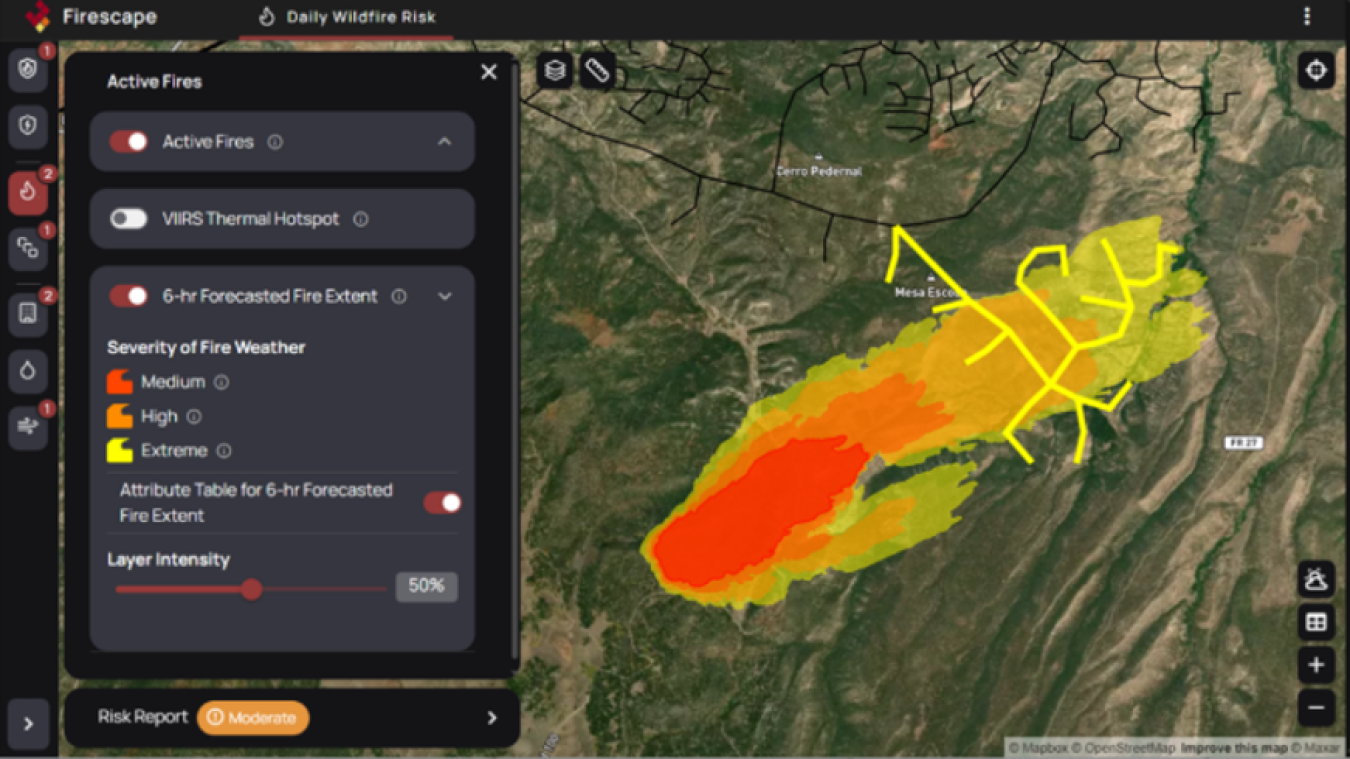
FireMap helps utility companies understand the specific nature of their wildfire risks and identify appropriate mitigation strategies to improve grid resilience. It uses satellite imagery to assess the moisture of flammable vegetation and calculate an energy release component, which is the measure of how much heat would be released if there were a fire in that area. With wildfire risk mapped, asset data can be overlaid to determine what areas are at risk of damage from wildfire. After participating in Energy I-Corps, Eagleston launched Firescape and added grid resilience recommendations to the platform.
"There's actually a lot of competition in this space, especially with the wildfires that happened recently," said Eagleston, "so one of our distinguishing features is that we are a decision-making tool." Smaller utility companies don't typically have enough staff or capacity to process data and find meaningful insights. "So Firescape does all that work for them—shows them which mitigations to use where and at what time. Mitigations can include changing protection settings to activate faster if a fault occurs (i.e., fast-trip), reducing the timeframe that a fault can potentially ignite a wildfire. It might be doing targeted vegetation management or long-term grid hardening investments. It's a user-friendly, concrete decision-making tool that they can operationalize," she said.
The FireMap team's participation in Cohort 16 of Energy I-Corps helped them discover a major customer pivot. Initially, they thought insurance agencies were their target customers. But in their Energy I-Corps customer discovery interviews, Eagleston and her team learned "there really wasn't a product market fit for insurance agencies. Our technology was more focused on situational awareness than it was on risk mapping, and insurers didn't see that as a strong need or pain point." So FireMap pivoted to focus on utility companies instead.
The Energy I-Corps customer discovery interviews were "really fast paced,” remarked Eagleston. "And the training we received on how to ask the right questions was invaluable, it’s something that any researcher could use to understand how their solution might be used in industry."
After the team completed Energy I-Corps, Eagleston departed SNL through their Entrepreneurial Separation to Transfer Technology program and launched Firescape—a company that helps utility companies and other stakeholders proactively manage wildfire risks to safeguard critical infrastructure and communities. Firescape won a $500,000 grant from the state of New Mexico's advanced energy program to build out their technology. Eagleston is also in the process of applying to the DOE Office of Electricity’s Digitizing Utilities Prize.
Firescape will also launch two six-month pilot programs with utility companies in New Mexico and the Northeast region of the United States. "The Northeast pilot is a paid pilot that I won at a pitch competition during Avangrid’s innovation week,” she said.
Eagleston recommends every scientist participate in Energy I-Corps. "You start to really understand what the product needs to be rather than simply how your research solves a problem. Even if you're not interested in being an entrepreneur, it helps you become a better grant writer. You'll understand how your technology can actually plug in to industry.”