DOE supports researchers who are finding new ways to apply artificial intelligence to high energy and nuclear physics.
December 16, 2025 Estimated Read Time min
Shannon Brescher Shea

Shannon Brescher Shea (shannon.shea@science.doe.gov) is the social media manager and senior writer/editor in the Office of Science’s Office of Communications and Public Affairs. She writes and curates content for the Office of Science’s Twitter and LinkedIn accounts as well as contributes to the Department of Energy’s overall social media accounts. In addition, she writes and edits feature stories covering the Office of Science’s discovery research and manages the Science Public Outreach Community (SPOC). Previously, she was a communications specialist in the Vehicle Technologies Office in the Office of Energy Efficiency and Renewable Energy. She began at the Energy Department in 2008 as a Presidential Management Fellow. In her free time, she enjoys bicycling, gardening, writing, volunteering, and parenting two awesome kids.
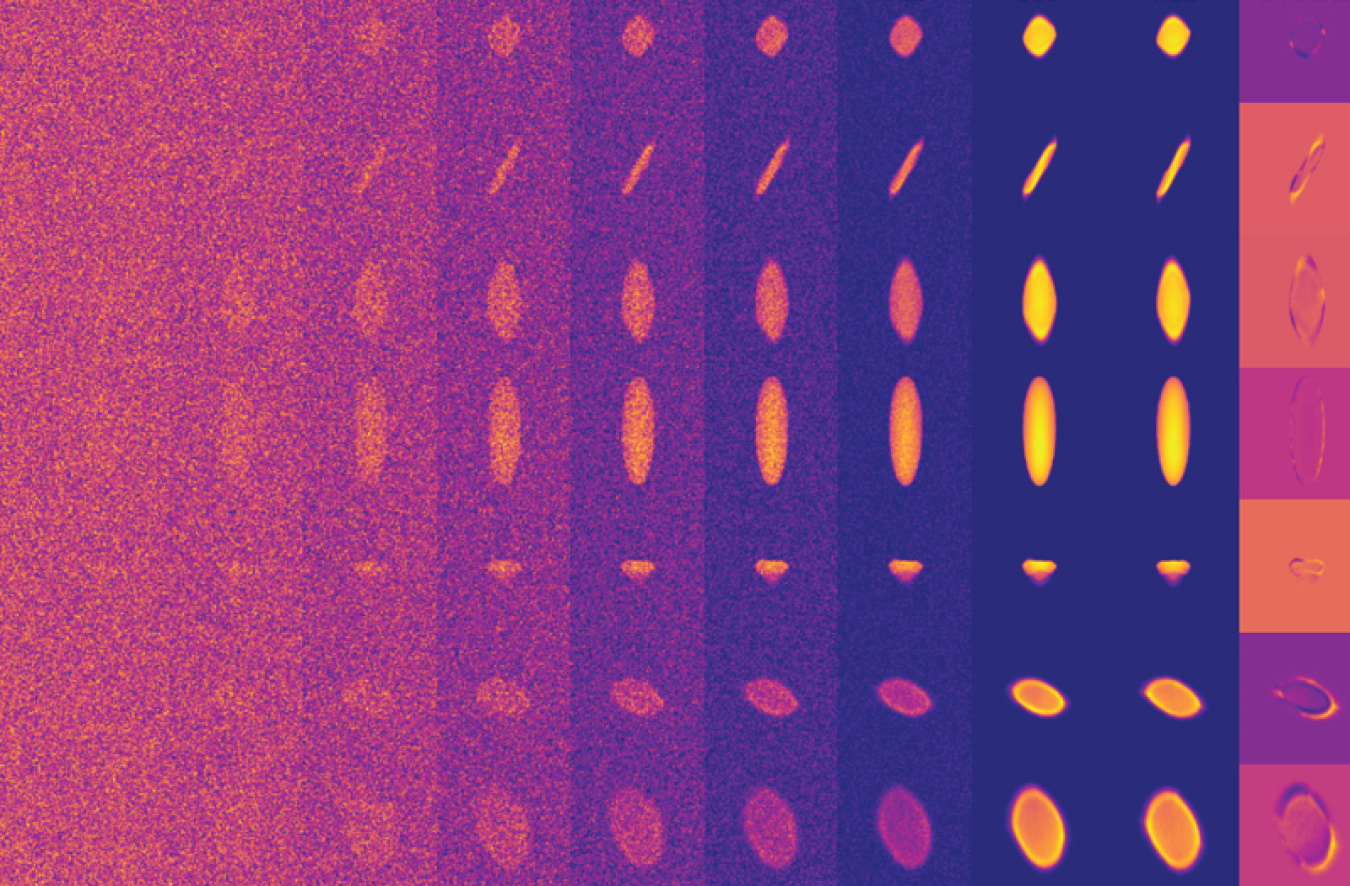
What is the structure of the quark-gluon plasma that existed at the beginning of the universe? Is the dark energy that is causing the universe to expand ever faster changing over time? While these questions address vastly different areas in high energy and nuclear physics, the Department of Energy’s (DOE) Office of Science is supporting scientists using artificial intelligence (AI) to help answer them.
Understanding artificial intelligence
AI is the broad term for intelligence in computers, as opposed to intelligence that occurs in organisms in nature, including humans. AI performs tasks or solves problems that require learning, reasoning, or making decisions. Machine learning is a specific type of AI.
In machine learning, programs learn from previous analyses of data to improve how they analyze similar data in the future. The most well-known form of machine learning is generative AI. In generative AI, a program is trained to create text, images, or video. However, there are many different forms of machine learning. These include programs that can find patterns in data, categorize images, learn how to use lab equipment, and identify unusual data points.
To develop a machine learning program, scientists must train it on vast amounts of data. This data could come in the form of images, text, or numbers.
Harnessing AI for particle physics, nuclear physics, and astrophysics
In the sciences, machine learning can perform many tasks faster and more efficiently than humans can. As scientific experiments produce more and more data, scientists will need to rely on machine learning to process and analyze it.
The NSF-DOE Vera C. Rubin Observatory is one project that is creating enormous amounts of data. Over the next decade, it will take huge, high-resolution images of the sky in the Southern Hemisphere. During this time, it will detect approximately 38 billion cosmic objects. The Rubin Observatory team is using machine learning to adjust where the camera is pointing, identify new and changing objects, and combine images together. The scientists will also use it to categorize supernova that are perfect for measuring distances from Earth.
Other scientists are using AI to simulate the structure of the universe. Specifically, they want to understand dark matter and dark energy. Dark matter is the invisible matter that makes up 85 percent of the universe’s matter. Dark energy is the label for the phenomenon that is causing the universe to expand ever faster. Scientists are taking data from telescopes to build these simulations. They then work backwards to understand the underlying characteristics that would lead to these observations.
In contrast to the vast cosmos of astrophysics, nuclear physics examines the smallest components that make up the ordinary matter of our world. Nuclear physicists work to understand nuclei and their components. These include the protons and neutrons that make up nuclei and the quarks and gluons that make up protons and neutrons. Nuclear physicists are pursuing effective ways to use machine learning to process huge amounts of information.
For example, data from the Relativistic Heavy Ion Collider – a DOE Office of Science User Facility – allows scientists to investigate the beginning of the universe. It mimics conditions just after the Big Bang, before quarks and gluons were bound into protons and neutrons. RHIC smashes ions together at such high speeds and temperatures that it “melts” the nuclei into a fireball called the quark-gluon plasma. Researchers at DOE’s Lawrence Berkeley National Laboratory are using machine learning to separate out types of sprays of particles in the quark-gluon plasma.
The next generation of nuclear physics research will be carried out at the Electron-Ion Collider (EIC), an upcoming User Facility at DOE’s Brookhaven National Laboratory. Scientists expect to use machine learning to maximize the operational efficiency of the EIC, analyze information from its data sets, and reduce repetitive tasks to save researchers time. Scientists are already using AI to improve accelerator beams used for nuclear and high energy physics.
Future investments in AI and machine learning
This variety of applications is why we are investing in AI for use in both high energy and nuclear physics.
Through our High Energy Physics Hardware-Aware AI solicitation, we are providing $22 million for seven awards. These projects will support two areas of research. The first is research on smart detectors that will use AI to improve detector measurements, readouts, and electronics controls. The second is research to use AI to improve operations. These efforts will improve real-time facility, experiment, and observatory operations and control.
In nuclear physics, we are providing $16.6 million for eight awards through our AI and Machine Learning Applied to Nuclear Science and Technology solicitation. These projects will help scientists improve the efficiency of accelerators and other scientific instruments, extract information from complex data sets, and set up autonomous systems to control equipment. They will also allow scientists to create “digital twins” of colliders to improve designs and enable scientists to use AI to find potential new areas of physics research.
Whether they are tackling the largest or smallest phenomena in the universe, physicists are finding new ways to leverage the power of AI, supported by DOE’s Office of Science.