An official website of the United States government
Here's how you know
Official websites use .gov
A .gov website belongs to an official government organization in the United States.
Secure .gov websites use HTTPS
A lock (
) or https:// means you’ve safely connected to the .gov website. Share sensitive information only on official, secure websites.
Project: About Building Energy Modeling
Photo
Caption
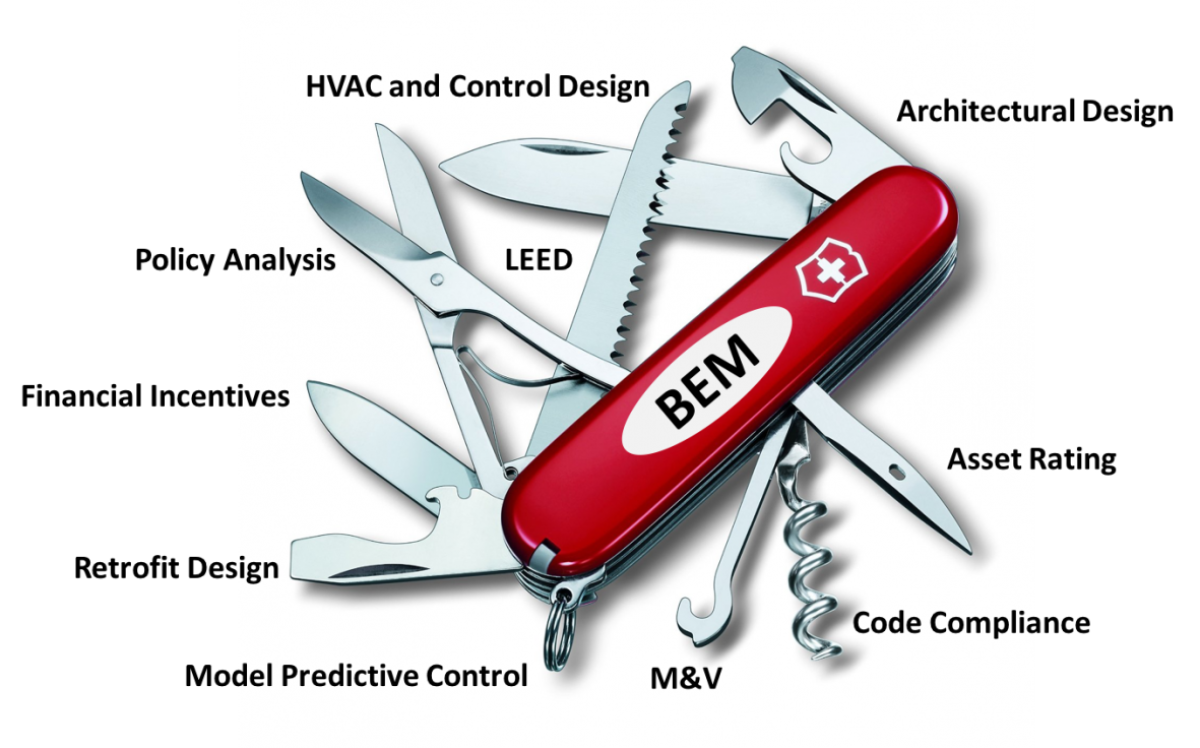
Building Energy Modeling (BEM)—physics-based software simulation of building energy use—is a multipurpose tool for building energy efficiency, supporting a variety of applications. The most traditional, and most intuitive, applications of BEM are in architectural, mechanical, and control design of new buildings and retrofits. The ability of BEM to evaluate buildings under standard weather and operating conditions—an evaluation that is impractical to perform in the physical world—is the basis of applications in code-compliance, green certification, and project documentation for financial incentives. BEM is also used to conduct large-scale analysis—at the level of a utility service territory—to inform policy decisions and to develop per-project and overall savings estimates. Emerging use cases of BEM include dynamic applications like model predictive control, where a model of a building is integrated with real-time information from weather forecasts, the building automation system, and the grid to evaluate and choose optimal short-term building control strategies.
Photo
Caption
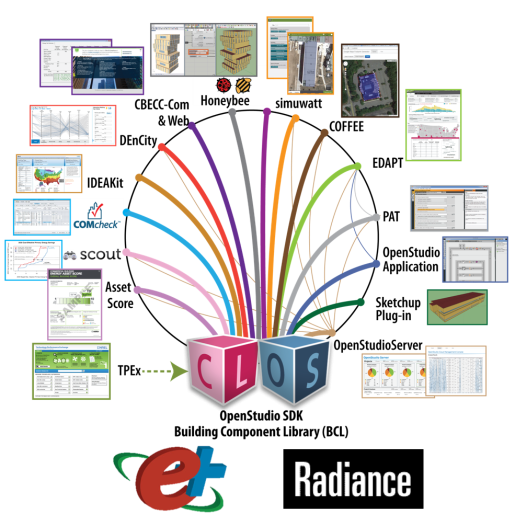
DOE has been funding the development of BEM tools since before its ascent to a cabinet-level department. Since 2012, DOE’s BEM strategy has revolved around the development of a state-of-the-art open-source BEM platform, which consists primarily of the EnergyPlus™ BEM engine, the Radiance™ lighting engine, and the OpenStudio™ software development kit (SDK), which helps developers build applications and services that use EnergyPlus and Radiance. The introduction of OpenStudio has spurred the adoption of EnergyPlus by both developers and end-users. Third-party OpenStudio-based applications include the CBECC-Com™ compliance tool, the simuwatt® audit tool, and the Honeybee plug-in for Rhino/Grasshopper. EnergyPlus downloads have also increased from under 15,000 per version in 2012 to over 40,000 per version in 2016.
Credit: NLR
Photo
Caption
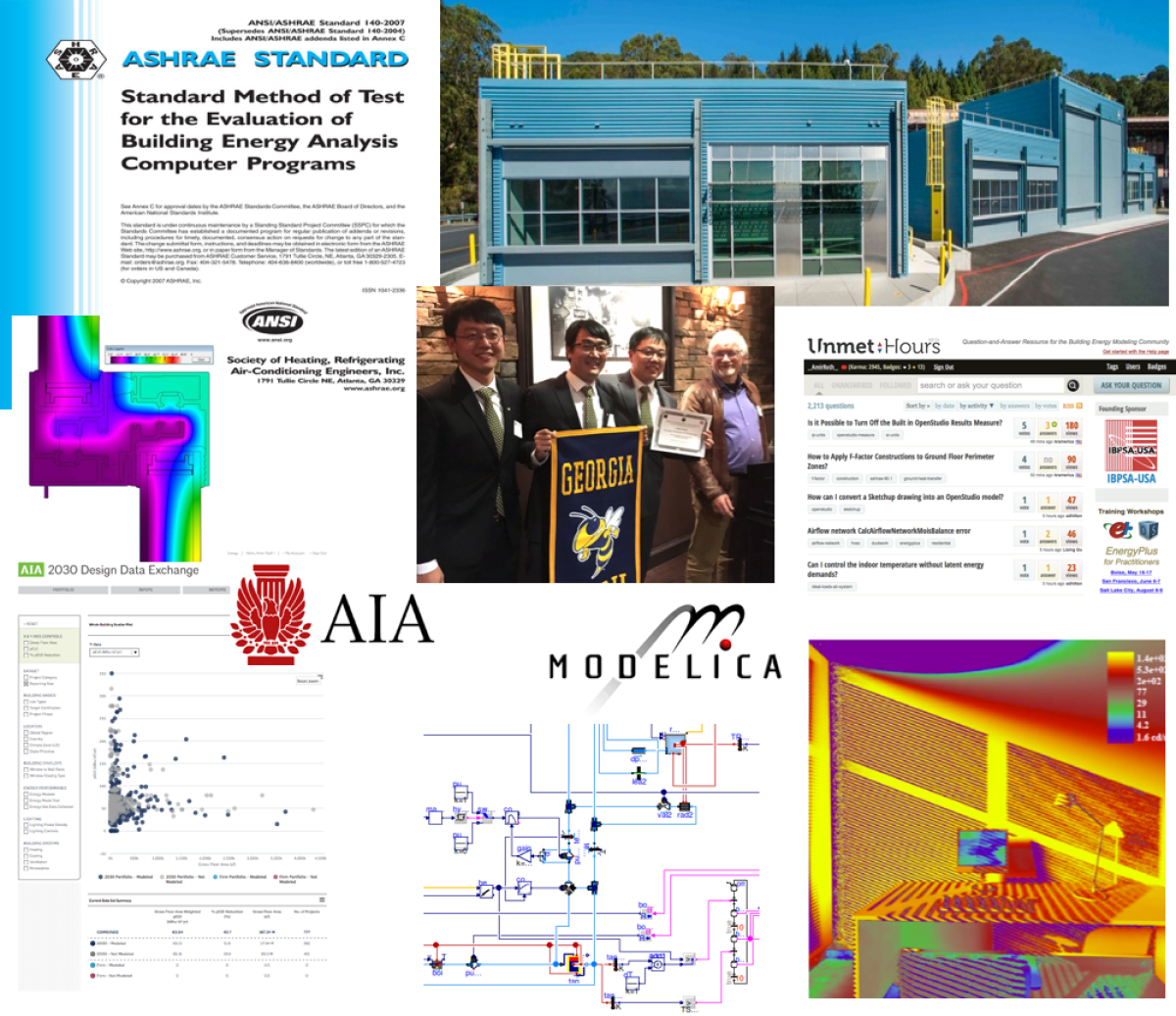
DOE complements its flagship software development projects with other activities that support BEM and its community of practitioners, researchers, educators, and students. DOE funds laboratory experiments that can be used to validate the various calculations that are embodied in BEM. These experiments, along with analytical and comparative tests, are codified in a testing framework that allows different implementations to form an evolving consensus. DOE also invests in basic algorithm development as well as in next-generation computational tools frameworks that can be used as the basis for future products and services. DOE works with professional organizations like ASHRAE, AIA, and IBPSA to provide services for practitioners and to sponsor student conference travel and competitions. Finally, DOE uses a range of competitive funding mechanisms to fund universities, organizations, and businesses small and large in research, application and service development, and other activities related to BEM.
Photo
Caption
Building Energy Modeling (BEM)—physics-based software simulation of building energy use—is a multipurpose tool for building energy efficiency, supporting a variety of applications. The most traditional, and most intuitive, applications of BEM are in architectural, mechanical, and control design of new buildings and retrofits. The ability of BEM to evaluate buildings under standard weather and operating conditions—an evaluation that is impractical to perform in the physical world—is the basis of applications in code-compliance, green certification, and project documentation for financial incentives. BEM is also used to conduct large-scale analysis—at the level of a utility service territory—to inform policy decisions and to develop per-project and overall savings estimates. Emerging use cases of BEM include dynamic applications like model predictive control, where a model of a building is integrated with real-time information from weather forecasts, the building automation system, and the grid to evaluate and choose optimal short-term building control strategies.
Building Energy Modeling (BEM)—physics-based software simulation of building energy use—is a multipurpose tool for building energy efficiency, supporting a variety of applications. The most traditional, and most intuitive, applications of BEM are in architectural, mechanical, and control design of new buildings and retrofits. The ability of BEM to evaluate buildings under standard weather and operating conditions—an evaluation that is impractical to perform in the physical world—is the basis of applications in code-compliance, green certification, and project documentation for financial incentives. BEM is also used to conduct large-scale analysis—at the level of a utility service territory—to inform policy decisions and to develop per-project and overall savings estimates. Emerging use cases of BEM include dynamic applications like model predictive control, where a model of a building is integrated with real-time information from weather forecasts, the building automation system, and the grid to evaluate and choose optimal short-term building control strategies.
Photo
Caption
DOE has been funding the development of BEM tools since before its ascent to a cabinet-level department. Since 2012, DOE’s BEM strategy has revolved around the development of a state-of-the-art open-source BEM platform, which consists primarily of the EnergyPlus™ BEM engine, the Radiance™ lighting engine, and the OpenStudio™ software development kit (SDK), which helps developers build applications and services that use EnergyPlus and Radiance. The introduction of OpenStudio has spurred the adoption of EnergyPlus by both developers and end-users. Third-party OpenStudio-based applications include the CBECC-Com™ compliance tool, the simuwatt® audit tool, and the Honeybee plug-in for Rhino/Grasshopper. EnergyPlus downloads have also increased from under 15,000 per version in 2012 to over 40,000 per version in 2016.
Credit: NLR
Photo
Caption
DOE complements its flagship software development projects with other activities that support BEM and its community of practitioners, researchers, educators, and students. DOE funds laboratory experiments that can be used to validate the various calculations that are embodied in BEM. These experiments, along with analytical and comparative tests, are codified in a testing framework that allows different implementations to form an evolving consensus. DOE also invests in basic algorithm development as well as in next-generation computational tools frameworks that can be used as the basis for future products and services. DOE works with professional organizations like ASHRAE, AIA, and IBPSA to provide services for practitioners and to sponsor student conference travel and competitions. Finally, DOE uses a range of competitive funding mechanisms to fund universities, organizations, and businesses small and large in research, application and service development, and other activities related to BEM.
DOE complements its flagship software development projects with other activities that support BEM and its community of practitioners, researchers, educators, and students. DOE funds laboratory experiments that can be used to validate the various calculations that are embodied in BEM. These experiments, along with analytical and comparative tests, are codified in a testing framework that allows different implementations to form an evolving consensus. DOE also invests in basic algorithm development as well as in next-generation computational tools frameworks that can be used as the basis for future products and services. DOE works with professional organizations like ASHRAE, AIA, and IBPSA to provide services for practitioners and to sponsor student conference travel and competitions. Finally, DOE uses a range of competitive funding mechanisms to fund universities, organizations, and businesses small and large in research, application and service development, and other activities related to BEM.