




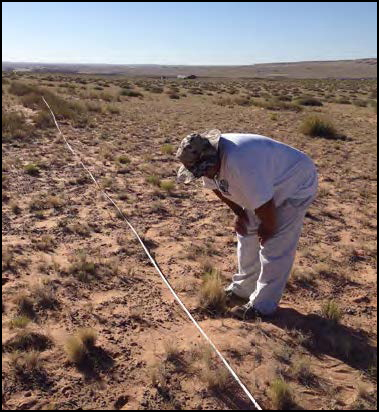
On a late June afternoon on the high desert east of Tuba City, Arizona, members of a Navajo family scoot along the sand riding all-terrain vehicles, rounding up their horses under a ceramic-blue sky. Across a dune ridge, Quentin Benally wipes his brow, adjusts his camo sun hat, and for the umpteenth time, leans over a 25-meter tape measure stretched across the desert floor and calls out the scientific names of plants. His associate stands nearby with pen to paper.
Image
|
| University of Arizona graduate student measures percent cover of desert plants using a line intercept method on historically grazed rangeland near the Tuba City disposal site. |
What is Quentin up to and what drives him to spend his day roasting in the desert sun? Quentin wants to know if his Navajo homeland is healing. He’s collecting data on the abundance of desert flora, evidence that will help him answer questions about the health of the land. His detective’s bag for scientific inquiry also holds results of soil fertility and soil morphology sampling, and satellite images that tell him how much rainwater the desert plants sip from the ground.
To the north and west of where Quentin works extend two different tracts of land. Nearly 30 years ago, the U.S. Department of Energy (DOE) stripped the soil and plants from one large swath to remove radioactive particles that for years had blown in from an abandoned uranium mill. DOE then scattered native plant seeds to begin the long process of healing the land. The other swath, across a livestock fence from Quentin, remained clean of harmful dust and protected from livestock grazing for all those years. This large, unspoiled island serves as an ecological benchmark to gauge the health of both the stripped area and the historically overgrazed rangeland.
Quentin designed his study to answer land stewardship questions that are important to his tribe:
• Did DOE achieve their revegetation goals—has the stripped land healed?
• How well did short-term evaluations predict long-term revegetation success?
• Did revegetation limit the spread of harmful weeds?
• Is the rangeland recovering after decades of overgrazing?
Quentin’s land stewardship study near Tuba City is an example of the growing partnership between the DOE Office of Legacy Management (LM), Native American students, and tribal colleges. LM is currently working with Dr. Karletta Chief, Assistant Professor in the Department of Soil, Water and Environmental Sciences at the University of Arizona (UA) in Tucson. In addition to serving as Quentin’s graduate faculty advisor, Dr. Chief works as an extension specialist bringing relevant science to Native American communities in a culturally sensitive manner.
Image
|
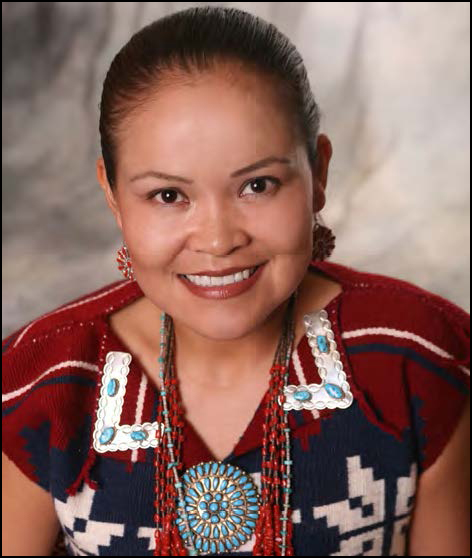
| Dr. Karletta Chief, Assistant Professor and Extension Specialist, Department of Soil, Water, and Environmental Science, University of Arizona. |
Dr. Chief also advises Carrie Joseph, an active member of Hopi communities in northeastern Arizona. Carrie is evaluating the ability of uranium-mill-tailings disposal cells near native communities to adapt to climate change. (An article, “Weaving Community and Science: Former Summer Intern Is Investigating Plant Uptake of Contaminants on Disposal Cell Covers,” about another of Carrie’s projects was published in the July–September 2013 LM Program Update.) An LM scientist serves on graduate committees for Quentin and Carrie through an adjunct faculty appointment with UA.
LM is also partnering with the Environmental Sciences program at Diné College, the 2-year tribal college of the Navajo Nation. Diné College was chartered in 1968 as the first public institution of higher learning established by Native Americans for Native Americans. Diné College pioneered a teaching philosophy that weaves traditional and Western learning, to encourage youth to be contributing members of both their Navajo communities and the greater global community. Instruction and community outreach within the Environmental Sciences program focus on air and water quality, remediation of land impacted by mining, and sustainable land management. An LM scientist recently taught the scientific method to students in an introductory class using, as an example, ongoing LM studies of groundwater phytoremediation—the science of using plants to naturally transform or prevent migration of contaminants in soil and water—at a former uranium-processing site near Shiprock, New Mexico. Faculty and students view phytoremediation as a culturally acceptable and potentially sustainable remedy. The Diné College teaching philosophy helps guide the studies, and the students help collect and analyze field data.
This winter Quentin is back in Tucson, analyzing his evidence and piecing together answers to his land stewardship questions. Quentin wrote, “This project is important to me as a member of the Navajo Nation—I am a stakeholder in this project. My family has been directly affected by the uranium that was mined and milled on the Navajo Nation. My overall goal working on this project is to protect my people from further exposure to these harmful elements, and through scientific research, prevent further damage to my people and our lands.”
Quentin, Carrie, and students like them are the next generation of leaders in their communities. They will advance the science, preserve the traditions, inform and protect the people, and help heal the land.