



Download the full FEMP report, Federal Best Practices: Core Principles of Sustainable Fleet Management.
ON THIS PAGE:
- Overview of Core Principles of Sustainable Fleet Management
- Right-Size Fleets and Vehicles to Mission
- Reduce Vehicle Miles Traveled
- Increase Fleet Fuel Efficiency
- Optimize Cost-Effective Alternative Fuel Use
Overview of Core Principles of Sustainable Fleet Management
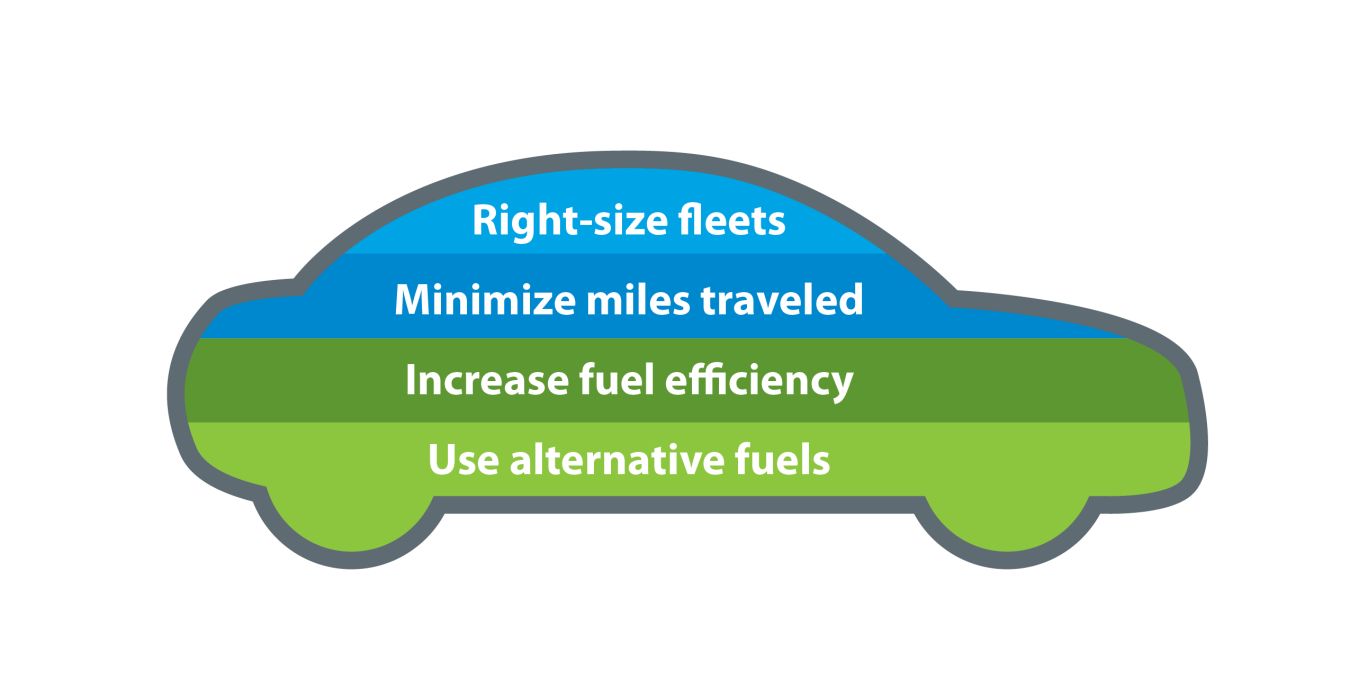
The Federal Energy Management Program (FEMP) recommends best practices for optimizing fleet management. To meet mission-critical needs and comply with all Federal fleet sustainability goals and mandates, an agency can reduce its fleet’s petroleum consumption through the appropriate combination of the four core principles of sustainable fleet management:
- Right-sizing fleets and vehicles to missions
- Reducing vehicle miles travelled (VMT) and idling
- Increasing fleet fuel efficiency
- Increasing use of alternative fuels (including biodiesel blends) and electricity (through deployment of electric vehicles [EVs] and related charging infrastructure).
The following sections introduce core principles that can help agency fleet managers develop a strategic plan for their fleet. For more detail on these core principles, download the full report, Federal Best Practices: Core Principles of Sustainable Fleet Management.
Agency fleet managers should evaluate petroleum reduction strategies and tactics for each fleet location based on an evaluation of site-specific characteristics, including availability of alternative fuel, fleet size, and fleet vehicle composition.
Right-Size Fleets and Vehicles to Mission
Agencies should right-size fleets to identify and eliminate unnecessary or inefficient vehicles and replace them, if necessary, with more efficient vehicles as well as alternative fuel vehicles (AFVs). To right-size its fleet an agency must (1) compile its vehicle inventory and understand how its vehicles are used (e.g., mileage, purpose, etc.); and (2) analyze the fleets’ operational (or mission) needs, while identifying opportunities to eliminate unnecessary, inefficient, and/or nonessential vehicles from the agency’s fleet inventory.
Right-Sizing Fleets
Right-sizing means matching an agency’s vehicle needs to its mission requirements.
A structured vehicle allocation methodology (VAM) process provides a framework for right-sizing an agency’s fleet. GSA’s FMR § 102-34.40 requires that federal agencies establish and document a structured VAM to determine the appropriate size and number of motor vehicles in the fleet and identify opportunities to eliminate unnecessary vehicles, right-size vehicles for their missions, and deploy AFVs effectively. GSA suggests that agencies complete a VAM at least once every 5 years. Agencies are encouraged to conduct a VAM study more frequently if agency missions or resources change. A VAM study can help your agency determine its optimum fleet inventory and reduce fleet costs. It can also support a fleet management plan through the appropriate acquisition, placement, and use of higher efficiency vehicles and AFVs. This plan should include an optimal fleet inventory size projection (by vehicle class and fuel type) to meet mission needs and sustainability requirements.
Development of a VAM provides agency fleet managers with a standard way to document the objective characteristics of a vehicle fleet for (1) a specific bureau or department and/or (2) a generic (where there are common characteristics) office/facility, program, occupational group, or other entity within an agency.
Vehicle Allocation Methodology
Section 102-34.40 of the GSA FMR requires all Federal executive agencies operating domestic or foreign fleets to establish and document a structured VAM to determine the appropriate size and number of motor vehicles (i.e., optimize fleets to agency mission).
Objective characteristics should include, but are not limited to:
- Number of vehicle users at a given site
- User-to-vehicle ratios (where applicable)
- Per-vehicle mileage
- Trips per vehicle
- Vehicle mission
- Terrain and climate
- Fleet condition and down time.
The data for the VAM is typically obtained by surveys and/or in-person interviews of stakeholders. However, much of this data could be collected and maintained while an agency is collecting vehicle inventory data for its annual data submission requirements.
Typically, the first step in implementing a VAM is completing a detailed vehicle utilization study to establish a baseline fleet profile. Agency fleet managers can use the results of the baseline fleet profile to create a list of vehicles approved for each organization. GSA Fleet can help your agency throughout this process and should be consulted when assessing the need for GSA leased vehicles. The following table outlines the general VAM process. For more detail on each step, download the full report, Federal Best Practices: Core Principles of Sustainable Fleet Management.
General Vehicle Allocation Methodology Process
Step Summary Actions Purpose 1 Create baseline fleet profile - Identify agency mission tasks and vehicle assets assigned to those tasks
- Complete an annual review of each fleet vehicle and collect data on utilization, downtime, age, maintenance, acquisition cost, number of users, per-vehicle mileage, trips per vehicle, mission, terrain, climate, fleet condition, number of passengers, and cargo capacity.
Perform a fleet utilization study to identify current vehicle assets and how they match with agency mission needs 2 Develop minimum vehicle utilization criteria - Determine vehicle assets required to complete necessary mission tasks
- Identify any critical missions that require vehicle retention no matter the utilization
- Establish minimum utilization criteria to be used in validating the need for vehicles based on their missions, such as mileage requirements, hours used, utilization (daily percentage), passengers carried, number of trips, and user/vehicle ratio.
Establish a baseline of fleet assets required to complete necessary mission tasks 3 Compare existing fleet composition to mission task needs - Determine if vehicles meet minimum requirements needed to accomplish mission tasks
- Evaluate alternatives, including mass transportation or contract shuttle services
- Determine vehicles that are mission essential
- Identify vehicles below minimum utilization or mileage requirements and dispose or reassign as needed.
Complete gap analysis of current vehicle assets and required mission needs and eliminate or replace vehicles that do not meet required mission needs 4 Develop a vehicle acquisition plan to support VAM results - Create a 5-year vehicle acquisition and replacement plan, with recommended vehicles (type and size) for each mission as determined by the VAM
- Create a list of vehicles approved for each organization that meets the agency mission.
Establish clearly defined policy to ensure fleet and vehicles are correctly sized and appropriate for the agency mission 5 Review and update VAM - Complete a fleet management plan, which includes the agency strategy to achieve their optimal fleet inventory and annual progress toward achieving that inventory
- Review and update the agency VAM annually or sooner as agency mission needs change.
Revise VAM based on changes in vehicle solutions or agency mission needs
Reduce Vehicle Miles Traveled
One of the first steps in developing an agency-wide petroleum reduction strategy is to evaluate opportunities to reduce the miles your fleet travels. Reducing fleet VMT decreases fleet petroleum use and fleet costs, including reduced vehicle operational and maintenance costs and longer vehicle life before replacement. Further, reducing VMT can enable a reduction in the number (and cost) of vehicles required to accomplish the fleet’s mission, and therefore is directly related to actions taken to right-size fleets. Fleet managers should always try to minimize VMT even while increasing fleet efficiency and alternative fuel use (including electricity).
There are no specific mandates to reduce VMT. However, success in doing so contributes to achieving EISA Section 142 petroleum reduction requirements. The significant benefit of this approach, relative to other petroleum reduction strategies, is the opportunity for immediate and sustained reduction of total fleet management costs.
The strategies to reduce VMT discussed here should be applied to all fleet vehicles, regardless of vehicle type (light-duty, medium-duty, or heavy-duty) or vehicle fuel type (AFV, EV, or conventional-fueled vehicle). A variety of options for VMT reduction are available for consideration and implementation. Fleet managers can implement some of these measures independently while collaboration with facility or agency management may be necessary in other cases. Measures to reduce VMT include the following:
- Eliminating vehicle trips. Use telephone, video, and web conferencing tools for meetings, work from home when practical, and walk or bike as appropriate.
- Consolidating trips. Consolidate routes and carpool to eliminate duplication of trips.
- Providing agency shuttles. Provide a shuttle service for high-use routes to consolidate trips.
- Using mass transportation. Use mass transportation alternatives to eliminate fleet vehicle transportation needs.
- Improving scheduling and routing. Optimize travel time and distance for delivery of services by using telematics and GPS technology to improve routing and efficiency of fleet vehicles.
- Implementing transportation on demand. Use demand-responsive systems to offer shuttle, bus, or carpooling service to employees.
Increase Fleet Fuel Efficiency
Increasing fleet fuel efficiency is a simple, low-cost, and effective method to comply with statutory mandates and reduce fleet petroleum use. This section provides an overview of the following five tactics to increase fleet fuel efficiency. Agencies should implement these strategies regardless of vehicle size or fuel type.
Agencies should deploy the smallest, most fuel-efficient vehicles appropriate for the vehicle’s mission. Acquiring vehicles that burn less fuel per mile (higher fuel economy) will reduce overall fleet petroleum use to complete the same agency transportation mission. Lower fuel economy vehicles use far more fuel than high fuel economy vehicles for similar missions and annual mileage. Therefore, agencies should focus on opportunities to improve the fuel efficiency of the lowest fuel economy vehicles in their fleets.
Fuel economy is a major component of replacement plans for fleet vehicles. When ordering vehicles, agencies should answer the following questions:
- Will a smaller vehicle get the job done?
- Is there a more fuel-efficient vehicle that would meet my needs?
- Do I have access to alternative fuels?
FEMP offers resources and best practices to help agencies through the Federal vehicle acquisition process.
The DOE and EPA Fuel Economy website is an excellent interactive resource where users can compare cars and trucks based on emissions and fuel efficiency.
Hybrid electric vehicles (HEVs) combine the internal combustion engine of a conventional vehicle with a rechargeable energy storage system such as the battery and electric motor of an electric vehicle. The combination can increase fuel economy and reduce emissions while maintaining the power, range, and convenient fueling of conventional vehicles. HEV batteries are recharged by the internal combustion engine and recovery of energy ordinarily lost while braking. They do not recharge by plugging into an external source of electricity (such vehicles are referred to as PHEVs, or plug-in hybrid electric vehicles).
HEVs often top their vehicle classes in fuel economy. At the same time, they do not require alternative fueling infrastructure. Deploying HEVs can save agencies money without complications. Acquisition of an HEV to replace a conventional-fueled vehicle may provide a reduction of more than 30% in petroleum use.
Acquiring HEVs is an effective measure to reduce petroleum use in locations where alternative fuel is unavailable. However, in fleet locations with reasonable and affordable access to alternative fuel, acquisition of AFVs will provide greater petroleum reductions—alternative fuel used by an AFV displaces the petroleum that would be used in a conventional-fueled vehicle. Agencies also receive one EPAct 1992 AFV acquisition credit for each qualifying HEV acquired regardless of weight class (learn more about EPAct 1992 AFV acquisition requirements and credits).
In addition to choosing fuel-efficient vehicles, fleet managers and drivers can keep fleet vehicles properly maintained to improve fuel economy. GSA FMR Bulletin B-19 encourages agency fleet managers to incorporate the following recommendations into preventive maintenance programs and driver inspections:
- Keep your vehicle engines properly tuned
- Keep tires properly inflated to the recommended tire pressure
- Check and replace air filters regularly
- Use the recommended grade of motor oil for your vehicle to increase fuel economy.
Federal fleet vehicle drivers can help improve fuel economy and reduce petroleum use by driving more efficiently. GSA FMR Bulletin B-19 recommends that agency fleet managers “develop and implement a communication plan to ensure that strategies for improving fleet fuel efficiencies are disseminated agency-wide and that all drivers are aware of fuel efficiencies gained by driving more efficiently.”
The communication plan should include the following:
- Drive at speeds that conserve fuel
- Use cruise control, when appropriate, on the highway to maintain a constant speed
- Drive safely and responsibly
- Remove excess weight such as unnecessary items in the trunk.
When idling, vehicles typically burn from 0.25 to 1 gallon of fuel per hour. Unnecessary idling pollutes the air, wastes fuel, and causes excess engine wear, and reducing idle time is a simple policy to implement. Typically, the following actions can help reduce unnecessary vehicle idling:
- Turn off your engine when you are parked or stopped (except in traffic) for more than 1 minute
- Avoid using a remote vehicle starter, which encourages unnecessary idling
- Avoid drive-through windows; walk inside instead.
For heavy duty vehicles, a variety of technologies are available to reduce idling. Onboard equipment such as automatic engine stop-start controls and auxiliary power units can be used anywhere. Truck stop electrification enables trucks to hook up to stations that provide power and other amenities.
For light duty vehicles and medium duty vehicles, three types of idle reduction technologies are available to keep vehicles warm: coolant heaters, air heaters, and energy recovery systems. Coolant heaters keep the engine warm by using fuel from the vehicle to pump heated coolant through the engine, radiator, and heater box. To provide passenger compartment warmth, air heaters are separate, self-contained units that directly blow hot air into the vehicle interior using fuel from the vehicle. Energy recovery systems use electric pumps connected to the water line to keep the car’s cooling system and heater operating after the engine is turned off, using engine heat that would otherwise dissipate.
Optimize Cost-Effective Alternative Fuel Use
One effective strategy to reduce petroleum use is to displace it with alternative fuels, including electricity, biodiesel blends, and renewable diesel blends. Alternative fuels have additional advantages as well. Most are produced domestically, benefitting the national economy, and oftentimes they are more affordable than gasoline or diesel. Agencies should decide on the type of AFV and infrastructure based on fleet location characteristics.
To promote increased alternative fuel consumption by AFVs in the Federal fleet, Section 701 of EPAct 2005 requires Federal agencies to use only alternative fuel in its dual-fueled vehicles, except where the vehicles have received a waiver from DOE due to the local unavailability of alternative fuel or fuel that is unreasonably more expensive than gasoline. This means, for example, that if E85 infrastructure is available at or near a fleet location, all fleet E85 FFVs operating at that location are required to refuel solely with E85 using that infrastructure. Agencies are encouraged to focus on deploying dual-fueled AFVs in locations with existing or planned alternative fuel infrastructure and deploying new alternative fuel infrastructure near high concentrations of dual-fueled vehicles waivered due to the unavailability of fuel.
Alternative fuels include but are not limited to electricity, E85 (a blend of 85% ethanol and 15% gasoline), neat (100%) biodiesel (B100), neat (100%) renewable diesel, compressed natural gas (CNG), liquefied natural gas (LNG), hydrogen, and liquefied petroleum gas (LPG) or propane.
Alternative fuel and alternative fuel vehicle types include:
- Electricity. Electricity use requires both EVs, which include battery electric vehicles (BEVs), low-speed electric vehicles (LSEVs), and PHEVs, and dedicated charging infrastructure.
- E85, CNG, LNG, and LPG. The use of these alternative fuels requires both AFVs and dedicated refueling infrastructure. These alternative fuels are best used at fleet locations where alternative fuel is currently available or expected to become available (i.e., emerging markets) or at high-use locations where alternative fuel sites are planned in the near term.
- Neat biodiesel and biodiesel blends. Neat biodiesel and biodiesel blends require dedicated refueling infrastructure but can be used in conventional diesel vehicles. Biodiesel strategies are ideal for locations with high diesel fuel use. Biodiesel blends refer to blends of greater than 20% biodiesel with diesel (e.g., B20). Note that biodiesel blends are not alternative fuels. However, the neat biodiesel component of biodiesel blends greater than 20% is counted as biodiesel in calculating fleet alternative fuel use.
- Neat renewable diesel and renewable diesel blends. Neat renewable diesel and renewable diesel blends are “drop-in” replacement fuels for diesel; renewable diesel is fully compatible with existing diesel refueling infrastructure and engines. Substituting diesel fuel with renewable diesel is an effective petroleum reduction strategy at most fleet locations with diesel vehicles. Renewable diesel blends refer to blends of greater than 20% renewable diesel with diesel (e.g., R20). Note that renewable diesel blends are not alternative fuels. However, the neat renewable diesel component of renewable diesel blends greater than 20% is counted as renewable diesel in calculating fleet alternative fuel use.
To maximize alternative fuel use increases and petroleum reductions, agencies should support strategies to increase alternative fuel use by:
- Acquiring AFVs, including BEVs and PHEVs, and placing them in or near areas with existing or planned alternative refueling sites (agencies should ensure alternative fuel infrastructure, including charging infrastructure and the associated fuel necessary to support dedicated AFVs, is in place before accepting delivery of vehicles); and by running dual-fueled vehicles on alternative fuel
- Installing alternative fuel infrastructure (including charging infrastructure) in fleet locations with the highest AFV concentrations that use that fuel type
- Communicating and coordinating with nearby fleets (both public and private sector) to aggregate demand for alternative fuel.