



The U.S. Department of Energy’s Office of Environmental Management and its liquid waste contractor at the Savannah River Site have deployed a robot dog at the Salt Waste Processing Facility to support high-hazard operations while reducing personnel radiation exposure.
Office of Environmental Management
October 20, 2026 Estimated Read Time min
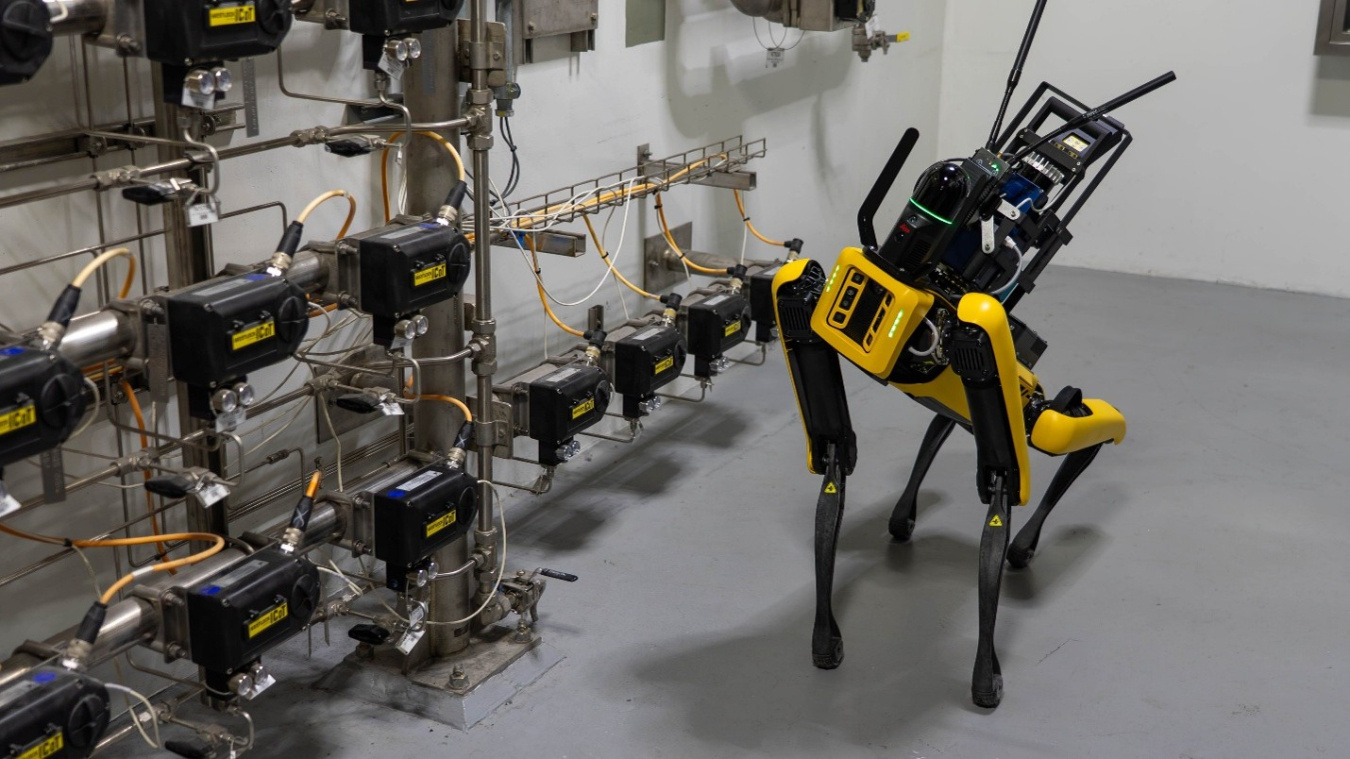
A robot dog scans a hallway at the Salt Waste Processing Facility at Savannah River Site. The four-legged robotic platform can collect radiation measurements in areas difficult to access, generate 3D models of rooms and perform other critical tasks to support the liquid waste mission.
AIKEN, S.C. — The U.S. Department of Energy’s (DOE) Office of Environmental Management (EM) and its liquid waste contractor at the Savannah River Site (SRS) have deployed a robot dog at the Salt Waste Processing Facility (SWPF) to support high-hazard operations while reducing personnel radiation exposure.
The robot dog can identify radiation boundaries in real time, collect consistent radiation measurements in areas difficult to access and generate 3D models of rooms. The resulting data supports job planning, informs radiation shielding placement, helps radiation protection personnel identify unusual or changing radiation readings and detects other changing conditions that engineering teams can address before they become more serious.
Remote inspections provide radiological, process and equipment data, enabling teams to identify and resolve problems more rapidly and with reduced risk. Identifying issues earlier than human detection improves risk reduction for employees.
The robots can perform autonomous inspections along predefined routes and carry equipment, such as ultrasonic-imaging systems. An optional robotic arm can perform selected tasks remotely, making the technology suitable for operations in which personnel safety is a concern or mobile data collection is required.
SRMC President and Program Manager Thomas Burns Jr. sees the robot dog as an investment in the future of the liquid waste mission.
“These robotics are a great piece of technology that can help us execute with excellence in the mission-critical work being done at SWPF,” Burns said. “Deploying technology into high-hazard areas allows us to perform more testing and data collection while keeping our people safe by avoiding unnecessary contact with high-radiation areas.”
SRMC continues to test and evaluate the robotic dog, and plans to deploy it soon in low-risk radiological areas that personnel can readily access to verify measurements or respond to problems. Testing will advance from the least-hazardous to most-hazardous areas.
-Contributor: TJ Lundeen
To receive the latest news and updates about the Office of Environmental Management, submit your e-mail address.