



The American-Made Challenges: Solar Desalination Prize is a four-stage competition designed to accelerate the development of low-cost desalination systems that use solar-thermal power to produce clean water from salt water. Competitors receive cash prizes as they advance through each stage, culminating in a $1 million grand prize for the successful testing and demonstration of a promising solar-thermal desalination system prototype.
Participants may enter the competition as individuals or teams, but all competitors who advance beyond the first stage must form teams. Competitors may include private companies, nonprofit organizations, academic institutions, students, and researchers at National Laboratories.
The U.S. Department of Energy (DOE) announced the prize on September 23, 2019. Round 1 was launched on April 28, 2020, and Round 2 was launched on April 12, 2021. DOE is investing $15 million in the two rounds.
Prize Structure
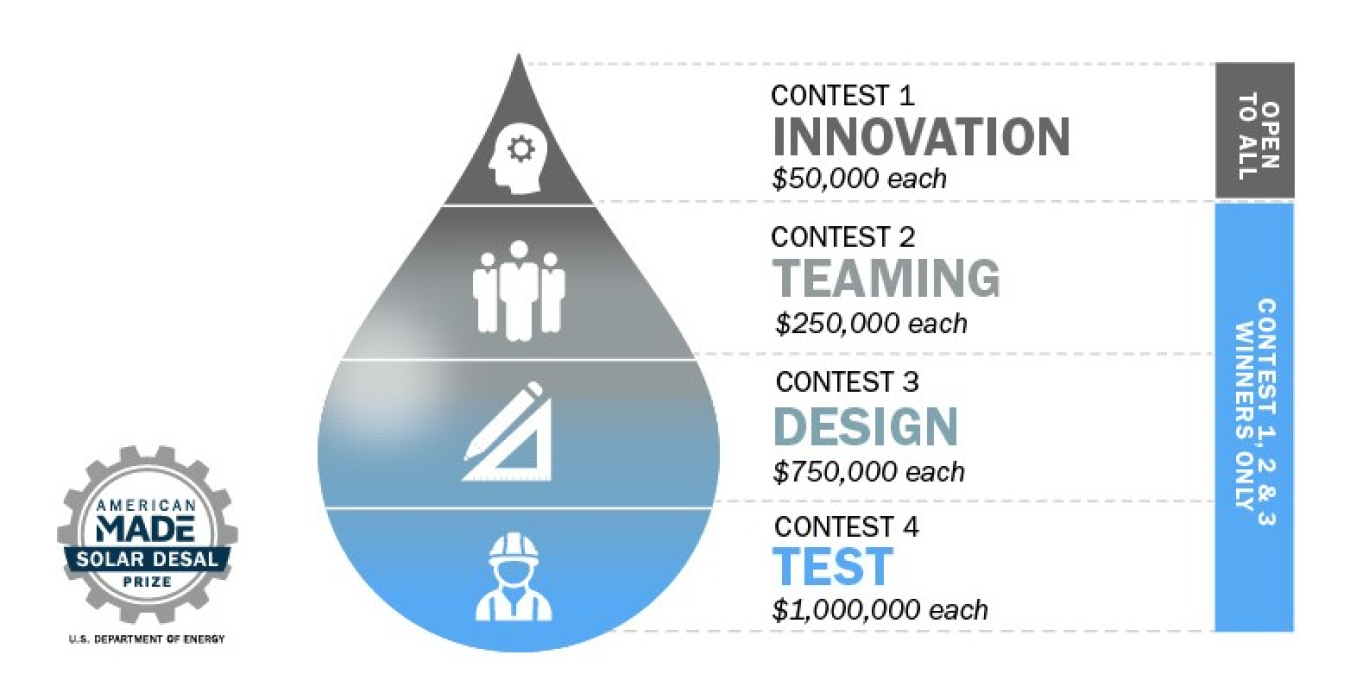
To enter the competition, participants must submit their ideas for a solar-thermal desalination component or system prototype, along with a pathway to commercialization. If their ideas are selected, competitors will receive $50,000 in cash, advance to the second phase to form a team, and refine plans for a fully operating solar-thermal desalination system.
The teams selected to advance to the third phase will receive $250,000 in cash and a $100,000 voucher that can be redeemed at a National Laboratory and/or qualified partner facilities to design their systems. While they’re completing detailed designs of their systems in the third phase, teams must also obtain the permitting and approval documentation necessary to build them.
Teams selected to advance to the fourth and final phase of the competition will be awarded a cash prize of $750,000 and another $100,000 voucher. These teams will then build their systems, demonstrate their operation, and validate key performance metrics. DOE will determine the winner, who will receive a $1 million cash prize.
Competitors can leverage industry expertise, access private capital, and obtain mentorship and support through the American-Made Network, a group of National Laboratories, incubators, investors, and industry experts. The network also provides access to local capabilities that will help accelerate the development of their desalination system prototypes.
Timeline
- Round 1 of the Solar Desalination Prize opened on April 28, 2020. Quarterfinalists were announced on October 19, 2020. Semifinalist teams were announced April 12, 2021. A finalist team was announced on February 28, 2023. Two more finalist teams were announced on August 2, 2024.
- Round 2 of the Solar Desalination prize opened on April 12, 2021. Quarterfinalists were announced on September 28, 2021. Semifinalists were announced on April 22, 2022. A finalist team was announced on April 18, 2024.
- Two additional finalist teams were announced on August 8, 2026.
Finalists
RadiPulse Solar (previously known as Winston Cone Optics): Integrated Compound Parabolic Concentrator
Location: Merced, California
Project Summary: This team is developing an innovative solar concentrator designed to minimize the capital costs, complexity, and operations and maintenance costs of the collector system of a solar-driven desalination process. This project aims to address water challenges for oil and gas operators efficiently and economically.
SolMem: Solar NZLD
Location: Houston, Texas
Project Summary: This team is developing a solar thermal treatment process to enable low-energy desalination of high-salinity wastewater for coal-fired power plant and landfill operators, including their waste streams. The team is also exploring the market for treating produced water from oil and gas operations for beneficial reuse.
GreenBlu: Reaching Pipe Parity for Desalinated Seawater through the Valorization of Magnesium
Location: Trenton, New Jersey
Project Summary: This team plans to construct an array of evacuated solar collectors and a crystallizer at the Federal Ohmsett facility in New Jersey to recover magnesium from seawater. They seek to recover valuable minerals from seawater while helping businesses to become zero liquid discharge facilities. GreenBlu’s primary innovation is their solar-thermal Temperature-Swing Vapor Pump (TSVP) crystallizer which operates at very high efficiency and fractionally crystallizes valuable salts from brines. GreenBlu’s TSVP crystallizer uses nanomaterial adsorbents that swing between 10-50°C. By fractionally crystallizing the brine in their TSVP crystallizer, Greenblu seeks to commercialize mineral recovery from high salinity brine waste streams.
Katz Water Technologies: Solar Thermal Desalination System at a New Mexico Oil Site
Location: Houston, Texas
Project Summary: Katz Water Technologies is redesigning its self-contained, compact distillation system to use solar-thermal energy instead of natural gas. The new design blends the existing multi-stage thermal distillation technology into a simpler design with the multistage process occurring in a single closed-loop heat exchanger. The technology has the potential to be a modular, portable system that can supply fresh water where needed. Prototype site testing is being planned at the Bureau of Reclamation’s Brackish Groundwater National Desalination Research Facility, with a particular focus on the oil and gas production market.
Solar Desalt: Mobile Sorption-based Solar Zero Liquid Discharge Desalination System
Location: Raleigh, North Carolina
Project Summary: This team, partnering with the Clos de Chance winery, plans to reduce the amount of wastewater rejected from wineries in the California area. They plan to treat wastewater with their two 10 kWh sun-tracking solar collectors with a thermal energy storage module. The team has combined a high-temperature desorption process with a low-temperature crystallization process. The high temperature raises efficiency and the mixture never completely boils to steam. The low temperature crystallization process reduces solubility and elevates the boiling point through the use of an ionic solution. This reduces scaling and the aggressiveness of the brine solution and allows for the use of low-cost materials like plastic. By maximizing the temperature difference in these two processes, Solar Desalt’s innovation achieves maximum efficiencies and a Gain Output Ratio of 8.8 while reducing wastewater from wineries using solar energy.
Sunvapor: SCEPTRE - Solar Cascading Evaporation Process
Location: Pasadena, CA
Project Summary: Sunvapor’s solar hybrid desalination process project focuses on brine management—taking in brines produced from a variety of sources, such as reverse osmosis waste, power plant cooling towers, and other waste streams with high salt content. Steam discharged from Sunvapor's Bullet Steam AccumulatorTM provides solar steam to support a hybrid low- and high-temperature desalination process. The thermal energy storage will be charged by a field of linear concentrating collectors. Together, this efficient use of thermal energy from stored solar steam has the potential to provide high-efficiency, low-cost treatment for wastewater that is too salty for reverse osmosis. Sunvapor’s initial target market is the oil and gas industry in the Permian Basin in New Mexico and Texas, where the technology will help recover clean water from produced water that is an incidental byproduct of oil and gas production. By providing a direct thermal energy resource at the location and a novel thermal desalination process, Sunvapor’s solution can desalinate produced water at low cost and with no emissions. The team plans to build a pilot facility at NGL's Striker 1 saltwater disposal facility in New Mexico to demonstrate the performance and effectiveness of the system using actual produced water.
Semi-Finalists
Location: Jacksonville, FL
Project Summary: A team led by Artic Solar has designed an integrated solar-thermal desalination system. The technology uses a thermally responsive solvent, which draws water from a brine stream. The solvent is then heated using an external compound parabolic concentrator, designed by Artic Solar, which separates the solvent from the generated fresh water. The team also includes technology developers of the novel desalination process and component suppliers. The team plans to test their system at Southern Company’s Water Research and Conservation Center in Georgia.Location: Hopewell, New Jersey
Project Summary: This team, led by AIL Research, is developing a membrane desalination system capable of handling very-high-salinity water and using recovered heat to preheat the brine feed. The system will be designed to pre-crystallize readily precipitating ions, such as magnesium and calcium, before the brine contacts the membrane, to prolong membrane lifetime. Managing the precipitation of salt and using recovered heat allows more water recovery from high-salinity brines. The team will focus their technology on the production of agricultural water for regions of the country where brackish groundwater is too saline to be used directly. They plan to install their prototype at Bell Ranch in California, in partnership with Global Water Innovations.Location: Storrs, Connecticut
Project Summary: This team, led by researchers from the University of Connecticut, will integrate a newly developed ceramic membrane technology with a solar collector system to treat high-salinity or chemically complex brines. The ceramic membranes provide thermal and chemical stability that enable them to process challenging saline waters, operate at higher temperatures than existing polymeric membranes, and be more aggressively cleaned when fouled by scaling salts and organics. The team will be developing their pilot for deployment at the Kay Bailey Hutchison Water Treatment Plant in El Paso, Texas.Location: Corvallis, Oregon
Project Summary: This team plans to advance and commercialize technology developed at Oregon State University and Michigan State University plans to advance a humidification-dehumidification process that can recover clean water from water produced by oil and gas extraction. A novel cyclone separator, which can be easily designed at small scale for portability, separates salt from humid air and enables the process. By separating humid air from solid salt particles, this technology could be a cost-effective method to achieve zero-liquid discharge. The team will design their pilot to be installed at the Bureau of Reclamation’s Brackish Groundwater National Desalination Research Facility.Location: Pasadena, CA
Project Summary: Planet A Energy has developed an innovative system concept that directly couples a low-cost solar collector with a low-cost thermal energy storage material that the solar collector can directly heat. The collector, absorber, and energy storage are all integrated into a single module, eliminating many of the system complexities associated with traditional CSP technologies. Planet A Energy has teamed with the Rosenblad Design Group and Aerometrix LLC. The team intends to couple Rosenblad’s proprietary evaporator technology with their collector and thermal energy storage systems at an Aerometrix desalination plant to demonstrate how this technology can be used to reduce the volume of brine wastewater.Location: Houston, TX
Project Summary: SolMem has developed a concept for desalination of various wastewater streams to produce drinking-quality water. The team’s membrane distillation (MD) technology simultaneously collects solar energy and desalinates water, greatly improving thermal efficiency and water recovery compared to conventional MD. SolMem has assembled a team that includes Winston Cone Optics and Rice University. The team intends to demonstrate their technology at the Brackish Groundwater National Desalination Research Facility.Location: Houston, Texas
Project Summary: A team led by researchers from Rice University has developed a nanoparticle-based high-efficiency, low-maintenance solar-heated membrane distillation technology. The team will design a prototype of their nanophotonics solar absorber desalination system in combination with thermal energy storage. The team plans to develop a scalable system design that uses spiral-wound architecture to minimize the plant’s physical footprint, which will be located at either the Bureau of Reclamation’s Brackish Groundwater National Desalination Research Facility or a development near Corpus Christi, Texas, to provide fresh water.Location: Pasadena, CA
Project Summary: Sunvapor’s Solar Cascading Evaporation Process (SCEPTRE) focuses on brine management—taking in brines produced from a variety of sources, such as reverse osmosis waste, power plant cooling towers, and other waste streams with high salt content. Steam discharged from a steam accumulator provides thermal energy storage to support both low- and high-temperature desalination processes. Together, this efficient use of thermal energy from stored solar steam has the potential to provide high-efficiency, low-cost brine treatment. Sunvapor intends to demonstrate this technology at an existing saltwater disposal injection facility.Location: Santa Barbara, CA
Summary Project: Team Trident has an innovative concept to targets a reduction in the cost of treating high-salinity brines for water produced from oil and gas extraction. By using low-grade thermal heat to drive TSSE’s separation and solvent regeneration processes, the technology advances a non-evaporative, non-membrane solar-thermal desalination concept, which can be implemented at a low capital and operating cost. In collaboration with Columbia University and Bechtel, the team plans to construct a prototype of their system at the Brackish Groundwater National Desalination Research Facility.Location: Rohnert Park, California
Project Summary: A team including researchers from Idaho National Laboratory and Trevi Systems is developing a solar-thermal-powered liquid/liquid extraction process that removes “hard” ions, like calcium and magnesium, before brine is treated by reverse osmosis, a conventional desalination process. This method could significantly improve the efficiency of reverse osmosis by allowing the process to operate over wider brine input conditions and requiring less maintenance to remove the scale caused by hard ions. The team has formed partnerships with Idaho National Labs, Artic Solar, and Global Water Innovation to develop and test their prototype at Bell Ranch in California, to target the agricultural water market.Location: Merced, CA
Project Summary: Winston Cone Optics (WCO) has developed an innovative solar concentrator designed to minimize system capital costs, complexity, and operations and maintenance costs of the collector system of a solar-driven desalination process. Their technology is designed to be quick to deploy and portable, allowing solar-thermal water treatment systems to gain access to niche markets where seasonal or multi-site application is needed. WCO will couple their solar collector technology with Trevi Systems’ Switchable Solvent Water Softener technology, a forward-osmosis-based desalination system. The team will demonstrate their zero-liquid-discharge desalination prototype for the agricultural market with their partners, Global Water Innovation and Wacomet Water.
Quarterfinalists
Location: Cambridge, MA
Project Summary: AeroShield is developing super-insulating, transparent silica aerogels to improve the performance of solar-thermal receivers by up to 40%. These aerogels could maximize solar transmittance while minimizing heat loss, improving the performance of concentrating and non-concentrating (flat-plate) solar collectors that can deliver heat to solar-thermal desalination systems.Location: Jacksonville, FL
Project Summary: This concept is an integrated solar-thermal desalination system that combines a non-tracking collector with a forward-osmosis desalination module. The technology uses a thermally responsive solvent, which draws water from a brine stream across a membrane. The solvent is then heated to separate it from the generated fresh water using Artic Solar’s external compound parabolic concentrator.Location: Frisco, Texas
Project Summary: Crystal Clearwater Resources is developing its “LTDis” evaporator technology, which can use solar heat to treat challenging waste streams and achieve zero liquid discharge. The concept uses a spray-based evaporation and condensation chamber to replace the stages with tubes (surfaces used for condensation and evaporation) in conventional multiple-effect desalination plants. Direct evaporation and condensation of sprays in vacuum chambers eliminate corrosion concerns and reduce the size and cost of vessels.Location: Fletcher, NC
Project Summary: D&D Manufacturing and Low Impact Technologies USA Inc. are working together to develop a solar-thermal multi-effect distillation (MED) process that can handle a wide range of input brine salinities. The team developed a low-cost, thermoplastic parabolic trough that provides heat to a solar-thermal desalination process. Thermoplastic allows for a more precise trough design because it can be melted, then molded. The trough acts as both the solar collector and a horizontal distillation column. The system is designed to recapture the heat of vaporization of the produced water vapor to maximize thermal efficiency. This technology is modular, scalable, and can potentially support zero-liquid discharge requirements for various applications.Location: Rohnert Park, California
Project Summary: This team of researchers from the Natural Energy Laboratory of Hawaii and Trevi Systems, a small company developing novel forward osmosis (FO) desalination technology, proposes to build a 500 m3/day FO system with solar collectors as a heat source. The team will advance its FO draw solution by significantly increasing throughput and lowering the system’s energy requirements.Location: San Marcos, TX
Project Summary: Frontier Research Group is developing a humidification-dehumidification (HDH) approach to desalination with a combination of technologies designed to optimize solar-thermal desalination over a range of salt concentrations. This concept significantly enhances the HDH process by creating sub-millimeter microbubbles with hot air, called sparging. Solar energy directly heats air and salt water through a compound parabolic concentrator. Then the air and salt water are mixed to improve heat transfer and evaporation. To collect fresh water, condensation is enhanced with advanced materials that form superhydrophobic structures, which repel water. This combination of technologies is a novel design that could be used in various solar-thermal desalination markets.Location: Arcadia, California
Project Summary: Element 16 is a small company developing a sulfur-based thermal energy storage (TES) technology to generate low-pressure steam for desalination. Sulfur has a low melting point (105° Celsius) and low cost ($80/ton). By using lower-cost containment materials, this project aims to reduce sulfur TES cost to below $15/per kilowatt-thermal and reduce heat-exchanger costs, to attain a levelized cost of water below $0.50 per cubic meter (m3).Location: Los Angeles, California
Project Summary: This team, led by researchers from the University of California, Los Angeles, is developing a humidification-dehumidification process that lowers the cost of manufacturing high-surface-area components. By using low-cost polymer string architectures in the dehumidification process, the team expects cost-effective, energy-efficient desalination of high-salinity water.Location: Andover, Massachusetts
Project Summary: Physical Sciences Inc. proposes to integrate a low-concentration solar receiver with a multistage flash evaporator in one device to reduce capital cost. The evaporator efficiently distills water by combining numerous distillation stages so that each one uses the heat output from the previous stage. The evaporator operates at low temperature, which allows the use of low-cost cylindrical optics. The team intends to build a 20-stage multistage flash device inside a cylindrical tube receiver to produce 100 m3/day of desalinated water.Location: Gainesville, Florida
Project Summary: This team, led by the small company Focused Sun, proposes a linear Fresnel solar-collector system that will generate steam for a process called thermal vapor compression (TVC) to provide pumping power for the system. The brine will be preheated by a membrane desalination (MD) system, which is then fed with brine from the TVC system to further desalt and recover water. This MD-TVC system could attain high energy efficiency at low pressure and be used to treat water produced from oil and gas extraction, with no electricity input.Location: Oak Ridge, TN
Project Summary: Researchers from Oak Ridge National Laboratory will produce fresh water from high-salinity water, with zero liquid discharge so that easily disposable salt is the only waste product, using a black graphite foam as a solar energy absorber and heat conductor. The graphite directly heats up salt water to produce fresh-water vapor, and by using a superhydrophobic coating on the surface of internal channels to repel water, this can be efficiently coupled to high-efficiency membrane distillation process, without requiring a heat-transfer fluid or electrical-to–thermal energy conversion.Location: Andover, MA
Project Summary: Physical Sciences has developed an integrated solar-thermal collector and desalination system to produce low-cost fresh water for small- to medium-scale systems (that produce 100 cubic meters daily or less). This concept has individual concentrating solar-thermal modules with glass receiver tubes in which salt water is distilled by multi-stage flash—a process that boils water to make steam, which is condensed and collected as fresh water. The goal is to combine the low-cost simplicity of a solar still with the thermal efficiency of multi-stage flash to reduce complexity and materials costs compared to traditional, high-temperature concentrating solar-thermal power equipment.Location: Pasadena, CA
Project Summary: This system couples a low-cost solar collector with a directly heated low-cost thermal energy storage material. The collector, absorber, and energy storage are integrated into one module, eliminating many system complexities associated with traditional concentrating solar-thermal power. The design uses an inert solid material as both an absorber and a storage medium. It provides integrated long-duration storage for around-the-clock operation for solar-thermal desalination and other process-heat applications.Location: Nashville, Tennessee
Project Summary: This team, led by researchers from Vanderbilt University, will develop a multistage membrane distillation system made of floating, flexible, layered “mats” to desalinate water. The mat has a nonporous, heat-absorbing top layer; a water layer that evaporates; a distillate layer where the vapor ends up after moving through a membrane to condense; a feedwater layer; and a conductive layer that heats the feedwater. This concept has the potential to be modular and portable, with higher production than similar existing systems.Location: Minneapolis, Minnesota
Project Summary: Researchers from the University of Minnesota propose a humidification-dehumidification desalination system that will handle small-volume brine from industrial facilities that do work such as electroplating, which coats metal onto surfaces, dyeing, and mining. This project will use large fans, evaporators, and heat-pump-driven condensation systems to manage brine mixed with industrial metals. The team plans to industrially source forced-flow evaporators and fans to attain a levelized cost of water no higher than $1/m3.Location: Houston, TX
Project Summary: This concept combines a solar-thermal-driven multi-effect membrane distillation (MD) process with electricity-powered reverse osmosis (RO) to desalinate various wastewater streams and produce drinking-quality water. The MD technology uses a nanophotonics-enabled photothermal membrane that converts light to heat to simultaneously collect solar energy and desalinate water. This improves thermal efficiency and water recovery compared with conventional MD. The conceptual hybrid system combines the low energy consumption of RO with the high salt tolerance of MD while mitigating the disadvantages with near-zero liquid discharge (NZLD) so salt is just about the only waste product.Location: Pasadena, CA
Project Summary: This technology takes in and treats brine using thermal energy from low-cost solar steam. Brine sources may be reverse-osmosis waste, power plant cooling towers, or other waste streams with high salt content. A steam accumulator discharges steam to provide thermal energy storage to support low- and high-temperature desalination processes. In the high-temperature stage, the accumulator uses a thermocompressor, which uses thermal energy to compress the steam, and in the low-temperature stage it uses a membrane distillation process.Location: Santa Barbara, CA
Project Summary: This concept aims to reduce the cost of treating high-salinity brines produced from oil and gas extraction by using a multi-stage temperature-swing solvent extraction technology for zero liquid discharge (TSSE-ZLD). This technology swings from high to low temperatures to extract water from brine. By using low-grade thermal heat to drive TSSE’s separation and solvent regeneration processes, the technology advances a non-evaporative, non-membrane solar-thermal desalination concept, which can be implemented at low cost.Location: Santa Barbara, California
Project Summary: A Columbia University-led team proposes a desalination technique using a solvent that, when heated, attracts brine in high-salinity water, separating it from fresh water. Increasing the temperature of the feedwater will cause the clean water to float above the solvent, enabling reuse of the solvent in subsequent cycles. This method has the potential to be highly thermally efficient because it does not require evaporation and condensation, unlike in conventional desalination systems.Location: College Park, Maryland
Project Summary: A team led by the University of Maryland’s Center for Energy Environmental Engineering will develop a vertical, building-integrated desalination system for urban areas. Solar-thermal collectors will be the energy source to heat multistage vacuum membranes in the system. This concept has the potential to decentralize desalination at the point of use.Location: Merced, CA
Project Summary: Winston Cone Optics has developed a low-cost, compact solar concentrator designed to minimize system capital costs, complexity, and operations and maintenance costs of a solar desalination collector system. It is designed to be quickly deployable and portable, allowing solar-thermal water-treatment systems to enter niche markets that need seasonal or multi-site applications. Unlike traditional solar-thermal collectors, this concept does not require tracking and tilting to perform well. It also allows modules to be installed next to each other, without casting shade, so they can fit in limited areas.Location: Pittsburgh, Pennsylvania
Project Summary: Epiphany Solar Water Systems has developed a water desalination and crystallizer unit that uses solar-thermal energy to desalinate water by increasing the temperature and pressure sufficiently to cause water to transition to a supercritical phase, in which salt does not dissolve. The fully integrated system will use solar collectors to provide heat, heat recovery from the supercritical water distillate to improve efficiency, and crystallizers to separate salts from the distillate. This technology has the potential to be more thermally efficient than conventional distillation techniques.
Learn More
- Visit the Solar Desalination Prize website for details on the competition.
- Join the American-Made Network.
- Watch a recording of the June 18, 2020 informational webinar that explains how the competition works.
- For questions about the Solar Desalination Prize, email challenge@nlr.gov.
Learn about other American-Made Challenges in the Integrated Energy Systems Office.
The Solar Desalination Prize is administered by the National Laboratory of the Rockies and is part of the American-Made Challenges.
Sign up to receive the latest news, updates, and opportunities from the Integrated Energy Systems Office.