



DOE expects that partners and funding recipients follow certain guidelines to protect the integrity of the DOE brand. This Office of Technology Commercialization (OTC) Communications Guidance document should be reviewed and followed to ensure that public communications about OTC-funded efforts remain clear, consistent, and aligned with the purpose of the funding. It is not intended to limit your organization’s independent messaging but to protect against public confusion or misinterpretation of DOE goals and non-federal missions.
Quick Resources
Follow the guidelines below to ensure that you’re aligned with DOE best practices.
✅ Do ❌ Don’t - Clearly acknowledge OTC support for the specific project or activity
- Imply DOE/OTC endorses your organization’s full mission or unrelated work
- Accurately attribute project/activity success or milestones in-part to OTC in all promotional content
- Blend DOE-funded work into broader messaging that may conflict with DOE’s goals
- Include OTC boilerplate and attribution language in press releases regarding OTC funded projects/activities
- Use language that could disparage DOE or the Federal government or use language that could be seen as political, partisan, or contradictory in relation to DOE support
- Coordinate with OTC on public communications when referencing the funding
- Conflate DOE-funded projects with organizational advocacy agendas
About the U.S. Department of Energy Office of Technology Commercialization
The Department of Energy (DOE) is one of the largest champions of technology transfer and commercialization in the federal government. Congress established the Office of Technology Commercialization (OTC) to advance this critical mission. By unlocking the tremendous potential within the Department and its 21 National Labs, plants and sites, and catalyzing private sector investment in novel technologies, OTC is driving innovation - and with it, American energy dominance and national security.
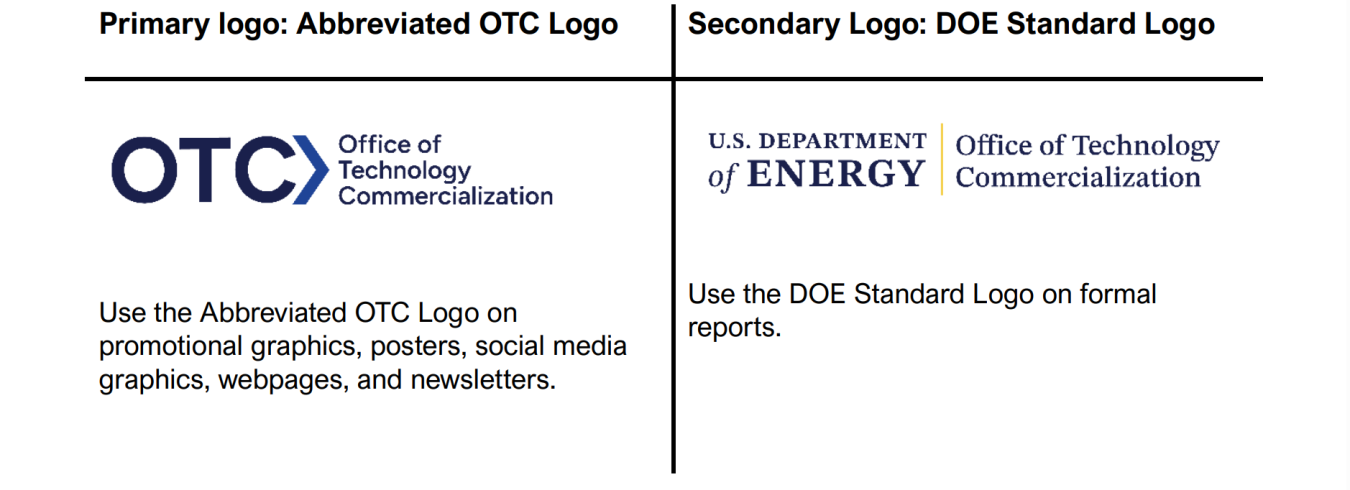
For accurate attribution purposes, please include OTC’s logo on graphics, webpages, and additional content that references your OTC supported project/activity. You should email the OTC communications team to request the high-resolution logo for your use. Our logos are available in blue and white fonts. Use the appropriate logo as indicated in the table below.
Use the following disclaimer wherever DOE branding, language, or logos appear:
“This work is supported by funding from the U.S. Department of Energy’s (DOE) Office of Technology Commercialization (OTC) and the OTC logos are used with permission from DOE. [Insert non-federal entity’s name] is not affiliated with the DOE or any of its programs, nor does DOE, the United States Government, or any agency thereof or its contractors or subcontractors endorse any specific product or service of [insert non-federal entity’s name].”
The disclaimer must be displayed in a reasonably prominent position with easily readable size on any such materials.
Awardees and partners are invited to share these OTC-approved flyers both internally and externally. Awardees and partners may also use these flyers for pre-approved language that can be used in partner content that references OTC.
FAQs
For DOE-funded projects, you may state that it is “supported by DOE funding” or “a DOE-funded project,” but avoid implying a formal co-management or endorsement.
For any press release or blog that mentions an OTC-funded project, please:
- Include the OTC boilerplate and OTC attribution.
- Share your draft with OTC 3–5 days before publication.
Contact Sean Sullivan, sean.sullivan@hq.doe.gov, to coordinate. OTC may provide a quote or amplify your announcement upon request.
We provide factual corrections or suggestions to ensure accurate representation, but not editorial control.
That’s fine—as long as your DOE-funded work is communicated clearly and separately, there’s no conflict.