



One of the enduring mysteries of the universe is the nature of matter—what are its basic constituents and how do they interact to form the elements and the properties we observe? The mission of the Nuclear Physics (NP) program is to solve this mystery by discovering, exploring, and understanding all forms of nuclear matter. Nuclear physicists seek to understand not just the familiar forms of matter we see around us, but also exotic forms such as those that existed in the first moments after the Big Bang and that exist today inside neutron stars. The aim is to understand why matter takes on the specific forms now observed in nature and how that knowledge can benefit society in the areas of commerce, medicine, and national security.
The quest to understand the properties of different forms of nuclear matter requires long-term support for both theoretical and experimental research efforts. Theoretical approaches are based on calculations of the interactions of quarks and gluons, which form protons and neutrons, using today’s most advanced computers. Other theoretical research models the forces between protons and neutrons and seeks to understand and predict the structure of nuclear matter. Experiments in nuclear physics use large accelerators that collide particles up to nearly the speed of light to study the structure of nuclei, nuclear astrophysics and to produce short-lived forms of matter for investigation. Nuclear physicists also use low-energy, precision nuclear experiments, many enabled by new quantum sensors, to search for a deeper understanding of fundamental symmetries and nuclear interactions. Comparing experimental observations and theoretical predictions tests the limits of our understanding of nuclear matter and suggests new directions for experimental and theoretical research.
Highly trained scientists who conceive, plan, execute, and interpret transformative experiments are at the heart of the NP program. NP supports these university and national laboratory scientists. We also support U.S. participation in select international collaborations and provide over 90 percent of the nuclear science research funding in the United States. The world-class scientific user facilities and associated instrumentation necessary to advance the U.S. nuclear science program are large and complex. NP supports four scientific user facilities: the Relativistic Heavy Ion Collider (RHIC) at Brookhaven National Laboratory (BNL); the Continuous Electron Beam Accelerator Facility (CEBAF) at Thomas Jefferson National Accelerator Facility (TJNAF); the Argonne Tandem Linac Accelerator System (ATLAS) at Argonne National Laboratory (ANL); and currently under construction the Facility for Rare Isotope Beams (FRIB) which will provide unprecedented opportunities to study the synthesis of the heavy elements in the cosmos. Each of these facilities has unique capabilities that advance NP’s scientific mission.
NP Areas
NP Science Highlights
-
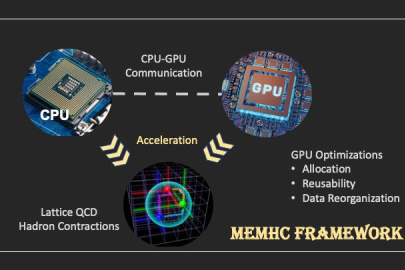 MemHC improves the efficiency of complex supercomputer physics calculations by optimizing memory management.
 -
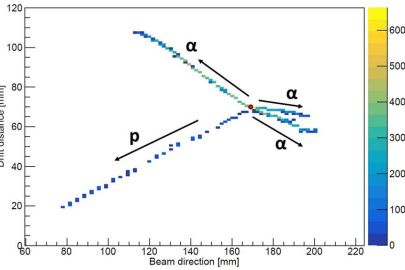 For the first time, scientists observe a new and rare decay mode where oxygen-13 breaks into three helium nuclei and a proton following beta decay.
 -
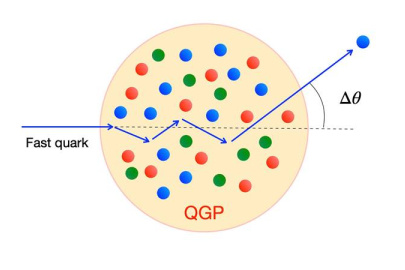 New calculations suggest that high energy quarks should scatter wider and faster in hot quark matter than can be accounted for by local interactions.
 -
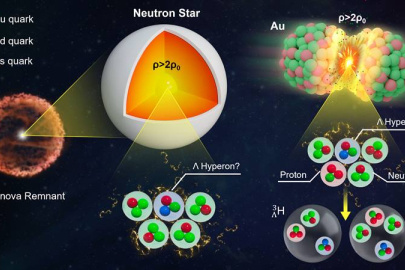 First measurements of how hypernuclei flow from particle collisions may give insight into the strange matter makeup and properties of neutron stars.
 -
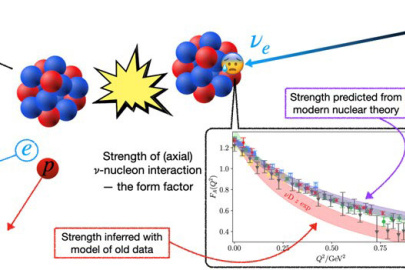 Modern nuclear theory predicts that nucleons appear less “squishy” when probed with neutrinos than was previously inferred from experimental data.
 -
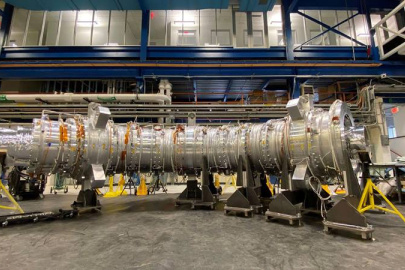 Nuclear “filters” will aid in searches for new-physics events occurring with odds of one in 100 quadrillion.
 -
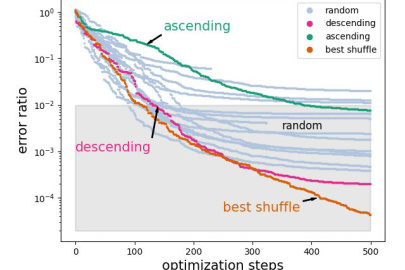 Researchers worked out how to efficiently prepare wave functions for the lithium-6 nuclear ground state and implemented those on quantum hardware.
 -
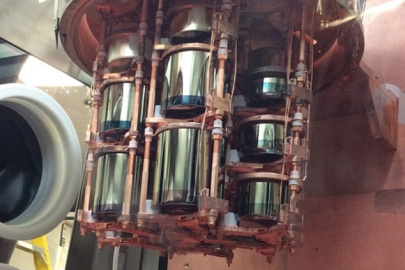 If observed, neutrinoless double-β decay would have changed our view of the Universe.
 -
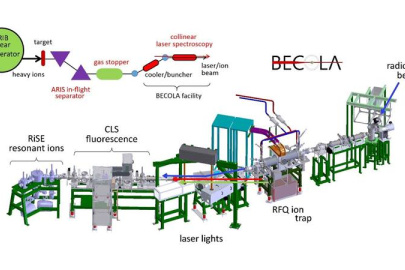 By reanalyzing the distribution of active protons in nuclei, researchers found a possible solution to a particle physics puzzle involving quarks.
 -
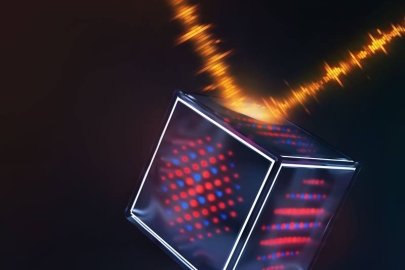 For the first time, the error correction process significantly enhances the lifetime of quantum information.
NP Program News
NP Research Resources
Contact Information
Nuclear Physics
U.S. Department of Energy
Germantown Building
1000 Independence Avenue., SW
Washington, DC 20585
P: (301) 903 - 3613
F: (301) 903 - 3833
E: sc.np@science.doe.gov