The South Pole Telescope has gathered new data on cosmic flares from white dwarf stars, demonstrating its unique capabilities.
January 22, 2026 Estimated Read Time min
Shannon Brescher Shea

Shannon Brescher Shea (shannon.shea@science.doe.gov) is the social media manager and senior writer/editor in the Office of Science’s Office of Communications and Public Affairs. She writes and curates content for the Office of Science’s Twitter and LinkedIn accounts as well as contributes to the Department of Energy’s overall social media accounts. In addition, she writes and edits feature stories covering the Office of Science’s discovery research and manages the Science Public Outreach Community (SPOC). Previously, she was a communications specialist in the Vehicle Technologies Office in the Office of Energy Efficiency and Renewable Energy. She began at the Energy Department in 2008 as a Presidential Management Fellow. In her free time, she enjoys bicycling, gardening, writing, volunteering, and parenting two awesome kids.
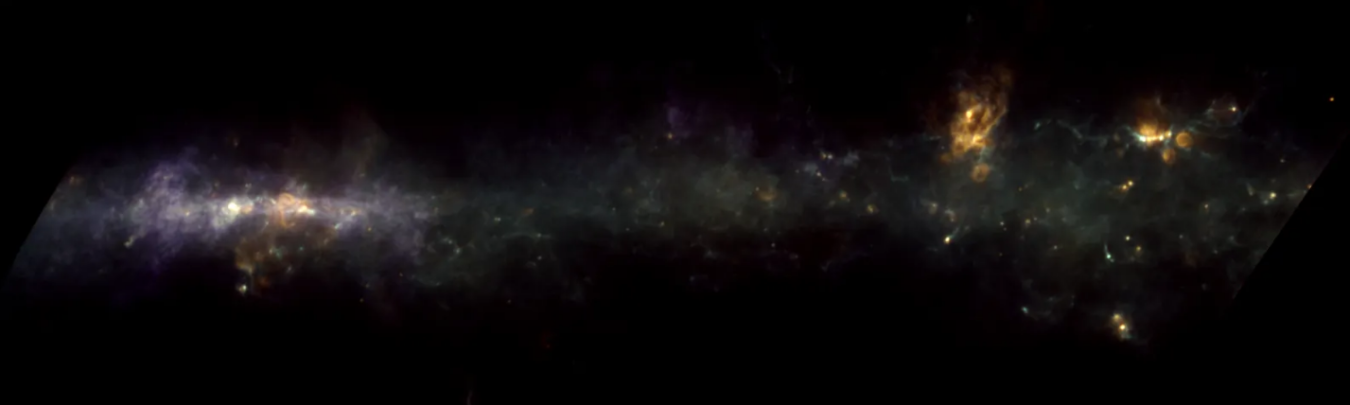
The remains of a dead star glows white despite using up its nuclear fuel. A second star revolves around that white dwarf. Each star of the binary moves in tandem with the other. The dwarf’s gravity wrenches gas off its companion that creates a swirling disk. This cosmic tug-of-war in the Milky Way’s Galactic Plane created a brief, strong flare of energy. That energy then traveled light years across the galaxy to Earth.
Among Antarctica’s endless ice fields, the South Pole Telescope captured this brief cosmic outburst. Then, within the span of two years, it captured a similar one. These flares are helping astrophysicists better understand the capabilities of this telescope and what insights it may provide in the future.
Greetings from the South Pole
Located at the NSF Amundsen-Scott South Pole Station, the South Pole Telescope (SPT) detects light with wavelengths around a millimeter. (This range is in contrast to radio waves, visible light, or X-ray light. There are other telescopes designed to measure each of those.) The SPT is supported by the National Science Foundation and the Department of Energy’s Office of Science. It gathers information about the ancient and current universe. The location’s stable, dry atmosphere allows scientists to capture data with minimal interference.
Most of the time, the SPT scans the sky to gather data on the microwave cosmic background. This phenomenon is ancient radiation that extended through the universe not long after the Big Bang. Sometimes called the universe’s baby pictures, it provides insights into the origins of the universe.
Scanning the sky
However, the survey that caught these flares of energy – called the SPT-3G Galactic Plane Survey – was different. The Galactic Plane is the plane of the Milky Way that has most of its mass. All sorts of astronomical objects crowd this area, from baby stars to giant dust clouds. The SPT doesn’t usually take observations from here because these objects would interfere with observing the cosmic microwave background.
In contrast, a team of scientists designed the Galactic Plane survey to understand how the SPT could provide new insights and track changes in the sky over time. The team was led by researchers from the University of Illinois supported by NSF and included scientists from multiple DOE National Laboratories. Running the telescope over multiple seasons, the team took 500 hours of observations. This resulted in hundreds of observations of the same areas of the sky. This method allowed them to notice changes from day to day that often indicate short-lived transient events. It also enabled them to filter out irrelevant information. Along with the normal challenges, they had to filter out interference from weather balloons launched from other parts of the South Pole station.
Spotting transient events
In the two years of data, the team spotted two unusual flares of energy. It was the first time that this type of survey had located this type of flare.
In the past, most transient events were spotted by telescopes that could detect optical light waves or X-rays. (The NSF-DOE Vera C. Rubin Observatory is an optical telescope that takes massive photographs; the Chandra X-ray Observatory captures data on X-rays.) It’s only recently that millimeter telescopes like the SPT have had the technology to do so. While the SPT had gathered data on more than 100 transient events before, it had never done so within the Galactic Plane.
In addition, telescopes often spot transient events because scientists already have an idea of where to look. In contrast, this survey was simply scanning the sky for items of interest. The fact that it was able to pick out these two flares demonstrates its unique capabilities.
Flares from far away
The flares showed up on the data as sudden, short-lived bursts of energy. Each of them lasted about a day – an incredibly short period in the vast history of the universe. From the data, scientists determined that the sources of the flares were most likely accreting white dwarf stars.
White dwarfs are the cores left over from stars that have used up their fuel and died. They are sometimes found in tandem with companion stars. In this pair, the white dwarf’s gravity can suck gases off the companion star. These gases gather into a disk surrounding the white dwarf. As the gases build up, the disk heats up and produces unusual signals. These signals were what the SPT captured.
As promising as these results are, they’re only the first results from the SPT-3G Galactic Plane Survey. The team plans to continue observations for one month each year until the end of 2028.
These results suggest that the SPT could be useful for studying how these binary stars change over time as well as studying other transient events. The Galactic Plane is dense with cosmic objects of interest, so there will be plenty to study.
These findings also point forward to the beginning of the Legacy Survey of Space and Time. The NSF-DOE Rubin Observatory will be running this survey starting later this year. Once started, it will scan the Southern Sky for a decade. As the Rubin Observatory takes images of visible wavelengths, the two cosmic surveys will complement each other.
This first compilation of data from the Galactic Plane has already revealed quite a bit, but there is so much more to find. As the SPT keeps sweeping the sky for answers, scientists are likely to find things that they didn’t even know to look for.
The South Pole Telescope is primarily funded by the U.S. National Science Foundation (NSF) and the Department of Energy and is operated by a collaboration led by the University of Chicago.