



Join the USDA and DOE for their virtual listening sessions where they'll hear stakeholders speak on benefits and challenges of clean energy siting on agricultural lands and in rural communities.
State and Local Solution Center
December 11, 2023 minute read time
The U.S. Department of Agriculture (USDA), in collaboration with the U.S. Department of Energy (DOE), hosted a series of virtual listening sessions to hear perspectives on the benefits and challenges of the increased levels of clean energy projects being sited on agricultural lands and in rural communities.
USDA and DOE seek feedback directly from a diverse set of stakeholders about what the agencies can do through their leadership, program guidance, or research and information sharing to encourage positive clean energy siting outcomes that benefit farmers, rural Americans, the renewable energy industry, and others.
The agencies hosted four listening sessions:
- Government Permitting and Policy Representatives on January 12.
- Agricultural Producers on January 16.
- All Stakeholders and Members of the Public on January 16.
- Rural Electric Coops and Clean Energy Developers on January 17.
Clean energy deployment is key to addressing climate change, domestic energy security, and rural economic development. Clean energy can offer significant economic opportunities to farmers and rural Americans. For example, leasing non-productive land for clean energy production can be an important source of income for farmers facing drought and other extreme weather events. There are also opportunities to co-locate clean energy on agricultural land and continue farming it.
However, state and local siting restrictions can prevent communities from accessing the benefits of clean energy deployment. These siting restrictions often arise out of concern over farmland loss, but the main driver of farmland loss is suburban expansion. There is no one-size-fits-all solution or best practice to siting renewable energy projects like wind and solar because each community that hosts a project is unique. DOE and USDA are interested in better understanding the impact of renewable energy development on these communities and public sentiment about these projects.
The listening sessions, facilitated by Rural Utilities Service Administrator Andrew Berke and DOE Acting Deputy Assistant Secretary for Renewable Energy Dr. Becca Jones-Albertus, were attended by over 800 people representing all 50 states. Sessions were held for agricultural producers, energy enterprises, state and local government officials, and the general public.
The key themes expressed by stakeholders in the listening sessions included:
- While rural communities generally support the transition to renewable energy, a range of stakeholders, including local government officials, farmers, cooperatives, and members of the public, expressed concern about the impacts of renewable energy development on rural communities. Many stakeholders expressed their support for renewable energy while also raising concerns about ecological, cultural, and economic values. These concerns include loss of prime farmland, increased farmland rental rates (particularly for tenant farmers), loss of rented acres when absentee landowners lease to renewables projects, and lack of local input on siting decisions. Some stakeholders requested that solar development be prioritized on rooftops and non-prime farmland; others expressed concerns that avoiding the use of farmland will significantly delay the clean energy transition; and others conveyed concerns that large-scale renewable energy development is exacerbating other types of farmland conversion and causing adverse environmental impacts.
- Farmers adopting distributed generation and those who have leased their lands for large-scale renewable energy infrastructure expressed positive experiences, such as improved financial stability, which allows their family farms to survive and even expand. Several farmers supported the right to make their own decisions about farming and energy generation on their lands. Through revenue created by renewable energy projects, some farmers were able to put their farms on more solid financial footing and invest in new opportunities. Their experiences demonstrate the benefits of integrating clean energy into agricultural operations.
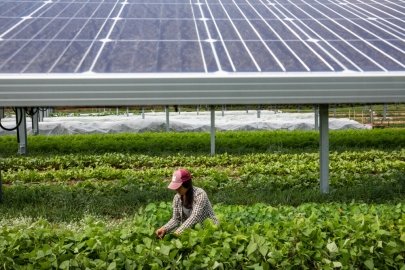
- Dual-use agrivoltaics—which combines solar and agriculture—is a promising practice. In all sessions, speakers discussed the possibility of siting energy infrastructure on disturbed lands (e.g., brownfields, mine lands), developed areas (e.g., solar parking lots), marginal farmland, or land with dual uses (e.g., agrivoltaics, canal solar). Agrivoltaics received a lot of support. Some solar developers believe it is ready for widespread adoption, but most have no experience developing dual-use systems. The primary barrier to identify widespread adoption of agrivoltaics is the increased cost associated with raising solar panels to enable farming and livestock grazing. All stakeholders agreed that it is an avenue worthy of further research and investment, and there was broad support for DOE and USDA to continue collaborating on innovative solutions.
- Community members welcome tangible benefits of renewable energy development, but those benefits are not always clearly identified. Farmers and residents of farm communities expressed a desire for rural residents to benefit from renewable energy development. Speakers cited examples of community improvements resulting from new tax revenues, including improvements in schools and roads. However, some stakeholders said it was not always clear what the benefits were or how to obtain them. A range of stakeholders noted that making benefits known to the community requires robust engagement between developers, local authorities, and community members.
- Rural community members expressed concern about the potential loss of local authority to permit large scale renewable energy facilities. Farmers, local government officials, and members of the public emphasized the need for land use decisions to be made at the local level and expressed concern about losing that authority if permitting for renewable energy facilities moves to the state level. Many local officials expressed interest in getting more information about renewable energy so the best decisions could be made for their rural communities.
- Stakeholders expressed broad support for USDA and DOE to provide objective information and tools to inform decisions about large-scale renewable energy permitting. Participants spoke about the need for resources on both physical (e.g., environmental and human health impacts) and economic (e.g., negotiating community benefits agreements) impacts of renewable energy development. Speakers identified model ordinances, planning tools, agency definitions, conservation program guides, and analytical research products on land use issues as potentially useful resources. Several speakers noted that these tools may be particularly needed by disadvantaged groups, including Tribes, and under-resourced state and local government officials.
- While rural communities generally support the transition to renewable energy, a range of stakeholders, including local government officials, farmers, cooperatives, and members of the public, expressed concern about the impacts of renewable energy development on rural communities. Many stakeholders expressed their support for renewable energy while also raising concerns about ecological, cultural, and economic values. These concerns include loss of prime farmland, increased farmland rental rates (particularly for tenant farmers), loss of rented acres when absentee landowners lease to renewables projects, and lack of local input on siting decisions. Some stakeholders requested that solar development be prioritized on rooftops and non-prime farmland; others expressed concerns that avoiding the use of farmland will significantly delay the clean energy transition; and others conveyed concerns that large-scale renewable energy development is exacerbating other types of farmland conversion and causing adverse environmental impacts.
Access solar energy resources for farmers and learn more about solar energy and agriculture co-location.

It is estimated that solar and wind installations could require up to 0.5 percent of all U.S. land by 2035, which could include up to 1 percent of U.S. cropland. This is comparable to all U.S. land currently used for coal mining and is less than the acreage used today for railroads or ethanol production. The majority of solar arrays covers less than 20 acres, but the largest solar arrays are increasing in size and can be thousands of acres. Although about half of all renewable energy development occurs on cultivated cropland, in 95 percent of counties that host solar arrays, these installations take up less than one quarter of one percent (0.25 percent) of the land.
Roughly 11 million acres of U.S. farmland was converted out of agricultural production between 2001 and 2016. Less than 1 percent of the loss was due to solar development; the remainder is mostly by driven by urban and suburban expansion. Nearly 40 percent of U.S. farmland is rented, and rental rates are rising – predominantly due to suburban expansion. Rental cost increases generally are not driven by renewable energy development, though higher farmland rental costs do heighten concerns about land-use decisions in farming communities and large individual projects could impact the market in some areas.
Federally funded projects—including wind and solar projects—must be evaluated for significant impact on farmland and alternative sites to minimize the use of federal funds on unnecessary conversion of farmland to nonagricultural uses must be considered. This is legally required under the Farmland Protection Policy Act and guided by the USDA Natural Resource Conservation Service as part of the environmental review process. In 2022, 32 federal agencies evaluated projects that combined, could potentially reach roughly one hundredth of one percent (0.014 percent) of farmland, and approximately three thousands of one percent (0.003 percent) of prime or unique farmland. That annual scale is comparable to findings from the last 15 years.
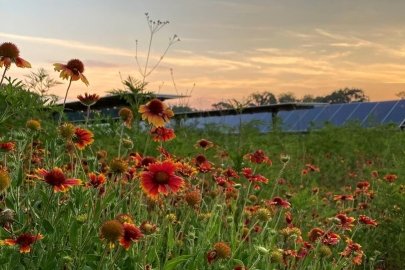
Yes, there are many ways to integrate farming and renewable energy on the same property. Marginal farmland can be used for solar panels. Agricultural producers can almost always co-locate their operations with wind generation. Agricultural producers can often co-locate crops or grazing with solar generation (a practice called “agrivoltaics”). While agrivoltaics does not currently work for all farm operations, there are more than 150 agrivoltaics projects across the country and research and interest is rapidly increasing. USDA and DOE, for example, are currently conducting research and development in agrivoltaics. More information about dual use and connecting with collaborators can be found at the DOE-supported AgriSolar Clearinghouse.
- Renewable energy is now the least-cost source of new electricity in the U.S.
- Farmers and rural businesses that install on-site renewable energy as participants in USDA’s Rural Energy for America Program saved an average of $15,400 in annual electricity costs.
- Farmers who lease sections of land for renewable energy are seeing long-term, stable revenue streams. A recent survey of farmers who lease land for wind installations found the average payment is $8,300 a year.
- Community benefit agreements are increasingly part of renewable energy projects and can be used to support community infrastructure needs such as schools and hospitals as well as the development of local agricultural assets such as building a local grain silo or a processing plant.
- Approximately 90 percent of renewable energy siting is projected to occur in rural communities by 2050. This could result in up to 1.5 million good-paying solar jobs by 2035 and up to 600,000 wind jobs by 2050.
Health and safety risks of renewable energy to host communities are minimal and can generally be addressed with appropriate permitting, zoning guidelines, and project design. Concerns about health risks are often covered on social media, which can create a false perception of risk; however, the scientific evidence is clear that renewable energy is safe for host communities and reduces pollution. Renewables like solar and wind technologies dramatically reduce greenhouse gas emissions, air pollutant emissions, and water pollution. Less pollution actually means healthier communities and fewer chronic deadly diseases for children.
Additional Resources
These reports were used in assembling the FAQs above and are useful sources of information on current and future renewable energy deployment.
Visions and Scenarios
- Solar Futures Study. U.S. Department of Energy, 2021.
- Wind Vision. A New Era for Wind Power in the United States. U.S. Department of Energy and National Renewable Energy Laboratory, 2015.
Market and Cost Reports
- Land-Based Wind Market Report: 2023 Edition. U.S. Department of Energy, 2023.
- 2020 Cost of Wind Energy Review. National Renewable Energy Laboratory, 2022.
- Utility-Scale Solar. Lawrence Berkeley National Laboratory, 2023.
- U.S. Solar Photovoltaic System and Energy Storage Cost Benchmarks. National Renewable Energy Laboratory, annual.
Jobs Reports
- Rural America at a Glance, 2023 Edition. U.S. Department of Agriculture, Economic Research Service.
- United States Energy & Employment Report. U.S. Department of Energy, 2023.
Mapping and Land-Use Resources
- Farmland Protection Policy Act Annual Report. National Resources Conservation Service, 2023.
- U.S. Large-Scale Solar Photovoltaic Database. U.S. Geological Survey, 2023.
- U.S. Wind Turbine Database. U.S. Geological Survey, 2023.
- National Land Cover Database. U.S. Geological Survey, 2021.
End-of-Life Information
- SETO Photovoltaics End-of-Life Action Plan. U.S. Department of Energy, 2023.
- Wind Energy End-of-Service Guide. U.S. Department of Energy, 2023.
These resources have been developed by the U.S. Department of Energy to help inform decision making for local communities.
- AgriSolar Clearinghouse – AgriSolar Clearinghouse is a nationwide hub funded by DOE and developed by the National Center for Appropriate Technology to connect businesses, landowners, and researchers with trusted resources to support the growth of co-located solar and sustainable agriculture, also known as agrivoltaic development.
- InSPIRE: The 5 C’s of Agrivoltaics – This resource from the National Renewable Energy Laboratory summarizes technical and non-technical insights from agrivoltaic field research sites from 2015-2021 to support i) appropriate deployment of agrivoltaic projects; ii) more successful research on agrivoltaics; and iii) more effective partnerships on agrivoltaic projects.
- Land-Based Wind Energy Economic Development Guide – This guide from the DOE Wind Energy Technologies Office (WETO) provides an overview of the local economic impacts of developing, constructing, and operating land-based, utility-scale wind farms.
- Land-Based Wind Energy Guidelines – These voluntary Guidelines from the U.S. Fish and Wildlife Service provide a structured, scientific process for addressing wildlife conservation concerns at all stages of land-based wind energy development. They also promote effective communication among wind energy developers and governmental and tribal entities.
- Local Government Guide for Solar Deployment – The U.S. DOE Solar Energy Technologies Office (SETO) designed this guide to assist local government officials and stakeholders in boosting solar deployment.
- Photovoltaic Stormwater Management Research and Testing (PV-SMaRT) – From NREL, the Photovoltaic Stormwater Management Research and Testing (PV-SMaRT) project is developing and disseminating research-based, PV-specific tools and best practices for stormwater management and water quality at ground-mounted PV sites.
- Pollinator Habitat Aligned with Solar Energy (PHASE) – This four-year project, funded by SETO, brings together leading researchers and large-scale solar developers to investigate the ecological and economic benefits as well as performance impacts of co-located pollinator plantings at large, utility-scale photovoltaic facilities.
- Solar@Scale – This project, funded by DOE and run by the International City/County Management Association, aims to help cities, towns, counties, and special districts understand and realize the potential benefits of large-scale solar development.
- WINDExchange – WINDExchange is a platform that shares the best available science and fact-based wind energy information to enable U.S. communities to: make wind development decisions; understand siting, permitting, and installation processes; weigh the costs and benefits of wind energy; and collaborate or partner with many organizations.
- Wind Energy Community Benefits Guide – This guide is intended to serve as an introduction to the concept of community benefits for decision-makers, local stakeholders, and developers as they seek to identify what community benefits mean for them.