



Although scientists conceived of Weyl fermions in 3D, researchers have observed their 2D equivalent in a monolayer film.
December 4, 2025 Estimated Read Time min
The Science
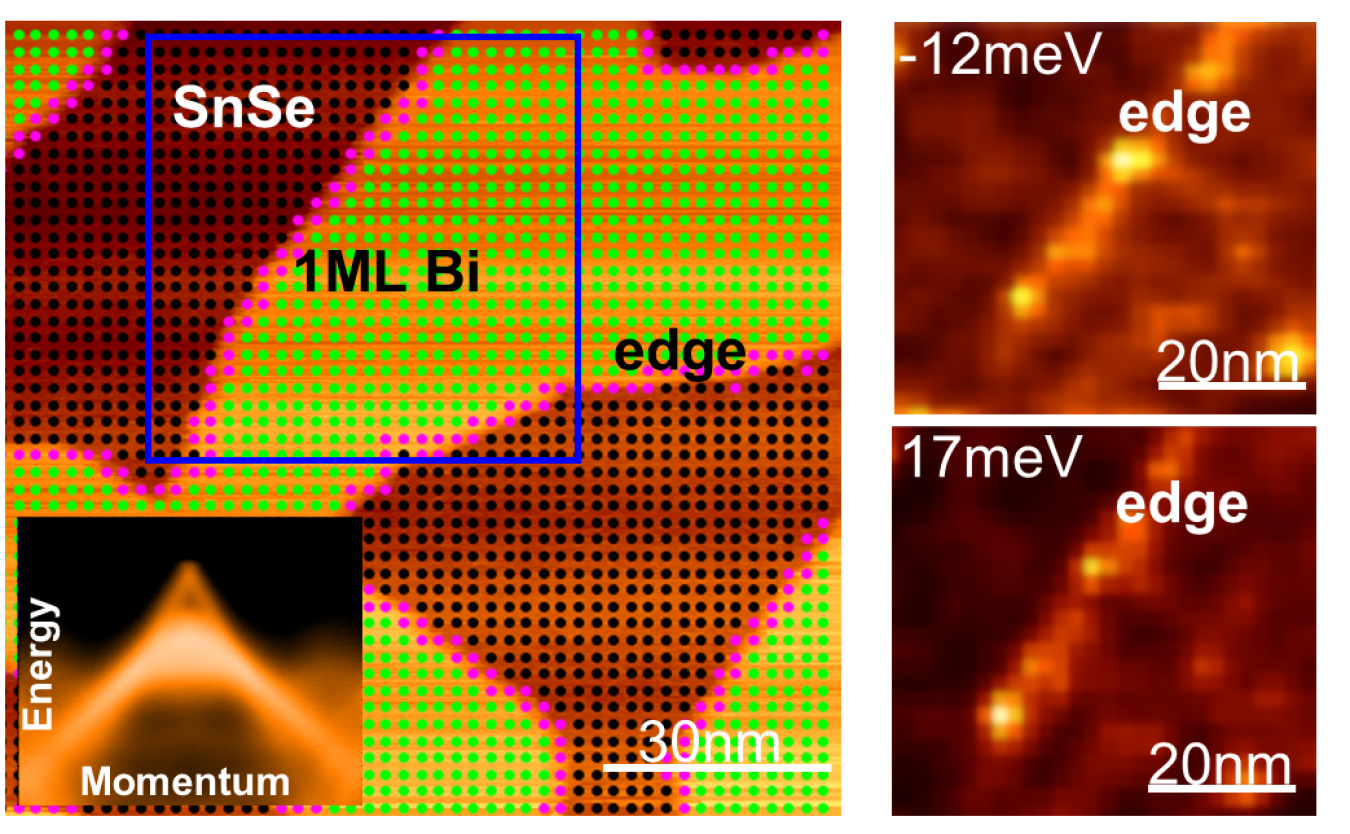
Weyl fermions are unusual particles. They are like electrons but don’t have any mass. Weyl fermions move very fast and possess chirality. Chirality means that their spin points either in the same direction as the particle’s motion (right-handed) or in the opposite direction (left-handed). Mathematician and physicist Hermann Weyl theoretically predicted Weyl fermions in 1929. In 2015, researchers detected them in the material tantalum arsenide (TaAs). Scientists later also found them in several other 3D materials named Weyl semimetals. With the growing interest in 2D materials, scientists have tried to figure out if Weyl fermions can exist in two dimensional systems as well. In this work, researchers found that a single layer of bismuth atoms (bismuthene) fabricated on a tin-selenium (SnSe) substrate can host the highly sought 2D Weyl fermions.
The Impact
In Weyl semimetals, the presence of magnetic or electric fields causes an imbalance between right- and left-handed charges. This imbalance leads to unusual optical and electrical behavior. For example, in certain situations, the electrical resistance (how much an object opposes the flow of electric current) might decrease when it would normally increase. 2D versions of Weyl semimetals exhibit additional unusual properties. In particular, the edges of a 2D Weyl semimetal behave like channels in which current flows without dissipating energy. If researchers can integrate 2D Weyl semimetals into next-generation microelectronics, they could build computer chips that use very little energy. These computers would have much greater power than current ones. Devices made of 2D Weyl semimetals could also be used for quantum computation.
Summary
A 2D Weyl semimetal is a condensed matter system where low-energy electronic excitations mimic massless Weyl fermions in two dimensions. It can be viewed as a spin-polarized analog of graphene. The 2D Weyl semimetal inherits the exceptional electronic properties of graphene. It also exhibits unique topological features associated with 2D Weyl fermions, such as chiral charge carries and a novel type of boundary mode known as Fermi string edge states. The Fermi string edge states are a group of electrons tightly bound to the edge of the 2D system, with properties significantly altered by their connection to the Weyl fermion bulk states. The distinctive electronic and spin structures of 2D Weyl semimetals, along with their Fermi string edge states, make them an ideal platform for developing energy-efficient and fast-response electronics and spintronics. Researchers experimentally realized a 2D Weyl semimetal in an intrinsic 2D system – bismuthene. This was a single atomic layer of bismuth epitaxially fabricated on a SnSe substrate. In this system, researchers observed for the first time the Fermi string edge states. These results open new avenues for exploring the intriguing quantum properties of Weyl fermions in reduced dimensionality. Part of the research was conducted at the Center for Nanophase Materials Sciences (CNMS), which is a U.S. Department of Energy (DOE), Office of Science User Facility at Oak Ridge National Laboratory.
Contact
Guang Bian
Department of Physics and Astronomy, University of Missouri, Columbia, MO
biang@missouri.edu
Funding
Research was primarily supported by DOE Office of Science, Office of Basic Energy Sciences, Division of Materials Science and Engineering. Additional sources of support include National Quantum Information Science Research Centers and Quantum Science Center; National Cheng Kung University, Taiwan; National Center for Theoretical Sciences, Taiwan; and Academia Sinica, Taiwan.
Publications
Lu Q., et al., Realization of a two-dimensional Weyl semimetal and topological Fermi strings. Nature Communications 15, 6001 (2024). [DOI: 10.1038/s41467-024-50329-6]