



Deploying an Energy Management Information System (EMIS) has the potential to produce substantial value and enhance existing energy management processes for federal agencies. Benefits include direct energy and cost savings as well as indirect benefits realized through data-driven operational improvements. Additionally, an EMIS provides an unmatched toolset for supporting compliance with federal laws associated with energy reduction, onsite renewable energy deployment, and metering.
Direct Value
EMIS delivers direct value to agencies by reducing energy and demand costs and preventing building performance from drifting over time. While many agencies already utilize various free software tools (such as the ENERGY STAR® Portfolio Manager for benchmarking), commercially available EMIS tools offer agencies enhanced benefits that justify the investment required to achieve these savings. In 2020, Smart Energy Analytics Campaign participants who implemented automated fault detection and diagnostics achieved median annual savings of $0.27 per square foot, compared to deployment and recurring costs of $0.05 and $0.07 per square foot, respectively.
Many federal sector facilities have already made substantial improvements with traditional energy conservation measures, but are now experiencing diminishing returns from further investment.
To meet additional reduction goals, EMIS can be a source of untapped opportunities for energy conservation measures such as failed heating, ventilation, and air conditioning (HVAC) components, air handling unit scheduling problems, and control sequences that need to be optimized.
EMIS can also help operators analyze and understand energy demand profiles, create demand reduction strategies, quantify and verify demand changes, and allow the automation of those strategies through supervisory control. Utility rebates and incentives for installing both an EMIS and the energy conservation measures identified by the EMIS can further shorten the payback period for deployment.
A variety of external factors typically affect a federal agency’s monthly energy usage and associated cost, such as variable energy prices, changes in building operation or space utilization, and changes in weather patterns from year to year. These factors can make the measurement and verification of energy savings a time-consuming and complicated endeavor.
As energy conservation and demand reduction measures are implemented, EMIS can support measurement and verification via weather-normalized regression analysis and automated processing and weather normalization of 15-minute interval data.
Some EMIS platforms can also provide automated measurement and verification for individual energy conservation measures.
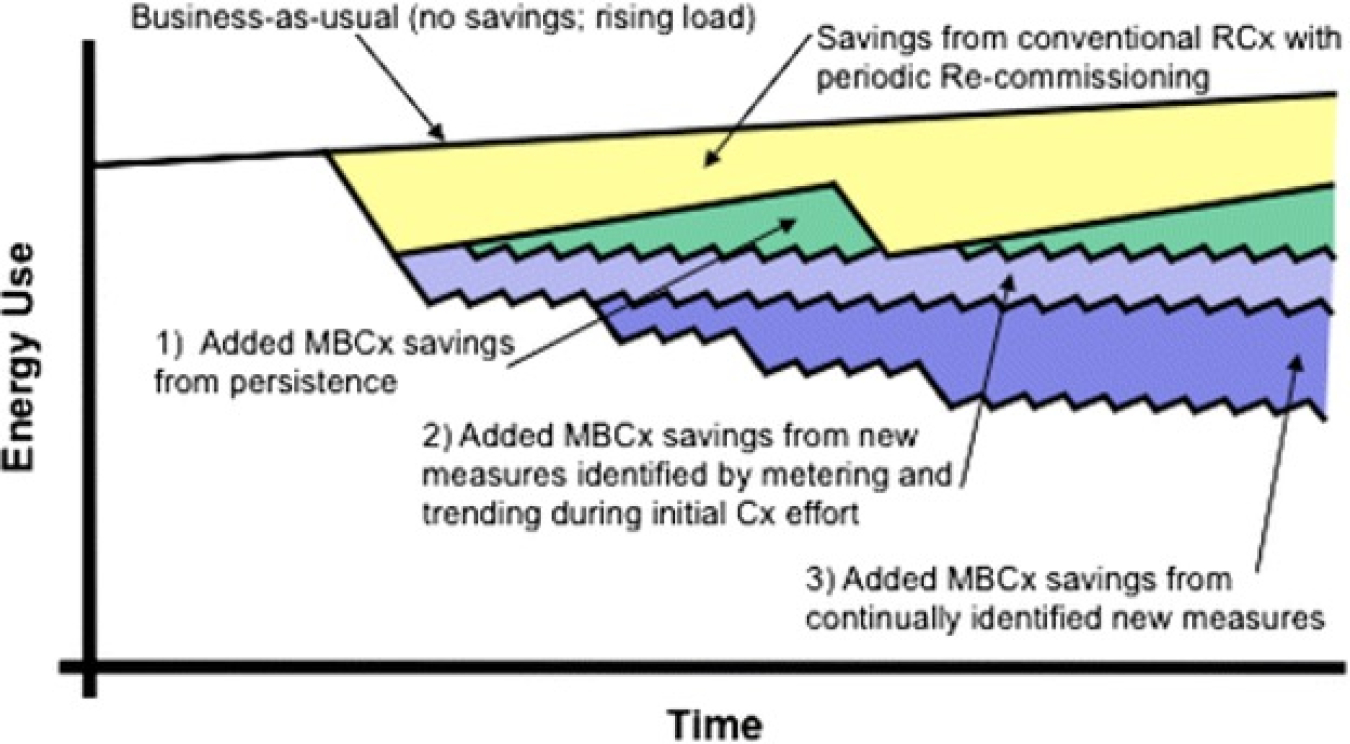 As compared to traditional commissioning and recommissioning, an MBCx EMIS system delivers additional savings over time.Image Credit: Lawrence Berkeley National Laboratory
Operators of commercial buildings strive for ever-increasing levels of energy efficiency and operational performance. To help meet these goals, design engineers are specifying increasingly complex and sophisticated HVAC systems and BAS, while integrating advanced metering, smart lighting controls, internet-of-things devices, electric vehicle charging stations, on-site distributed generation systems, and electrical or thermal energy storage.
Over time, this increased complexity also has the tendency to broaden the gap between design intent and the in-situ performance of commercial buildings as facility operations staff have difficulty keeping up with the operations and maintenance requirements of each facility.
As facility operational performance declines over time, energy use increases and interior thermal comfort can start to degrade or drift. Rather than commissioning and periodic recommissioning, EMIS allow facility operators to address this problem continuously by collecting and using data to ensure building systems operate correctly, often in support of a monitoring-based commissioning (MBCx) program, enhanced operations and maintenance programs, and 15-minute-interval data anomaly detection.
Indirect Value
The data visualization and analytics capabilities of EMIS can add value for an agency's core mission and stakeholders. This added value can often outweigh the direct impact of EMIS. Indirect benefits include full facility, campus, and portfolio visibility; mitigating challenges with AMI and BAS; compliance with applicable federal laws and regulations; and supporting the Department of Energy’s 50001 Ready program.
Federal energy management presents a number of challenges in centralizing data in one place to provide situational awareness of operations and maintenance and energy management. With most federal buildings located on campuses, energy is purchased, reported, and managed on a total installation basis rather by individual building.
In many instances, electricity, natural gas, and water are tracked by utility-owned revenue meters at the campus level, typically with some additional deployment of individual building meters. In some instances, electricity is billed at the campus level with natural gas metered by the utility at the building level. Federal campuses typically have central chilled water and steam or hot water plants that serve multiple buildings.
Further, a significant portion of the electricity consumed on a federal campus is typically consumed by lighting and equipment external to buildings. EMIS presents a significant opportunity for federal agencies to integrate data from utility invoices, 15-minute AMI data, and other relevant data sources into one common platform and enable a host of advanced energy management capabilities outlined in proceeding sections.
Some federal meter data systems and BAS were designed to be used by utilities rather than facility managers. These systems may not have embedded capabilities and functionality to fully utilize meter data to model predicted building load profiles, benchmark building energy usage, compare usage across facility types, and automatically track weather-normalized energy savings. Other AMI implementations suffer frequent losses of meter data due to issues with data dropouts and network connectivity. Many federal meter data systems use simple 15-minute load profile graphs that have no built-in automated features that would allow for useful, automated analysis of multiple buildings on a single site.
The federal sector can also face BAS deployment challenges. Many federal campuses have multiple BAS vendors, and there can be numerous equipment-level controllers that are not fully integrated into the BAS, multiple vintages of BAS operating systems, and varying levels of functionality. EMIS can be used to centralize BAS functionality to a single user interface, store data from disparate BAS systems into a common database, perform analytics across disparate BAS systems, and implement supervisory control actions across the portfolio from a single EMIS.
EMIS deployment and operation have the potential to significantly reduce federal sector energy usage by addressing the issues of both campus and individual building-level energy usage and reporting, AMI analytics, and BAS centralization and analysis.
Supporting Compliance with Federal Laws and Regulations
EMIS can serve as a critical asset in meeting federal mandates. Since the passage of the Energy Policy Act of 2005, a series of federal facility energy management laws and executive orders have been issued that affect federal agency portfolios regarding how federal energy usage is measured, managed, and reported. Federal agencies are required by these laws and executive orders to meet various Energy Independence and Security Act of 2007 and Energy Act of 2020 requirements for:
- Acquisitions and electronics stewardship
- Facility energy efficiency
- Fleet management
- Greenhouse gases
- High performance sustainable buildings
- Performance contracting
- Performance tracking and reporting
- Renewable energy and electricity
- Waste management
- Energy and water metering.
EMIS Capabilities
A comprehensive, agency-wide EMIS directly and indirectly supports a number of federal mandates and executive orders. The following table shows vertical mapping of federal mandates to EMIS capabilities.
| Category | Centralize, Normalize, Visualize Data | Utility Bill Management | Interval Meter Analytics | Measurement & Verification (M&V) | Automated Fault Detection and Diagnostics (AFDD) | Supervisory Control | O&M Optimization |
|---|---|---|---|---|---|---|---|
| Energy Reduction | X | X | X | X | X | X | X |
| Data Center Management | X | X | X | X | X | X | X |
| Benchmarking of Federal Facilities | X | X | X | X | |||
| Energy and Water Evaluations | X | X | X | X | X | X | |
| Follow Up on Implemented Measures | X | X | X | X | X | X | |
| Recommissioning and Retro-Commissioning | X | X | X | X | X | X | |
| Web Based Certification | X | X | X | X | |||
| Metering Requirements | X | X | X | X | |||
| Annual Energy Report | X | X | X | X | |||
| Renewable Energy Report | X | X | |||||
| Waste Management | X | X | X | ||||
| Water Management | X | X | X | X |
An EMIS that integrates AMI also fulfills ongoing metering objectives of the Energy Act of 2020, which requires a comprehensive energy and water evaluation and recommissioning or retro-commissioning for approximately 25% of covered facilities once every four years, unless the facility is under ongoing commissioning, recommissioning, or retro-commissioning. An EMIS with automated fault detection and diagnostics would meet the requirements of the exemption, significantly reducing costs of compliance.
While EMIS provide a process for data-informed decisions and operations, a site can also benefit from coupling an EMIS to an energy management system (EnMS) as defined in International Organization for Standardization (ISO) Standard 50001. The EnMS codifies administrative and operational practices around the understanding and management of energy. These include proper staffing and training, developing energy improvement lists, and coordinating with energy and operations staff and management to implement operational and project-based improvements. ISO 50001 is a voluntary international standard that serves as a best practice for establishing, implementing, maintaining, and improving an EnMS. The Department of Energy has developed the 50001 Ready program as a self-certification path to implementing ISO 50001 that provides no-cost tools and resources as well as recognition to U.S. sites that meet 50001 Ready requirements.
The 50001 Ready framework requires agencies to continually improve their energy management based on the plan-do-check-act process. A functioning EMIS can be used to help identify and prioritize energy efficiency measures during planning. In addition, as ECMs are implemented, the EMIS can be used to verify savings. Finally, EMIS can be used to act on additional energy efficiency opportunities.
One of the primary components of the 50001 Ready program is outlining the elements of the site’s EnMS process. EnMS, as defined per ISO 50001, combines elements of site energy policy, energy management action plans, energy data collection and benchmarking, and reporting to help federal agencies comply with federal energy reduction goals. EMIS software products are not required per ISO 50001, but can serve as a critical element to complement an EnMS and help an agency both achieve ISO 50001 and track progress over time. While the EnMS brings the cultural and organizational aspects that will lead to proven energy performance improvements (mostly through no- and low-cost actions), a companion EMIS can bring improved data and operational controls to offer even greater energy improvements.
EMIS deployment can also support initiatives such as sustainability, resilience, retuning, distributed energy resources, cybersecurity, occupant engagement, operational technology, operations and maintenance, and supply chain management. Finally, EMIS deployments can provide value to almost all types of federal facilities, including high energy users like laboratories and data centers.
The Federal Information Security Modernization Act (FISMA) requires federal agencies to implement a security program to manage organizational risk and assure the agency-wide security of information and information systems, including agency-owned assets as well as those provided or managed by another agency or contractor. FISMA applies to federal facilities with pre-existing equipment, such as AMI or BAS. For agencies that fall under this requirement, EMIS scope systems that may be integrated into the EMIS and related assets that collect, process, store, maintain, use, share, disseminate, and dispose of information should comply with information security requirements.