



A trio of new and improved filters in a key operating facility at the Savannah River Site has optimized efficiency and accelerated production of the radioactive waste tank cleanup mission — marking the completion of a U.S. Department of Energy Office of Environmental Management priority to execute key cleanup to safely address the risk associated with legacy waste. December 23, 2025
Office of Environmental Management
December 23, 2025 Estimated Read Time min
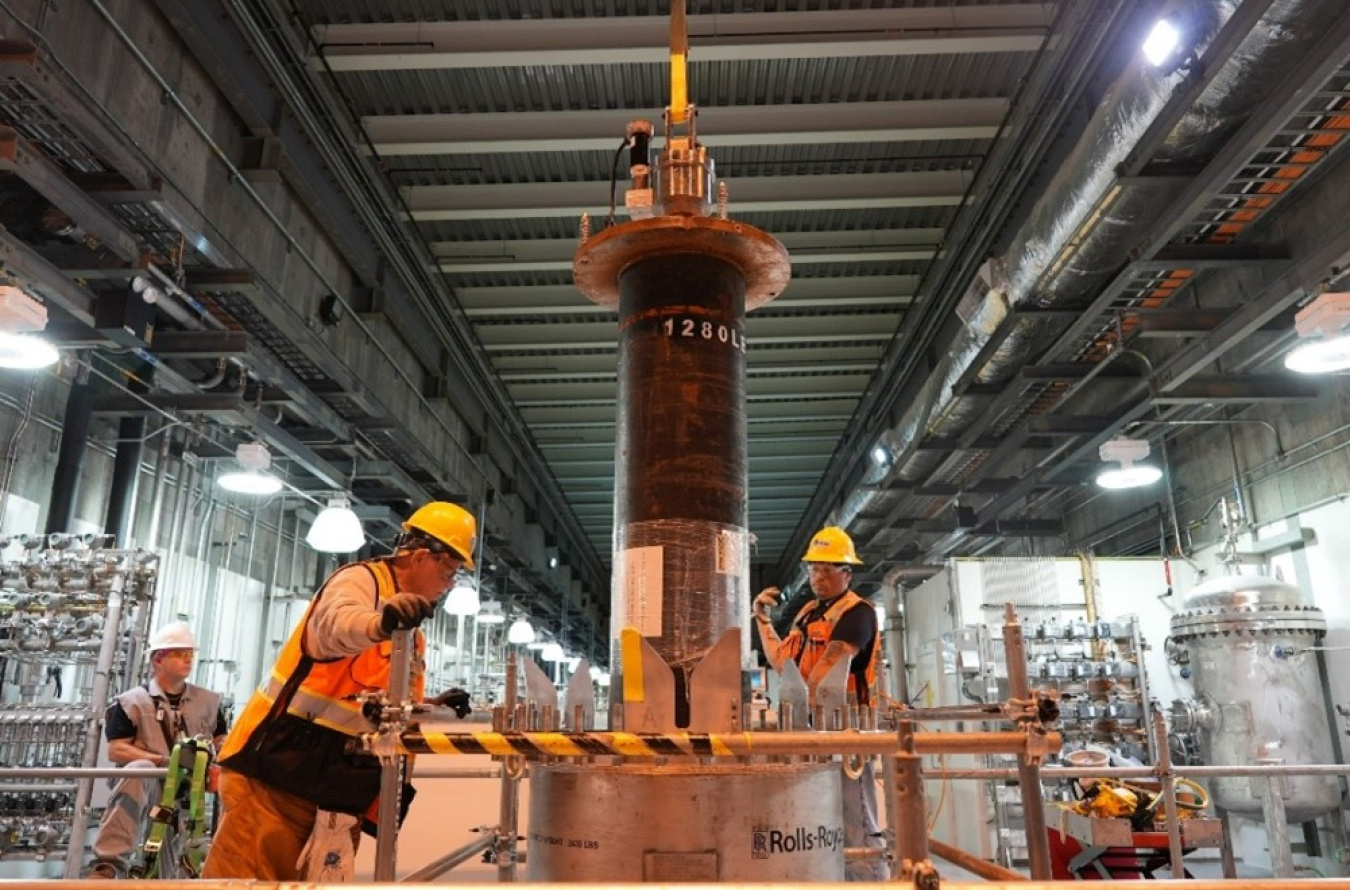
Savannah River Mission Completion installed three larger, higher-capacity cross flow filters used in the decontamination process at the Salt Waste Processing Facility to achieve the facility’s optimum production rates. Pictured are personnel conducting a mock-up trial of the filter changeout before executing the work in a highly radioactive area.
Innovation central to the site’s achievement of an EM priority to help execute key cleanup projects to address risk safely
AIKEN, S.C. — A trio of new and improved filters in a key operating facility at the Savannah River Site (SRS) has optimized efficiency and accelerated production of the radioactive waste tank cleanup mission — marking the completion of a U.S. Department of Energy Office of Environmental Management (EM) priority to execute key cleanup to safely address the risk associated with legacy waste.
EM’s liquid waste contractor at SRS installed larger, higher-capacity cross flow filters at the Salt Waste Processing Facility (SWPF) during a planned system-wide operational outage this year to conduct repairs and upgrades across all SRS liquid waste facilities.
Tony Robinson, DOE-Savannah River acting assistant manager for waste disposition, said increasing the processing rate at SWPF was critical to advancing the cleanup mission at SRS.
“Salt waste is the majority of the volume that remains in the tank waste at SRS,” Robinson said.
“SWPF is the key facility to remediate the remaining tank waste. The increased processing rate and improved operational reliability of SWPF will accelerate the tank waste mission and reduce the risks of this legacy waste.”
In a significant feat of innovation, Savannah River Mission Completion (SRMC) engineers devised a novel way to double the available surface area of the filters. The previous 10-foot-long filters, containing 234 filter tubes, were replaced with 16-foot-long filters, containing 288 filter tubes.
SWPF receives salt waste from the tank farms, a grouping of underground waste tanks, and decontaminates the waste by removing the highly radioactive contaminants using filters and a solvent-extraction process.
The cross flow filters at SWPF are used in the decontamination process to separate the radioactive materials, such as strontium, uranium, and plutonium, and solid particles from the less-radioactive salt waste stream. Filtration is the first step before the liquid waste undergoes a solvent-extraction process to then remove the cesium from the waste.
Since restarting the plant post-outage with the new filters, SWPF continues to set new processing records. SWPF set a new 30-day processing record in November of over 600,000 gallons.
When operating only one filter, SWPF can process at a rate of 18.5 gallons per minute, providing the throughput to meet mission needs.
Operating a first-of-a-kind and highly integrated nuclear facility does not come without unique challenges that require innovative solutions, according to Thomas Burns Jr., SRMC president and program manager.
“SRMC has had transformative success with the targeted effort to increase throughput capabilities at SWPF,” Burns said. “This is a world-class team that leans into ingenuity to apply breakthroughs to any challenge that comes our way.”
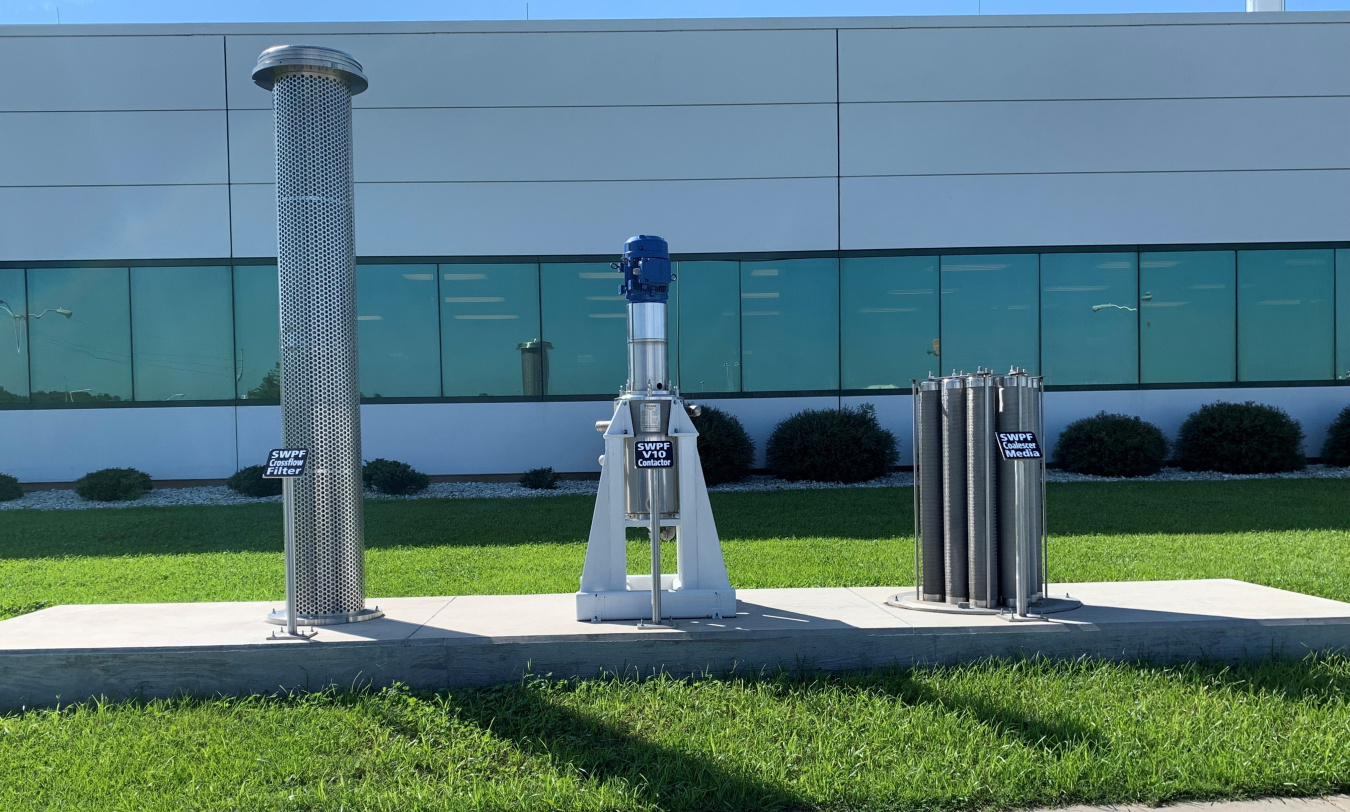
A display of a cross flow filter, a contactor and coalescer media in front of the Salt Waste Processing Facility at Savannah River Site.
The installation of cross flow filters is just one of the ways SRMC is using innovation and technology for critical tasks associated with the cleanup mission.
Recently, SRMC successfully demonstrated ultrasonic cleaning of the SWPF contactors. These mechanical mixers remove radioactive cesium from the liquid salt waste. During operation, solids build up inside the contactors. The accumulated solids are removed by a manual process. Ultrasonic cleaning is a faster, more thorough cleaning which minimizes downtime and is safer for workers. Additionally, drones are being used to perform internal inspections of waste tanks, generating precise mapping of the tank and its waste.
Other SWPF optimizations completed by SRMC over the last three years include streamlining the strategy for contactor cleaning and repair, improving the cleaning process of the strip effluent coalescer and acquiring a bank of 16 spare contactors. All of these improvements increase plant availability to process waste.
-Contributor: Colleen Hart
To receive the latest news and updates about the Office of Environmental Management, submit your e-mail address.