



Thanks to their safe and successful cleanup work in 2025, the Portsmouth and Paducah sites demonstrated the strong role the U.S. Department of Energy Office of Environmental Management plays in advancing American energy dominance and innovation. December 23, 2025
Office of Environmental Management
December 23, 2025 Estimated Read Time min
LEXINGTON, Ky. — Thanks to their safe and successful cleanup work in 2025, the Portsmouth and Paducah sites demonstrated the strong role the U.S. Department of Energy (DOE) Office of Environmental Management (EM) plays in advancing American energy dominance and innovation.
“Looking back at the progress we made in 2025, I can’t help but be excited about the future,” Portsmouth Paducah Project Office Acting Manager Reinhard Knerr said. “The Portsmouth and Paducah sites played a significant role in American energy and security during the Cold War. Now, thanks to our cleanup progress and what we will achieve going forward, these sites will again be important contributors to American prosperity.”
This year saw the Paducah Site in western Kentucky continue to grow as an attractive location for new nuclear energy development. In August, DOE reached an innovative lease agreement with advanced nuclear firm General Matter for reuse of a 100-acre parcel to construct a new domestic uranium enrichment facility to provide fuel for nuclear reactors. The planned project is a $1.5 billion investment, expected to create approximately 140 full-time jobs and generate more than $70 million in annual regional economic benefits.
Notably, the agreement helps EM to continue cleanup progress. The pact provides General Matter with cylinders of existing depleted uranium hexafluoride (DUF6) from past enrichment operations to use as supply fuel for the new facility. Combined with an agreement with Global Laser Enrichment, the partnerships allow both companies to access a portion of the Paducah Site’s remaining 40,000 DUF6 cylinders, turning liabilities into assets and accelerating production of domestic energy supplies.
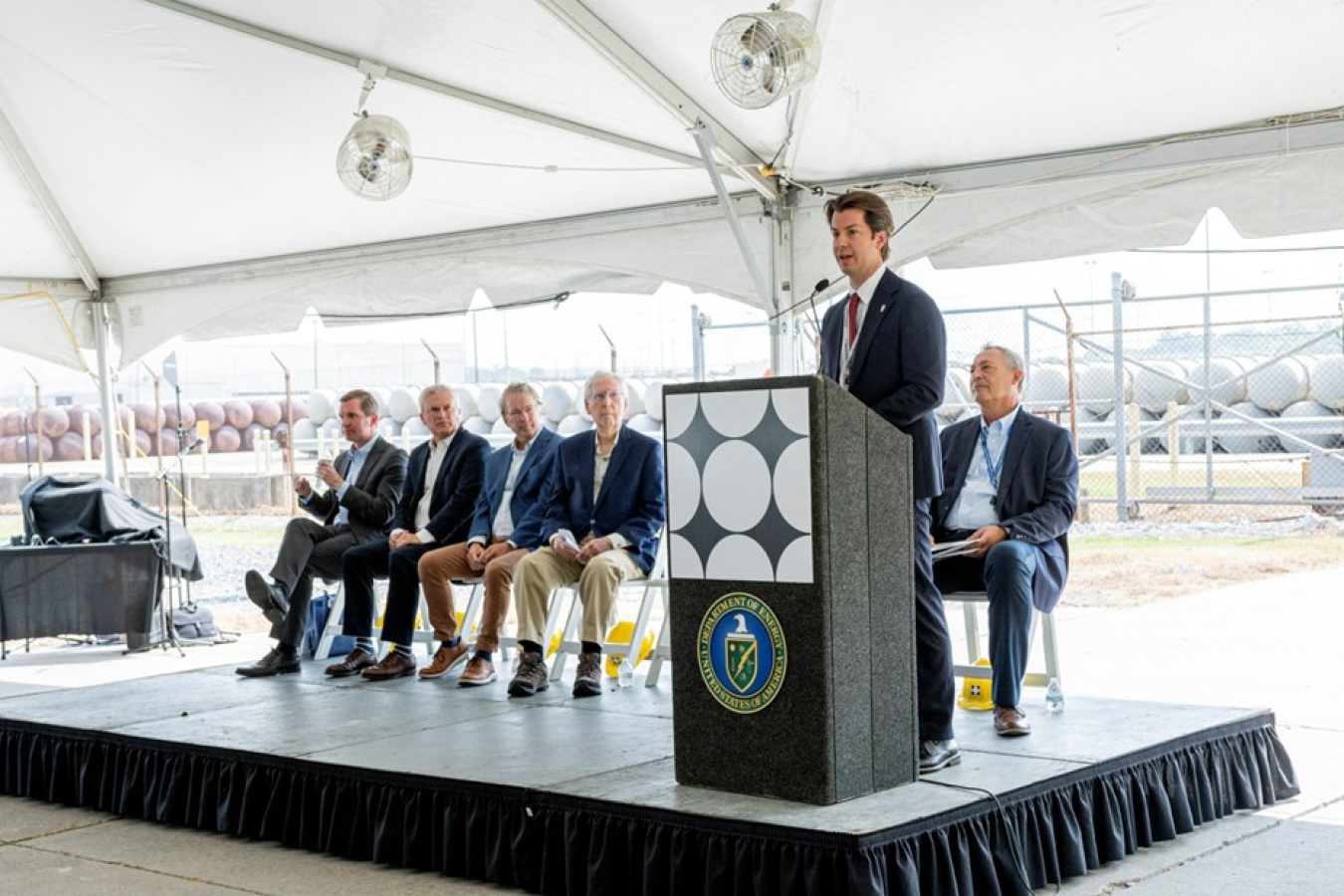
General Matter CEO Scott Nolan addresses the crowd during a groundbreaking ceremony at the Paducah Site in August. The domestic private-sector uranium enrichment facility will sit on a leased 100-acre parcel of land at the Paducah Site.
This year, DOE also selected the Paducah Site as one of four Department locations to move forward with plans to invite private-sector partners to develop cutting edge artificial intelligence (AI) data center and energy generation projects. As Energy Secretary Chris Wright said in announcing the selection of Paducah and the other DOE sites, “By leveraging DOE land assets for the deployment of AI and energy infrastructure, we are taking a bold step to accelerate the next Manhattan Project — ensuring U.S. AI and energy leadership.”
The Portsmouth Site, in southern Ohio, is already home to a variety of firms working to drive American energy dominance. This year, DOE continued to make land at the Portsmouth Site available for redevelopment by providing a third parcel of land to the Southern Ohio Diversification Initiative, a local community reuse organization, bringing the total to more than 350 acres transferred for reindustrialization.
State officials in Kentucky and Ohio are increasingly interested in additional ways the Paducah and Portsmouth sites can drive American energy. State nuclear authorities from Kentucky and Ohio visited the sites this year, underscoring their prime locations for reindustrialization in conjunction with the local communities’ visions.
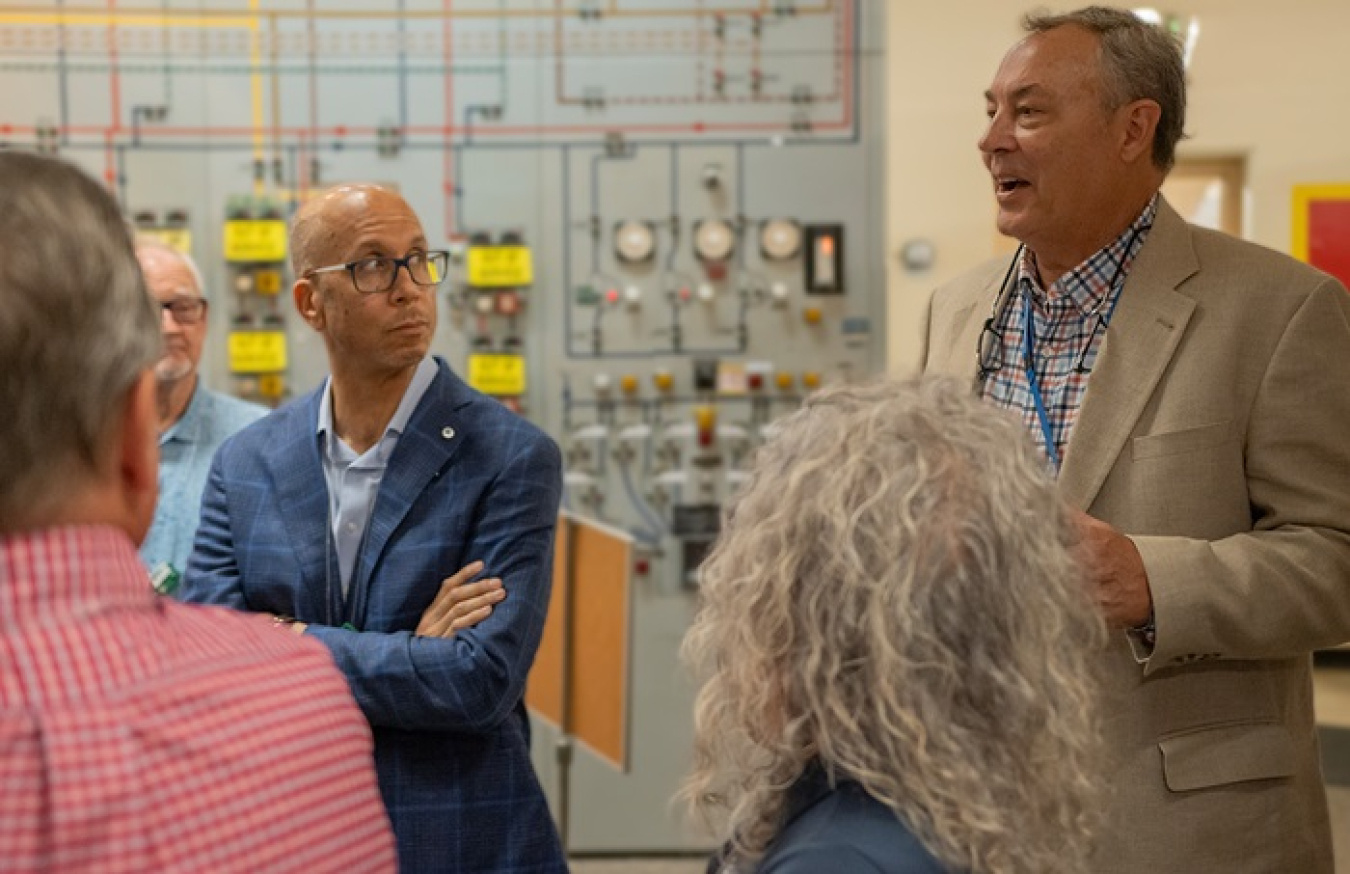
Members of the Kentucky Nuclear Energy Development Authority tour the Paducah C-300 Central Control Building during a site tour. The group visited the Paducah Site to explore its potential role in the state’s nuclear energy future.
‘First Bite’ of Second Enrichment Building Among Cleanup Accomplishments
DOE’s success in reusing the Portsmouth and Paducah sites for American energy and innovation stems from the successful cleanup underway at both locations. This year, EM achieved a priority by taking the “first bite” of the massive X-333 Process Building at Portsmouth. This 33-acre facility is the second of the site’s three former uranium enrichment process buildings to be demolished.
Portsmouth workers also continued excavating contaminated areas at the site and made progress constructing the next cells for the On-Site Waste Disposal Facility to hold demolition debris.
Working with federal and state environmental regulators, EM continued to advance an initiative dubbed “Decision 2029” at the Paducah Site. The initiative seeks to accelerate regulatory decision-making, and ultimately, enable more cleanup to begin sooner.
Crews also continued to prepare the Paducah Site’s former uranium enrichment process buildings for eventual demolition. At the C-333 Process Building, workers safely completed segmentation activities for more than 450 large pieces of equipment called converters. Deactivation activities also began in the C-337 Process Building. In addition, crews safely demolished unused facilities at the Paducah Site, reducing the cleanup footprint by approximately 19,000 square feet.
At the DUF6 conversion facilities at the Paducah and Portsmouth sites, the team checked off an EM priority by converting more than 1,000 cylinders of DUF6 into a safer, more stable oxide form.
“Everything we have achieved at Portsmouth and Paducah, and what we will continue to achieve, is based on a foundation of strong partnerships with all those who play a role in the cleanup and future of these sites,” Knerr said. “Our partnerships with state and local leaders and private industry ensure that as they see cleanup is accelerating, it will drive future use of these sites.”
-Contributor: Sarah Marko
To receive the latest news and updates about the Office of Environmental Management, submit your e-mail address.