



The Hanford Site’s Waste Treatment and Immobilization Plant has reached another major commissioning milestone, producing more than 20 stainless steel containers of immobilized low-activity waste. December 9, 2025
Office of Environmental Management
December 9, 2025 Estimated Read Time min
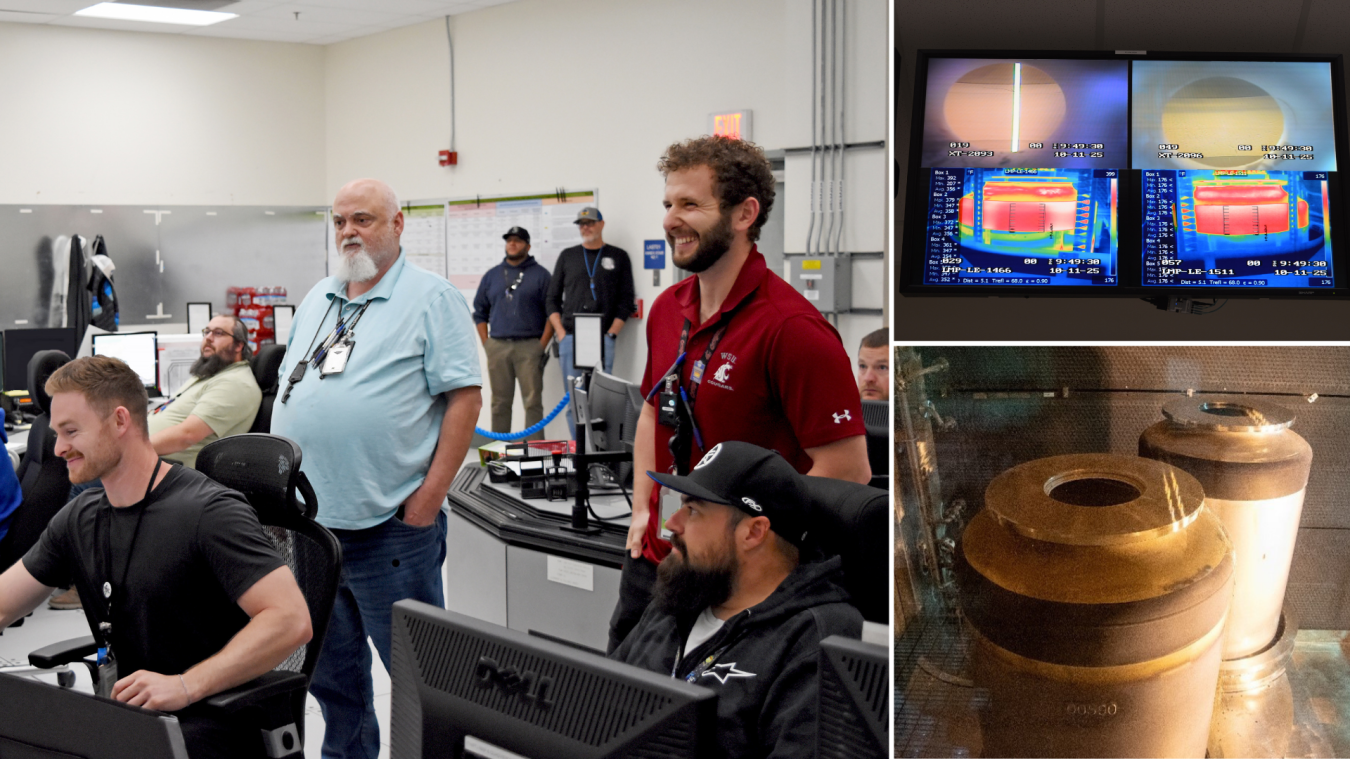
A Waste Treatment and Immobilization Plant crew vitrified the first Hanford Site tank waste inside one of two melters in the Low-Activity Waste Facility. At top, a camera inside the melter’s pour cave shows the vitrified waste being poured into a stainless steel container as seen via remote camera as well as the hot liquid inside the container. Below, the first two containers filled with vitrified waste are seen in the pour cave prior to being lidded, swabbed to verify their exterior is free of contamination, and then moved into the export bay.
RICHLAND, Wash. — The Hanford Site’s Waste Treatment and Immobilization Plant (WTP) has reached another major commissioning milestone, producing more than 20 stainless steel containers of immobilized low-activity waste.
“Each container represents tangible progress in the mission to protect the Columbia River and community,” said Mat Irwin, the Hanford Field Office assistant manager for WTP.
The first pretreated tank waste was transferred to the plant’s Low-Activity Waste Facility in early October, when hot commissioning began. Inside that facility’s two 300-ton melters, radiological and chemical waste is combined with glass-forming materials and then heated to 2,100 degrees Fahrenheit.
That process, called vitrification, transforms the waste into a stable glass form and seals it in stainless steel containers, each of which is 4 feet wide and 7.5 feet tall, weighing approximately 7 metric tons when filled. The vitrified product meets the state of Washington’s requirements for long term disposal at Hanford’s Integrated Disposal Facility.
“Our team has turned progress into momentum, and we’re committed to carrying that forward through continued operations,” said Brian Hartman, WTP project director and senior vice president with Bechtel, the contractor leading design, construction and commissioning of the plant.
The accomplishment also represents the beginning of extended hot commissioning, during which the team will build production consistency and establish a steady rhythm of performance for safe and sustained operations.
Hanford is home to 56 million gallons of radioactive and chemical waste stored in 177 massive underground tanks. The waste was generated as part of the nation’s efforts to end World War II and win the Cold War.
The plant facilities can be viewed using the self-guided Hanford Virtual Tour available here.
To receive the latest news and updates about the Office of Environmental Management, submit your e-mail address.