



Crews recently reduced the legacy footprint at the Savannah River Site by demolishing two structures surrounding a facility that once helped power deep-space missions such as Galileo, Ulysses and Cassini. December 23, 2025
Office of Environmental Management
December 23, 2025 Estimated Read Time min
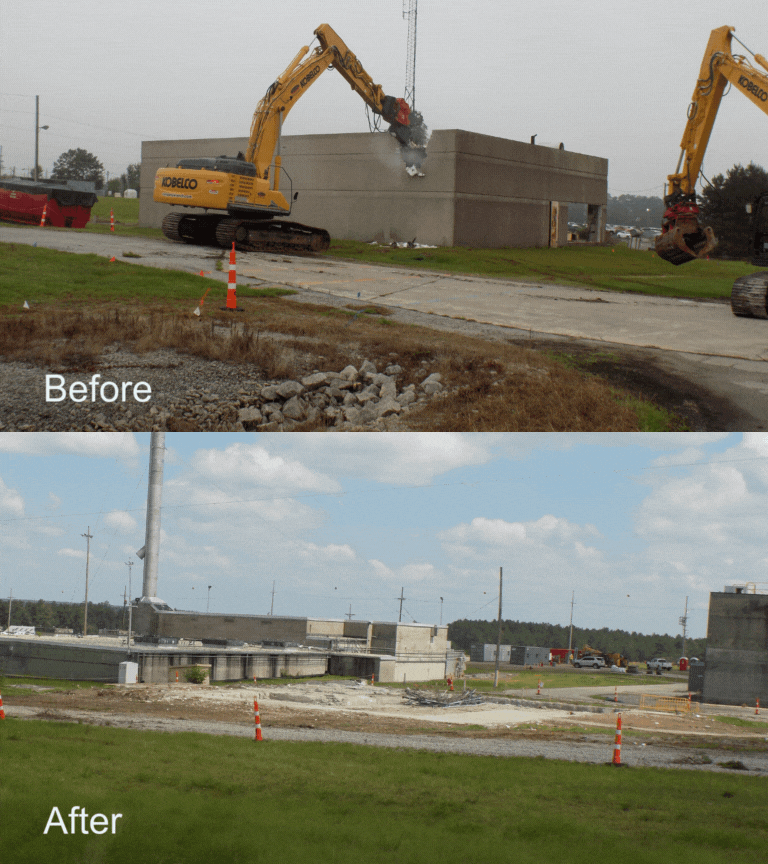

Before and after photos show the successful demolition of the 720-F Central Alarm Station down to a slab.
AIKEN, S.C. — Crews recently reduced the legacy footprint at the Savannah River Site (SRS) by demolishing two structures surrounding a facility that once helped power deep-space missions such as Galileo, Ulysses and Cassini.
The achievement marks a U.S. Department of Energy Office of Environmental Management (EM) priority, implementing common sense solutions that meet cleanup responsibilities while delivering more value for American taxpayers.
The EM crews tore down key ancillary structures of the F-Area Material Storage Building (235-F) called the 701-4F Entry Control Facility and the 720-F Central Alarm Station. This initiative, in the works for over a decade, supports EM’s mission to safely decommission legacy facilities while strategically reducing the number of structures requiring management and oversight, with the ultimate goal of safely decommissioning 235-F and associated structures.
“This demolition project is a perfect example of how the EM mission at SRS is meeting our cleanup commitments while being smart stewards of taxpayer dollars,” said Edwin Deshong, Savannah River Operations Office manager. “By safely decommissioning these legacy structures around 235-F, we are reducing our legacy footprint and positioning the facility for final in-situ decommissioning.”
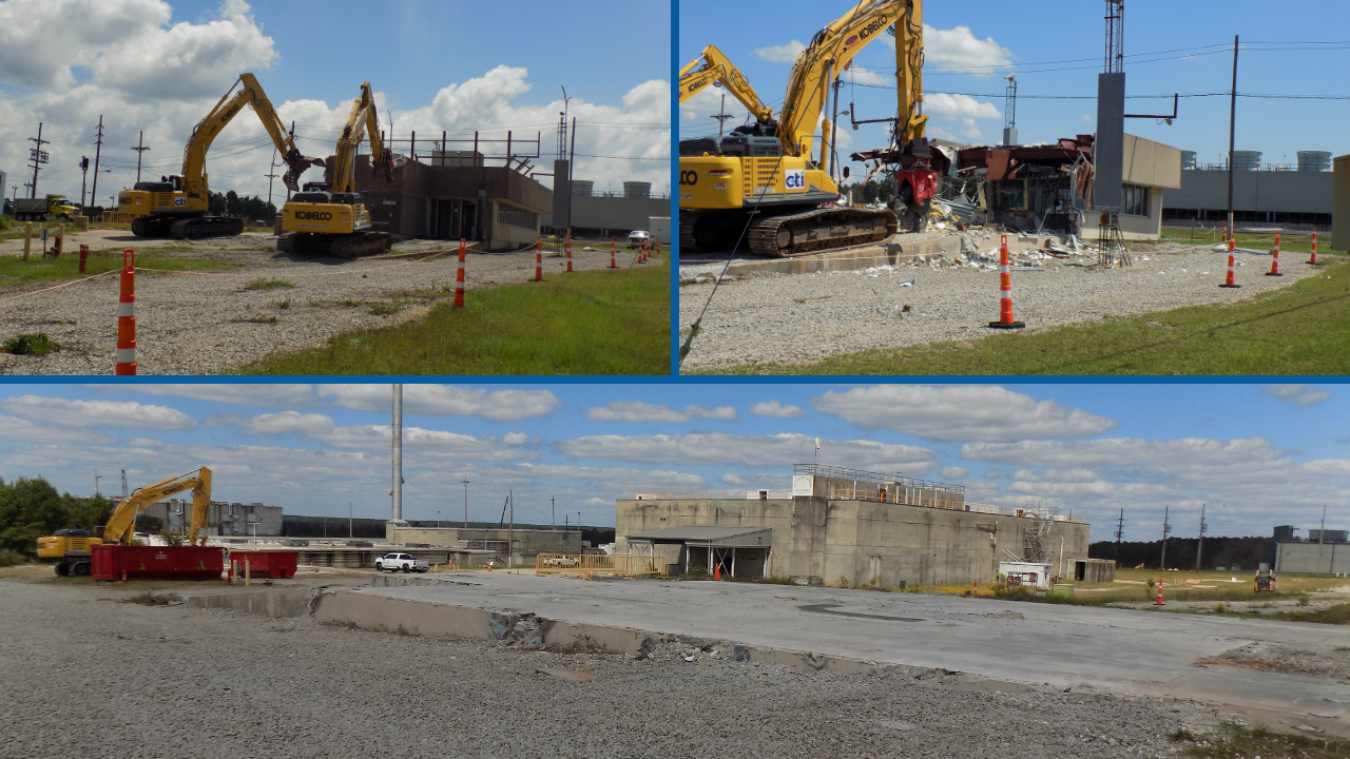
Views of 701-4F Entry Control Facility demolition progress from start to finish.
The crews also dismantled two layers of perimeter security fencing and removed electronic security components located between the fences.
“This ongoing work serves as another testament to our commitment to making the world a safer place,” said Jeff Griffin, president and CEO of EM contractor Savannah River Nuclear Solutions (SRNS). “We pride ourselves on the progress achieved so far and remain steadfast in our efforts to see this vital project through to completion.”
Workers produced the fuel spheres and pellets from plutonium-238 for the deep-space missions at 235-F, constructed in the early 1950s. The two-story, reinforced concrete structure has been inactive for more than 25 years. Deactivating 235-F in 2023 positioned it in a safe condition for continued surveillance and maintenance until in-situ decommissioning, which involves permanently entombing the facility in place, can proceed.
“This isn't just about dismantling structures; it's about building a safer future,” 235-F Decommissioning Project Manager Pat O'Neill said. “With the Department, SRNS and our state and federal regulatory partners, we remain dedicated to fulfilling our environmental commitments, ensuring safety and compliance at every step.”
SRNS Design Engineering completed the conceptual design for the 235-F decommissioning in August. The project team is now developing the detailed design, revised safety basis documents to support final decommissioning and a detailed project schedule and estimate. In-situ decommissioning field work is scheduled for the fiscal year that begins in October.
-Contributor: Fallan Flatow
To receive the latest news and updates about the Office of Environmental Management, submit your e-mail address.