



The Office of Geothermal is supporting four enhanced geothermal systems (EGS) demonstration projects directed by the Infrastructure Investment and Jobs Act (IIJA). These projects will demonstrate EGS in a variety of geographic locations, geologic formations, and subsurface conditions. The results can help expand the use of firm, flexible geothermal energy to more locations nationwide.
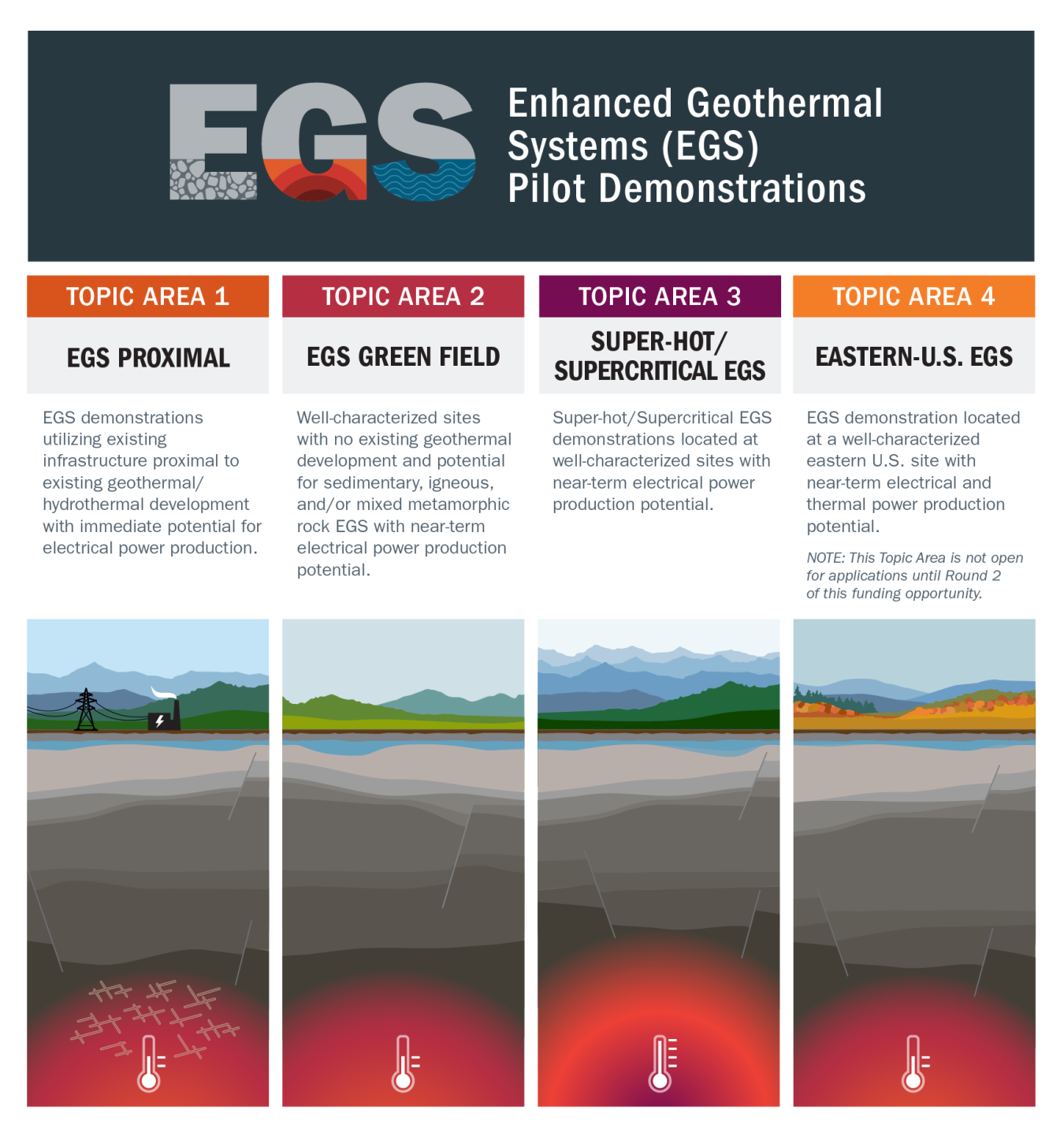
IIJA authorizes projects in four Topic Areas. The three projects selected in the first round are intended to increase geothermal power production in the United States in the near term from areas surrounding existing geothermal fields (Topic Area 1) while facilitating new opportunities for widespread power (or power with cascaded heat production) in the future from regions where heat is present, yet no geothermal energy production exists (Topic Areas 2 and 3) and the second-round project aims to demonstrate EGS in the eastern United States (Topic 4).
The projects are:
- Chevron New Energies (HQ: San Ramon, CA)—This EGS pilot demonstration will use innovative drilling and stimulation techniques to access geothermal energy near an existing geothermal field.
- Fervo Energy (HQ: Houston, TX)—This pilot within the Milford Renewable Energy Corridor in Utah and adjacent to the DOE’s Frontier Observatory for Research in Geothermal Energy (FORGE) field laboratory aims to produce power from each of three wells at a site with no existing commercial geothermal power production.
- Mazama Energy (HQ: Seattle, WA)—This project will demonstrate super-hot EGS (temperatures above 375°C) on the western flank of Newberry Volcano in Oregon. This demonstration will help advance the science needed to operate in extreme heat conditions.
- Pennsylvania Department of Environmental Protection (HQ: Harrisburg, PA)—This project will convert a horizontal shale gas well in the Appalachian Utica Shale to geothermal.
By developing EGS pilot demonstrations in a variety of geologic formations and subsurface conditions, projects selected under this initiative are acting as:
- Models to prove reliability and performance and de-risk technologies required to develop and sustain EGS reservoirs,
- Experiments from which to learn by doing and identify new problems that are not apparent at smaller, lab-based scales,
- Opportunities to test hypotheses and validate design approaches for the geological conditions in which projects are located and extend those to broader EGS development,
- Opportunities for collaboration by which best practices can be established and operational processes can be standardized and improved,
- Opportunities to connect with consumers and offtakers to understand their needs, define the market, and account for those factors in design.
New Funding Opportunity for Next-Generation Geothermal Field Tests
On February 25, 2026, the U.S. Department of Energy announced a $171.5 million funding opportunity that includes up to $100 million to support next-generation geothermal field tests. Under Topic Area 1, OG expects to select 4‒10 projects for field tests at sites with potential for eventual electric power generation using EGS approaches. These projects selected under the Next-Generation Geothermal Field Tests and Geothermal Resource Characterization and Confirmation funding opportunity will directly support DOE's emphasis on learning-by-doing, help to identify and focus R&D priorities, and help derisk technologies and resource exploration for the industry.