



Gaseous Diffusion Plant (GDP) operations generated hazardous, radioactive, mixed (hazardous and radioactive), and nonchemical (sanitary) wastes. Past operations also resulted in soil and groundwater contamination at areas located within plant boundaries.
In 1989, DOE signed a Consent Decree with the State of Ohio and an Administrative Consent Order with the Environmental Protection Agency (EPA). This officially began the 20-year environmental management program at the Portsmouth Site. The Consent Decree required DOE to complete investigations to determine the nature and extent of any environmental contamination that exists, complete alternative studies, and implement corrective actions as needed at Portsmouth.
During the mid-1990s, nearly 1,000 groundwater monitoring wells were installed in and around the 3,777-acre plant site, tens of thousands of soil samples were taken at various depths, and five groundwater contamination areas or plumes were identified from sampling results. Today treatments are still in place at each plume and additional cleanup actions are in operation.
Integrated Project Portfolio
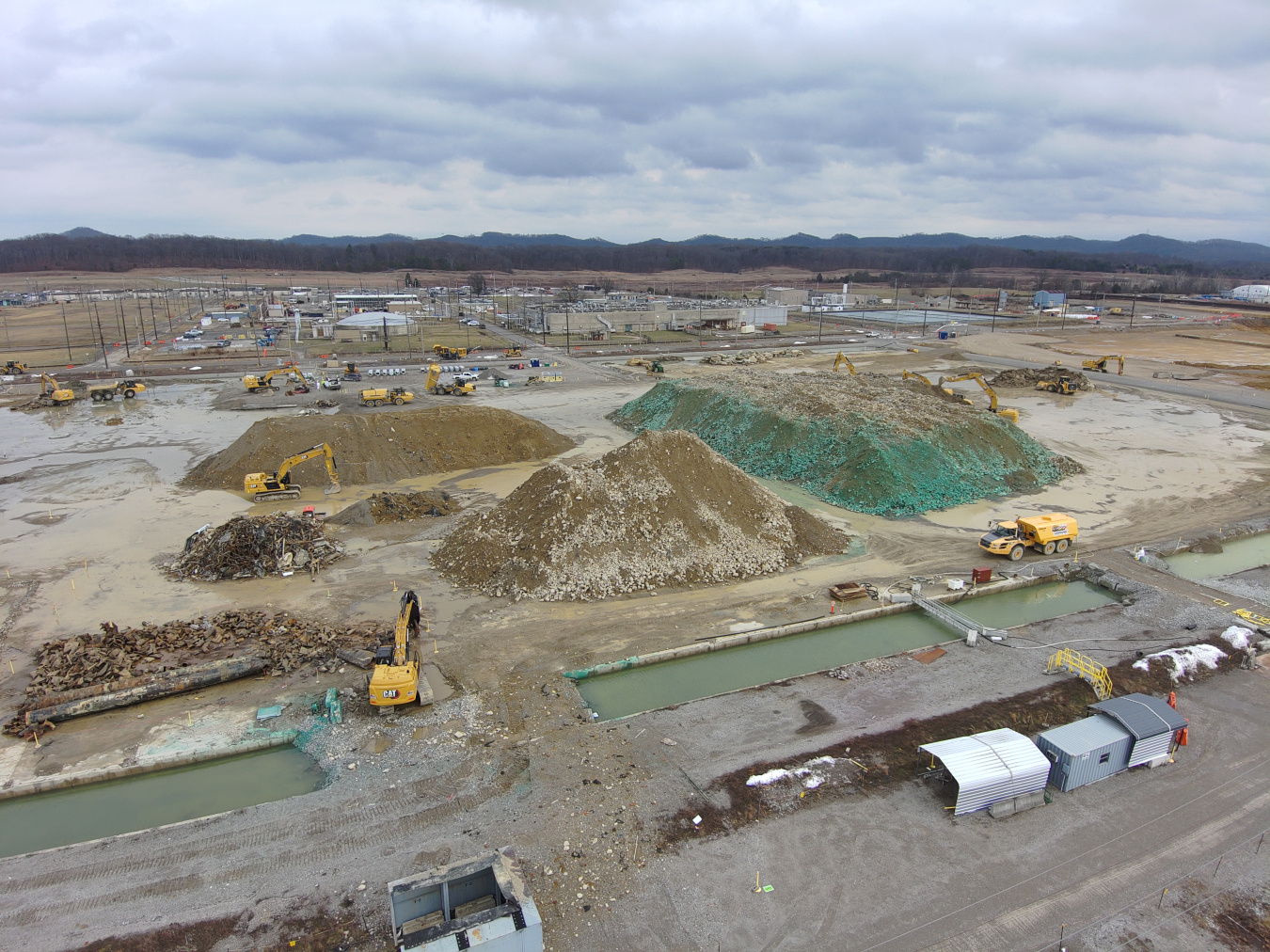
The Portsmouth Site is conducting cleanup using an integrated project portfolio. As buildings are deactivated and demolished, the debris is placed in an On-Site Waste Disposal Facility (OSWDF). Additionally, soil excavation is part of the cleanup strategy. With the help of the Portsmouth Site-Specific Advisory Board (SSAB), a plan was created to excavate landfills and plumes to use as fill for the OSWDF. The excavation also creates more contiguous land to be available for future reindustrialization of the site, another Portsmouth SSAB recommendation.
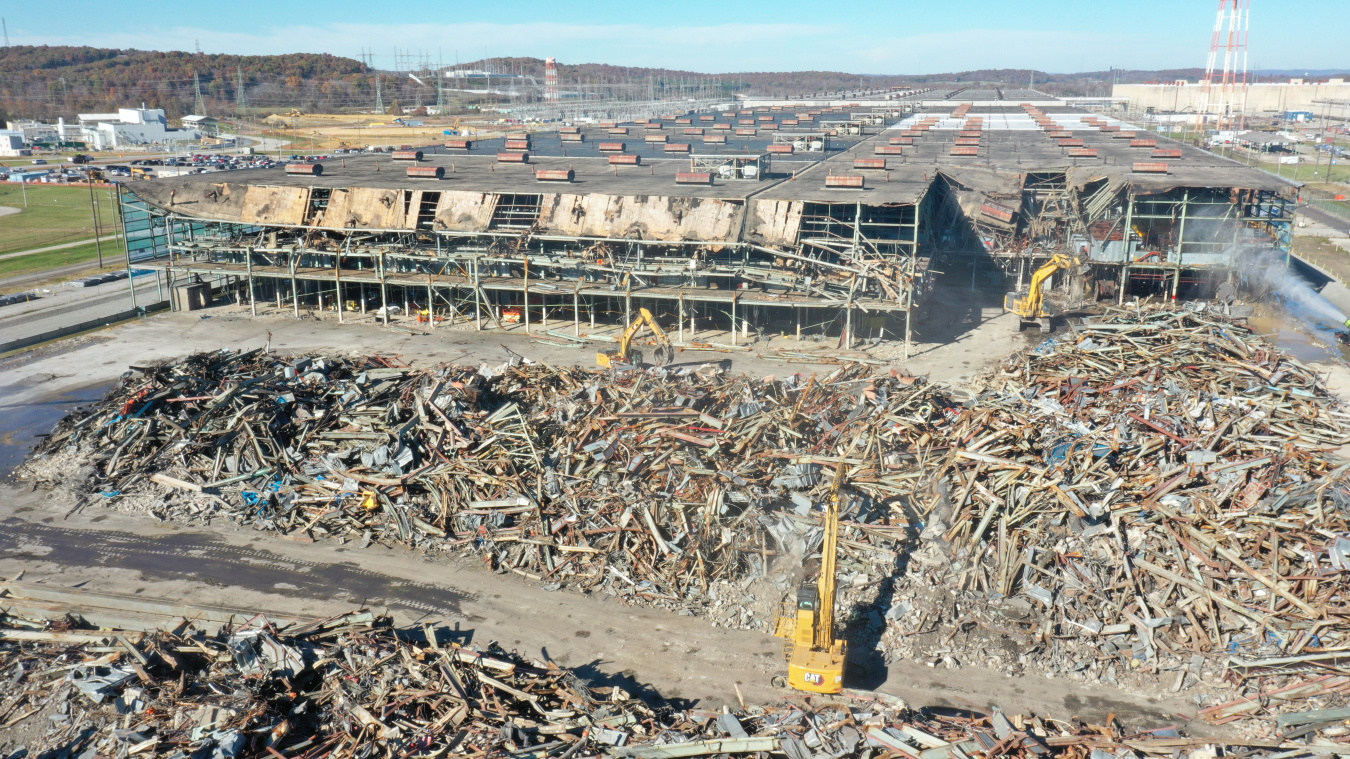
The Deactivation and Demolition (D&D) Program addresses deactivation, demolition and disposal of approximately 415 facilities currently identified on the Portsmouth Site. This includes the three gaseous diffusion process buildings that housed the process equipment and span the size of 158 football fields.
Other structures include support facilities such as electrical switchyards, cooling towers, cleaning and decontamination facilities, water and wastewater treatment plants, maintenance and laboratory facilities, and storage and office buildings. D&D activities will eliminate groundwater contamination sources and reduce surveillance and maintenance costs of the facilities. Less money is spent on demolished facilities because maintenance costs are decreased.
In 2020, construction of the On-Site Waste Disposal Facility (OSWDF) began. The OSWDF consists of approximately 21 acres of waste disposal capacity, a 32-acre soil management area. When a process building is deactivated and demolished, the debris from the building is placed in the cells of the OSWDF. There is the potential for 12 total cells, or sections of space, in the disposal facility. The Waste Disposition records of decision (ROD) created in 2015 calls for a combination of off-site shipping of more contaminated demolition debris and disposal of lower-level waste in the OSWDF.
Safe, efficient, and cost-effective waste disposition is key to continued progress in the legacy uranium-enrichment cleanup mission. To date, more than 210,000 cubic yards of Portsmouth disposal debris has been placed into the OSWDF there, along with 440,000 bank cubic yards of engineered-fill soil from legacy groundwater plumes under excavation. Disposal of the last remaining waste from the demolition of the X-326 Process Building was completed on August 24, 2023.
By Fiscal Year (FY) 2033, PPPO expects to complete the construction of all necessary disposal cells at the Portsmouth OSWDF to align with schedules for completing remaining D&D activities. By FY 2031, PPPO will ship deactivation waste not suitable for on-site disposal, and complete waste placement of demolition debris from the X-333 Process Building, and the rest of the site (including old landfills and groundwater-contamination plumes) into the OSWDF. This will include completing excavation of the 5-Unit Soil Remediation Project, X-749A and X749B soil remediation projects, and the X-326 and X-333 Process Buildings concrete slabs. A planned cap for the OSWDF is also expected to begin construction during this period.
In order to obtain engineered fill for the On-Site Waste Disposal Facility (OSWDF), the Portsmouth Site-Specific Advisory Board (SSAB) recommended using tested contaminated landfills and plumes when excavated. Removing soil from these areas provides engineered fill to support the debris placed into the Portsmouth OSWDF while addressing previously capped and closed landfills. The result will be an approximately 1,000-acre industrial site available for transfer and redevelopment as the DOE cleanup mission winds down.
The first plume excavated was the X-740 Plume. The contamination was caused by trichloroethylene (TCE) which is a lubricant that was used during operations. The four-acre plume provided 25,000 cubic yards of fill for the OSWDF.
In the near term, PPPO will implement Corrective Measures of the Deferred Units (DUs) in accordance with the latest Ohio EPA-issued Decision Document.
The 5-Unit Excavation Project covers approximately 33 acres inside the Perimeter Road. At the completion of the project, the 5-Unit Excavation will have generated over 800,00 cubic yards of impacted soil for use as engineered fill in the OSWDF. Depending upon funding and progress of the D&D and OSWDF projects, the 5-Unit Excavation Project will be completed in 2029.
Portsmouth Regulatory Approach
The overall environmental cleanup strategy at Portsmouth is based on taking near-term actions to control or eliminate ongoing sources of contamination along with continued investigations of other potential sources. DOE works with regulators to further define project sequencing while optimizing resources and utilizing a risk-based approach to ensure timely environmental cleanup and minimize workforce impacts. Ohio Environmental Protection Agency (Ohio EPA) oversees environmental remediation activities at the Portsmouth Site under the Resource Conservation and Recovery Act (RCRA) Corrective Action Program.
The Portsmouth Site proceeds in accordance with five Director’s Final Findings and Orders (DFF&Os) that cover activities including natural resources, site treatment and integration.
Facility deactivation and demolition is covered in The April 13, 2010, Director’s Final Findings and Orders for Removal Action and Remedial Investigation and Feasibility Study and Remedial Design and Remedial Action, including the July 16, 2012, Modification thereto (referred to as the D&D DFF&O).
The D&D DFF&O addresses the investigation and cleanup of the gaseous diffusion process buildings and facilities, as well as evaluation of site-wide waste disposition and establishes the agreed upon regulatory framework for conducting those activities under the Comprehensive Environmental Response, Compensation, and Liability Act (CERCLA).
Steps within the DFF&O include developing viable alternatives then evaluating and comparing them, gaining public feedback on the range of alternatives, selecting a final approach and formalizing the decisions. The final step of the DDF&O was to implement the D&D and waste disposition remediation actions.
The D&D at the Portsmouth Site addressed deactivation, demolition and disposal of approximately 415 facilities identified on the Portsmouth Site. This includes the three gaseous diffusion process buildings that housed the process equipment and was the size of 158 football fields. Other structures include support facilities such as electrical switchyards, cooling towers, cleaning and decontamination facilities, water and wastewater treatment plants, maintenance and laboratory facilities, and storage and office buildings.
In 2015, the Ohio EPA and DOE agreed to a plan to demolish the process buildings and other facilities undergoing Decontamination & Decommissioning (D&D) at the Portsmouth Site. The formal Record of Decision (ROD) for the Process Buildings and Complex Facilities D&D Project details DOE’s decision for the D&D of the plant’s three large process buildings (each more than 30 acres under roof), other facilities, and auxiliary systems.
The decision came following the Portsmouth Waste Disposition ROD agreed to by the Ohio EPA and DOE that calls for the construction of an On-Site Waste Disposal Facility (OSWDF) as part of the remedy for more than 2 million cubic yards of deactivation & demolition waste. Waste that does not meet the approved acceptance criteria for the OSWDF will be shipped off site for disposal at appropriate licensed federal or commercial disposal facilities.
Regulatory Documents
Ohio EPA Director’s Final Findings and Orders for CERCLA Actions to Restore Natural Resources
Ohio EPA Director’s Final Findings and Orders for Cost Recovery Settlement
Portsmouth Decommissioning and Decontamination (D&D) Project Director's Final Findings and Order
Portsmouth Integration Director's Final Findings and Order
Portsmouth Director's Final Findings and Orders, Site Treatment Plan