



Scientists found a potential way to suppress large damaging edge-localized modes, providing an approach to protect future devices.
February 12, 2026 Estimated Read Time min
The Science
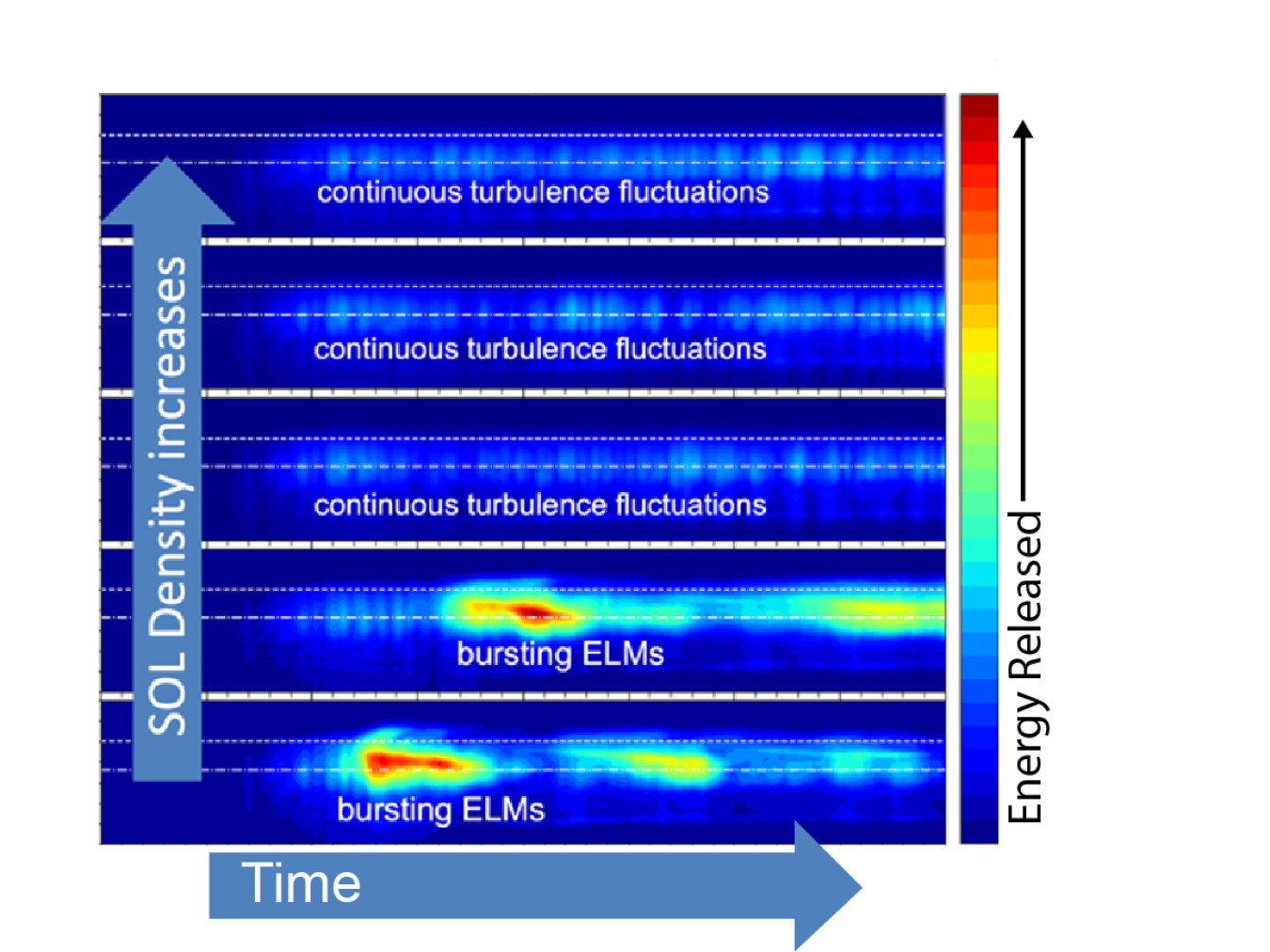
Tokamaks are donut-shaped fusion devices that confine plasma using magnetic fields. They’re a promising approach for producing fusion energy. However, plasmas can develop large instabilities that release strong energy bursts, called edge-localized modes (ELMs). These bursts have the potential to damage the device’s interior. To avoid material damage while maintaining high performance in the core, devices must limit drastic swings in temperature at their walls. This is a scenario called core-edge integration. There are scenarios that produce only small ELMs, rather than large destructive ELMs. While operating in these scenarios limits temperature swings, scientists do not yet understand the underlying physics. Prior experiments suggest that the density of the plasma at its edge is key to achieving small or no-ELM operation. Researchers at the DIII-D National Fusion Facility (an Office of Science User Facility) used a combination of modeling and experiments to confirm that high density in the plasma edge produces benign turbulence rather than large damaging ELMs.
The Impact
Tokamaks show great promise for fusion energy production. However, large disruptive bursts of energy can damage the device’s interior. Future commercial devices will need to avoid this. This work identifies a physics-based approach to suppress large ELMs. It focuses on controlling the density of the plasma edge. If devices can shift to operating approaches that produce only small ELMs (like the scenario identified in this study), it would reduce the heat load at the device walls while maintaining plasma confinement in the core. This solution would address the key challenge of core-edge integration. The simulation and experimental work underpinning this study provides actionable insights for the design and operation of future fusion devices and power plants.
Summary
Plans for commercial fusion energy production rely on the capability to produce a plasma with low heat flux at the edge and high confinement in the core. Recent work has shown that tokamak operation within a small ELM regime reduces heat flux at the divertor and improves impurity exhaust while maintaining high performance in the core. While the edge density profile is a key control parameter for accessing this regime, a team at the DIII-D National Fusion Facility is the first to determine how the scrape-off-layer (SOL) density affects ELM dynamics.
The team used the BOUT++ code to simulate DIII-D hybrid plasmas. The modeling identified a unique regime in which a high SOL density enabled small, benign ELMs that were triggered by ballooning instabilities. These conditions stabilized global peeling-ballooning modes to prevent large ELMs. Nonlinear simulations indicated that high SOL density induced localized pressure spikes that coincided with small ELM bursting. This situation prevented large ELM formation. Corresponding parameter scans during experiments confirmed that precise shaping of the SOL density profile stabilized large ELMs while enhancing turbulent transport, producing tolerably small ELMs. The researchers also identified key diagnostic metrics for real-time control of edge stability. This work has significant implications for steady-state plasma operation in larger future fusion devices. It could help enable the design of advanced control strategies for sustaining small ELM-only regimes in reactor-scale plasmas.
Contact
Nami Li
Lawrence Livermore National Laboratory
li55@llnl.gov
Xueqiao Xu
Lawrence Livermore National Laboratory
xu2@llnl.gov
Funding
This work was performed under the U.S. Department of Energy (DOE) by Lawrence Livermore National Laboratory under the SciDAC ABOUND Project. This work was supported by the DOE Office of Science, Office of Fusion Energy Sciences. It used the DIII-D National Fusion Facility and the National Energy Research Scientific Computing Center, both DOE Office of Science User Facilities.
Publications
Li N.M., et al. Exploring the transition from continuous turbulence fluctuations to bursting ELMs in high SOL density regimens.Nuclear Fusion 65, 076023 (2025). [DOI: 10.1088/1741-4326/ade0d0]