



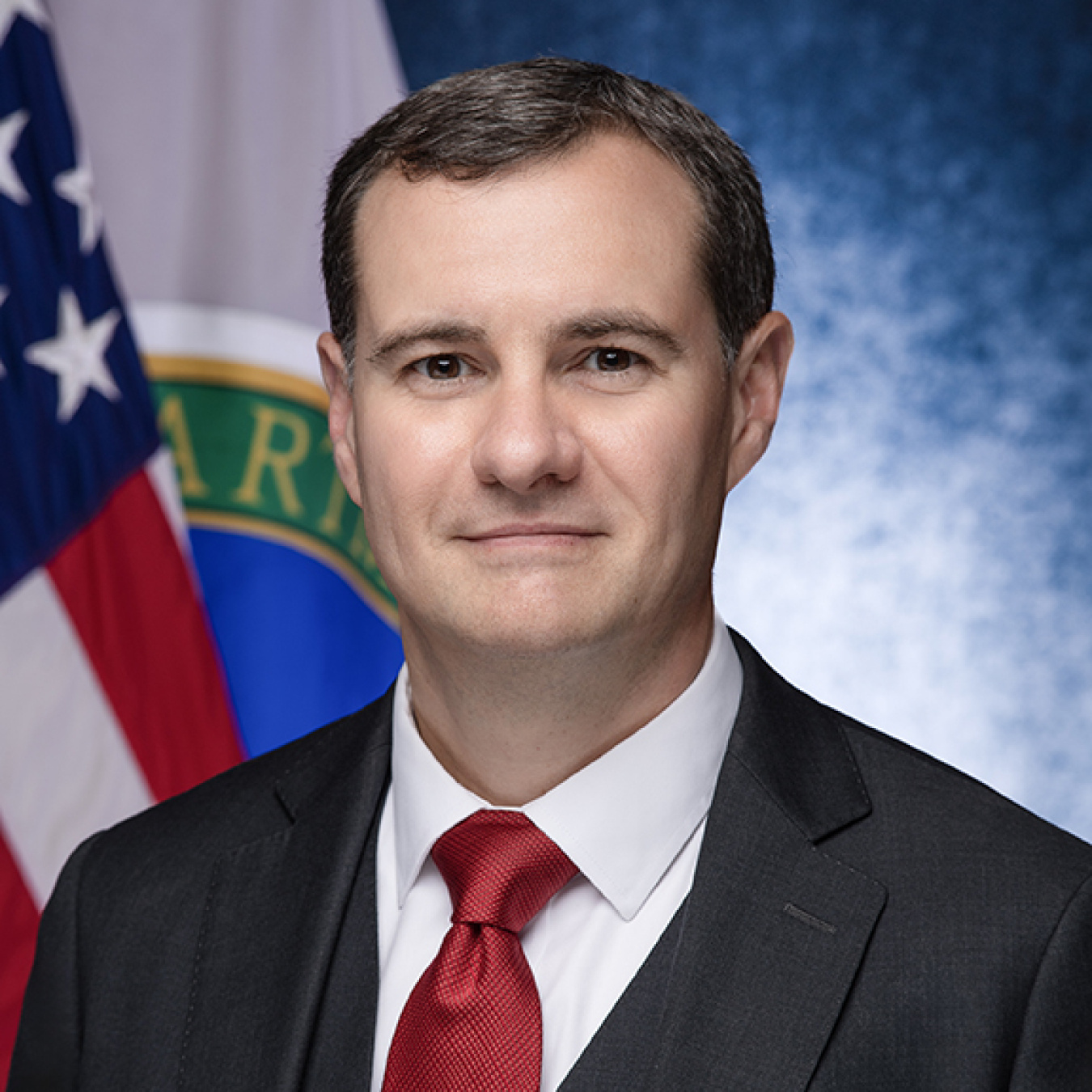
Dr. Matthew Napoli serves as the Deputy Administrator for Defense Nuclear Nonproliferation at NNSA.
In this capacity, his chief responsibility is to deny, detect, and defeat adversaries from acquiring nuclear and radiological weapons.
As lead for approximately 400 federal employees and contractors at the Department of Energy in Washington, D.C., he oversees unmatched nonproliferation and nuclear capabilities, including oversight of the Offices of Research and Development; Material Management and Minimization; Global Material Security; and Nonproliferation and Arms Control.
He has been recognized by the Secretary of Energy for his work with the governments of Japan, Venezuela, and Kingdom of Saudi Arabia.
Prior to his confirmation by the U.S. Senate, Dr. Napoli was an executive at the U.S. Naval Nuclear Propulsion Program; one of the most elite military engineering organizations in the U.S. armed forces. His career began as an officer in the U.S. Navy, where he served under a four-star admiral as a lead engineer for the Virginia Class attack submarine, the USS Gerald R. Ford Class aircraft carrier, and the Columbia Class next-generation ballistic missile submarine. As a civilian in the Naval Nuclear Propulsion Program, he oversaw all foreign policy, interagency policy, and public affairs, including oversight of nuclear-powered warship access to over 150 ports in over 50 nations.
In his Navy capacity, he was recognized for leading the renewal of the U.S./UK Mutual Defense Agreement; as a chief architect of the AUKUS agreement; for intelligence work with the Federal Bureau of Investigation, and as a first responder during Operation Tomodachi to provide support to Japan in response to the nuclear accident at Fukushima Dai’ichi.
Dr. Napoli is the recipient of the Navy and Marine Corps Commendation Medal and is a lifetime member of the Council on Foreign Relations.
He is a native of Monroe, Louisiana, and holds a bachelor's degree in mechanical engineering from Louisiana Tech University, a master's degree in mechanical engineering from the Naval Postgraduate School, a fellowship in national security from the Massachusetts Institute of Technology, and a Ph.D. from The George Washington University in public policy and public administration with a concentration in science and technology policy. His doctoral dissertation focused on nuclear proliferation.