



ALEXANDRIA, Va. – A central theme of the “Path to EM Success in 2016 and Beyond” session at the recent National Cleanup Workshop was how EM, its site workers, regulatory agencies, states and communities will build on successful cleanup to achieve...
September 30, 2016 Estimated Read Time min
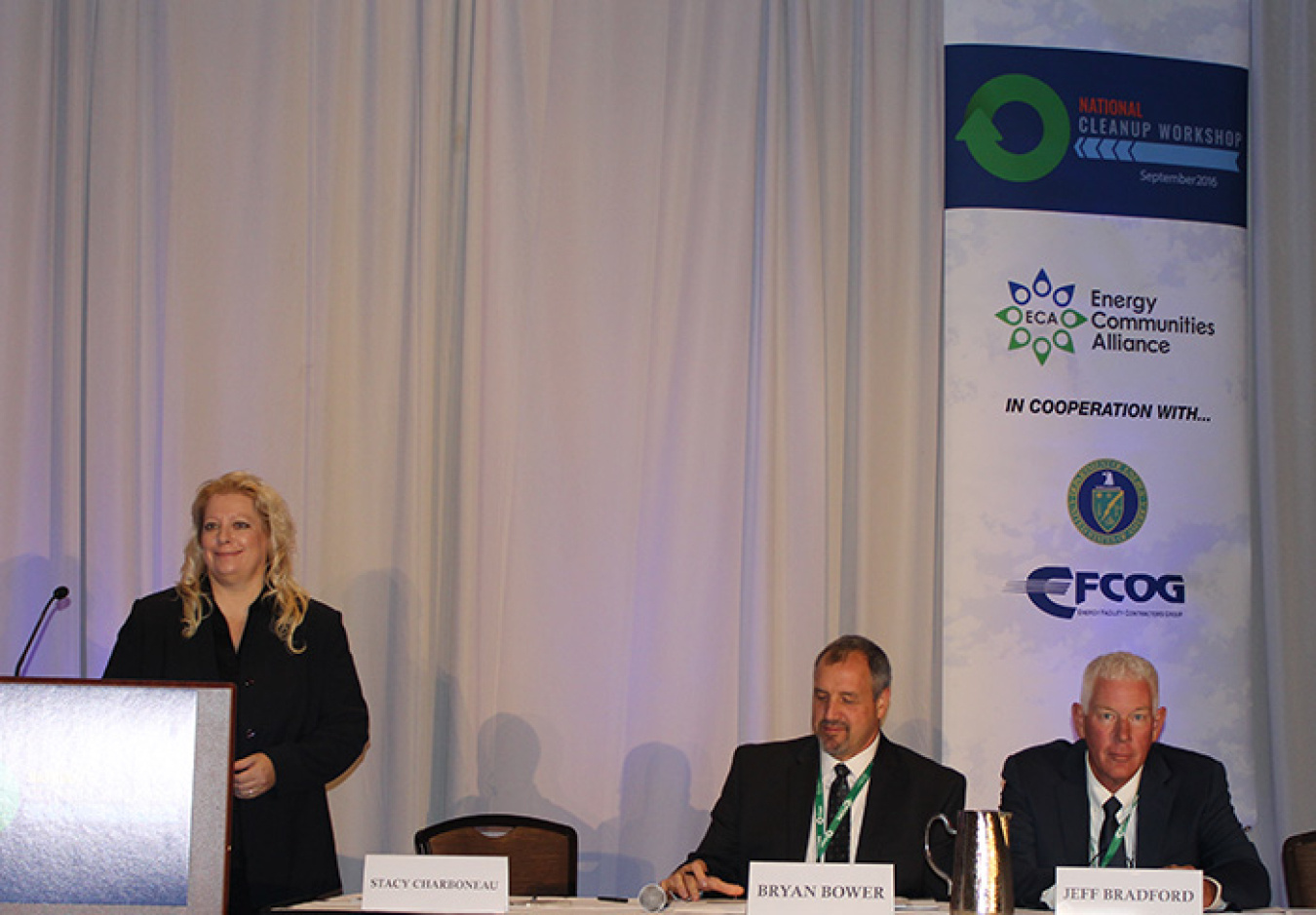
EM Associate Principal Deputy Assistant Secretary for Field Operations Stacy Charboneau, far left, addresses attendees at the National Cleanup Workshop. West Valley Demonstration Project Director Bryan Bower and CH2M HILL BWXT West Valley President and General Manager Jeff Bradford are at right.
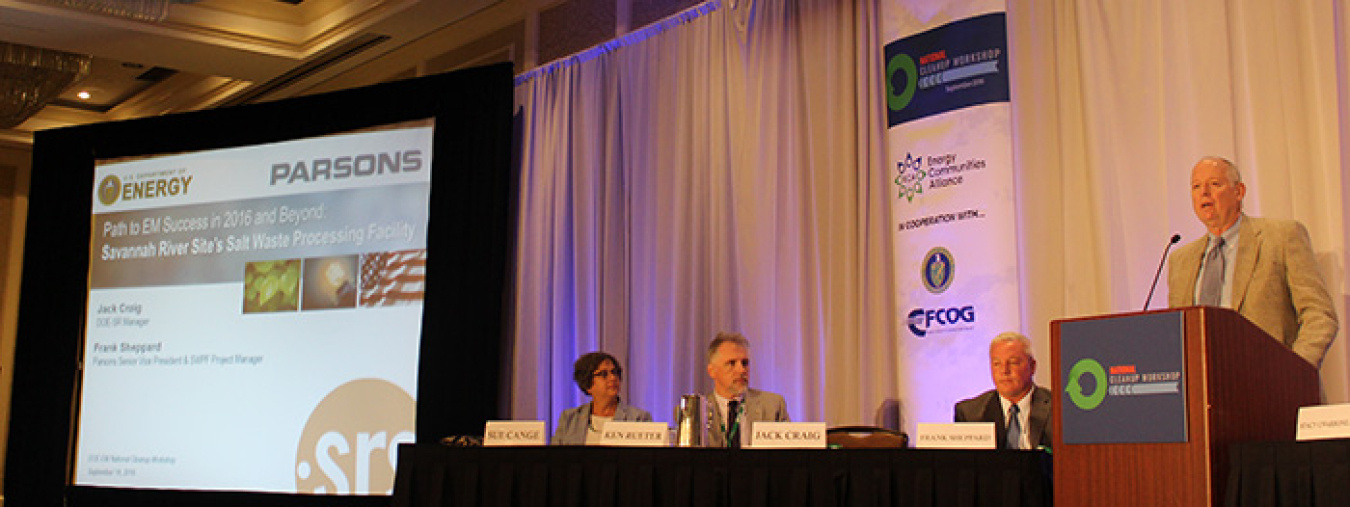
Savannah River Operations Office Manager Jack Craig, far right, discusses Savannah River Site successes. Other panelists included, left to right, Oak Ridge Office of Environmental Management Manager Sue Cange, URS-CH2M Oak Ridge President and Project Manager Ken Rueter and Parsons Senior Vice President and Project Manager Frank Sheppard.
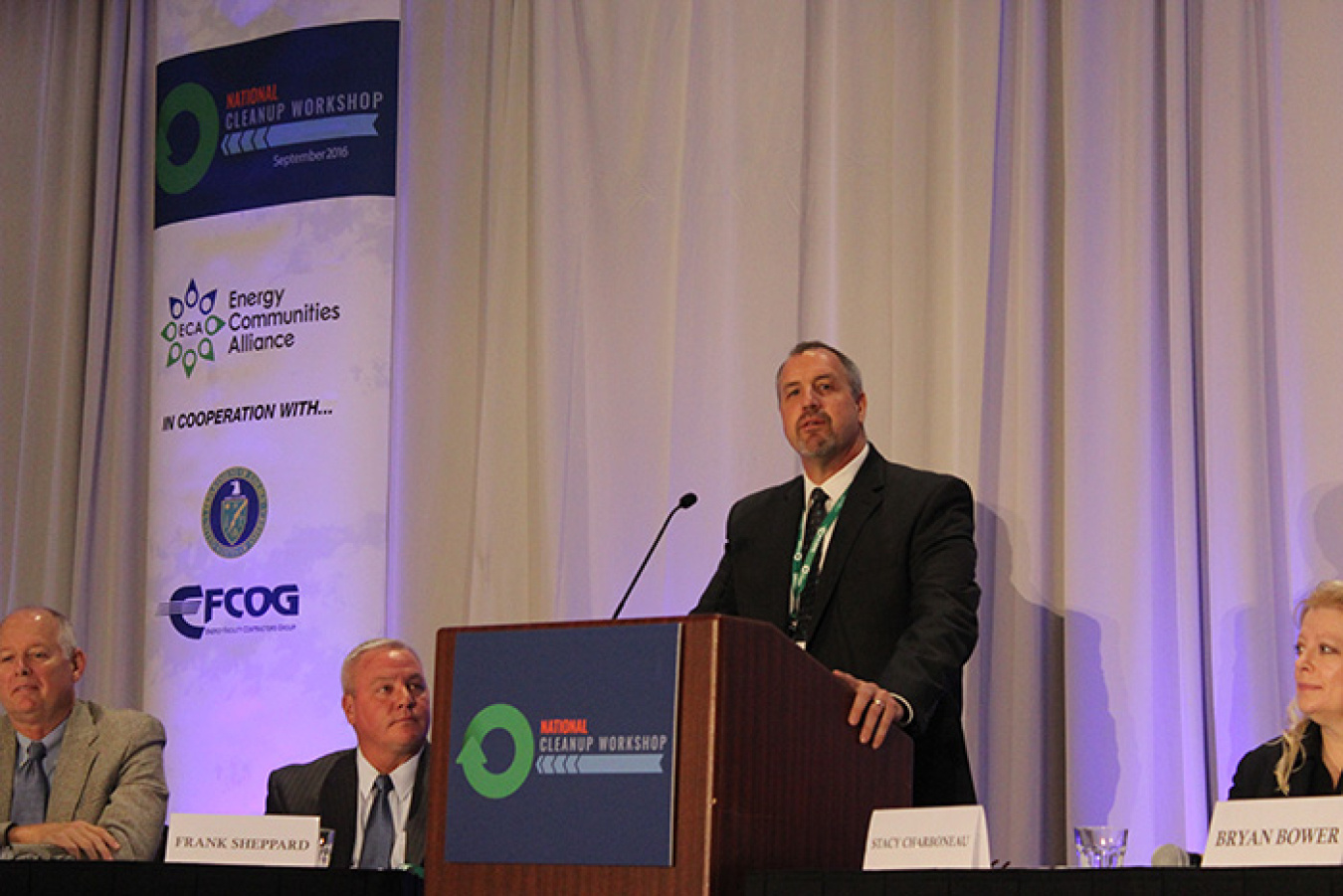
West Valley Demonstration Project Director Bryan Bower shares achievements at the EM site in New York state.
ALEXANDRIA, Va. – A central theme of the “Path to EM Success in 2016 and Beyond” session at the recent National Cleanup Workshop was how EM, its site workers, regulatory agencies, states and communities will build on successful cleanup to achieve goals at Oak Ridge in Tennessee, Savannah River Site (SRS) in South Carolina and the West Valley Demonstration Project (WVDP) in New York.
Officials provided a snapshot of work completed over the last several years to deactivate and demolish the five gaseous diffusion plants at the East Tennessee Technology Park (ETTP) in Oak Ridge, complete construction and begin startup of the Salt Waste Processing Facility (SWPF) at SRS and prepare for demolition of former spent fuel reprocessing facilities at WVDP.
EM Associate Principal Deputy Assistant Secretary for Field Operations Stacy Charboneau facilitated the discussion by site federal and contractor officials.
“The achievements we have realized, and are continuing to realize, at Oak Ridge, Savannah River and West Valley not only benefit those individual sites, but the EM program as a whole,” Charboneau said. “When one site marks a significant accomplishment, it shows all of our stakeholders across the country what the EM program can achieve and why we are worthy of their continued trust and support.”
Oak Ridge officials recognized a decade of work that led to the recent ETTP accomplishment and discussed the vision to complete cleanup there by 2020 and remediate the Y-12 National Security Complex.
“ETTP is the next site in the EM complex that will close, and we are extremely excited that this goal is clearly within grasp,” said Sue Cange, manager of the Oak Ridge Office of Environmental Management. “Future plans call for transferring parcels of cleaned-up land to the City of Oak Ridge and the Community Reuse Organization of East Tennessee. We’re working together to transform the site into a private-sector, brownfield complex capable of creating hundreds of jobs and millions of dollars in capital investment for the region.”
Ken Rueter, president and project manager of ETTP cleanup contractor URS-CH2M Oak Ridge, noted statistics that underscore the project’s safe, effective performance:
- Five enormous gaseous diffusion facilities demolished, the largest accumulation of Category 2 nuclear facilities in the world;
- 56,000 truckloads of waste transported with 3.6 million miles driven safely; and
- $1.12 worth of work delivered for every dollar spent, while working ahead of schedule.
Preparing for SWPF Operations
Construction of SWPF was a 10-year effort completed eight months ahead of the target schedule and more than $60 million under the target cost for construction activities from Dec. 31, 2012 through the end of construction. SRS officials discussed plans for the commissioning and startup in the years ahead.
“It takes a lot of hard work, good partnering, and a very talented workforce to achieve those results,” said Jack Craig, manager of the DOE Savannah River Operations Office. “It also takes partnering with the community, and we will be relying on continued safe performance of work and our partnerships to achieve our goal of starting up SWPF in two years.”
SWPF will provide a tenfold increase in capacity for treating high-level waste in the site’s underground tanks. To date, EM and its contractors have emptied and closed 12 tanks, and SWPF will process the remaining 36 million gallons stored in 42 remaining tanks.
There is much work to do over the next two years to prepare SWPF for operations, said Frank Sheppard, senior vice president and project manager for Parsons, the contractor responsible for SWPF:
- 71 systems are being turned over from construction; and
- 60 systems operation tests need to be done with three completed so far.
“Completing systems operations tests in the facility’s control room was a key to being able to work more efficiently to control and complete the remaining tests,” said Sheppard. “Our goal is to finish testing as early as possible at the lowest cost.”
West Valley Prepares for Complex Work Ahead
WVDP officials discussed challenging work underway to remediate facilities that processed approximately 640 metric tons of commercial spent nuclear fuel. The highly complex, contaminated WVDP facility is at a site with an intricate regulatory framework, requiring extensive dialogue among agencies.
EM WVDP Director Bryan Bower pointed out that the cleanup is performed by EM and its contractor on a site owned by the State of New York and licensed by the Nuclear Regulatory Commission (NRC), with key partnerships in the stakeholder community.
“We’re making sure we all move forward with a common vision for the site,” said Bower. “Working with our counterparts at NRC and the state, as well as the community, we are putting the vision in front of the workforce so they can proceed with their talents to get the job done safely.”
Jeff Bradford, president and general manager of cleanup contractor CH2M HILL BWXT West Valley, also touched on the complexity of the Main Plant Processing Building that will be demolished once canisters of vitrified high-level waste are removed and placed in storage casks.
"This facility wasn’t built for demolition,” said Bradford. “It’s a real Rubik’s Cube and in really bad shape. We have multiple crews going into very hazardous environments, there’s a lot going on at the same time, and there’s not a lot of space in the facility for doing the very hazardous work inside.”
Bradford and Bower outlined the project’s legacy of success and the vision for critical work ahead:
- Workers have completed 90 percent of preparations for demolition in the Vitrification Facility and 50 percent of preparations in the Main Plant Process Building. Demolition of the Vitrification Facility is scheduled to begin in March 2017 and be completed that year. Demolition of the Main Plant Process Building is scheduled to begin in 2018.
- 150 of the 278 canisters of high-level waste in the facility have been decontaminated and placed in storage casks, with 30 of 56 casks loaded and moved to a storage pad near the facility. West Valley is on track to finish removing the high-level waste canisters from the Main Plant Process Building in December 2016 – one year ahead of schedule.
- EM is working with the State of New York, NRC, the Environmental Protection Agency and stakeholders to determine plans for future cleanup of the site in the years ahead. Final decisions still need to be made for decommissioning of the waste tank farm (with four underground tanks) and two permitted landfills for radioactive waste.
“All of these accomplishments across the EM program are due to the workers at our sites, who perform their activities day-in and day-out safely and efficiently,” Charboneau said. “It’s my job and the job of all of us at EM headquarters to do what we can to continue to aid the field in achieving progress."