



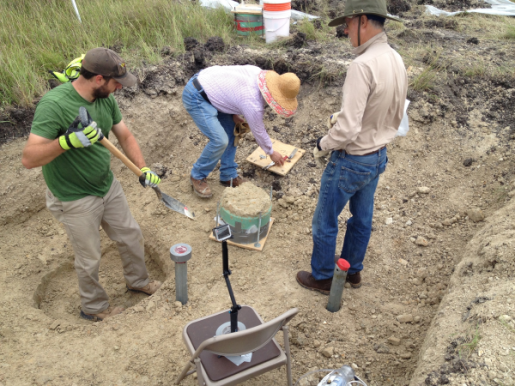
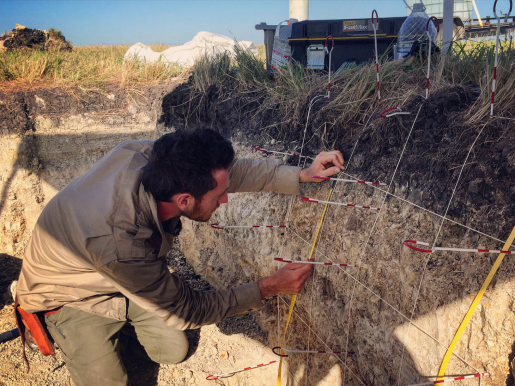
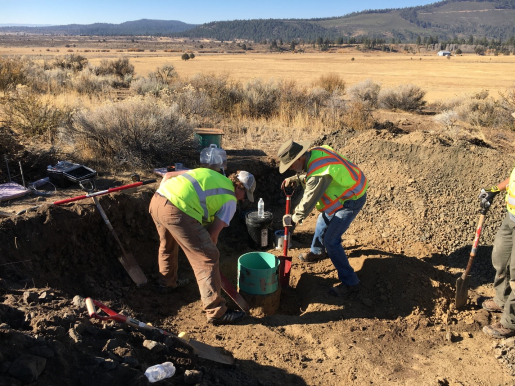
AS&T scientists and collaborators extracting an intact block sample of the Falls City, Texas, Disposal Site radon barrier to be submitted for lab analyses of soil engineering properties.
Applied Studies and Technology (AS&T) is at the core of LM’s efforts to use scientific understanding and technology to make remedies more protective, sustainable, and cost effective long term. Besides conducting independent technical investigations, AS&T works with other federal agencies, the environmental community, universities, national laboratories, and the international scientific community to benefit LM’s long-term surveillance and maintenance mission.
2025 Reports
- Applied Studies and Technology Fiscal Year 2025 Annual Report
- Soil Morphology and Plant Ecology at the UMTRCA Title I Disposal Cell and Natural Analogue at the Lakeview, Oregon, Disposal Site
- Applied Studies and Technology (AS&T) Soil Morphology and Plant Ecology at the Disposal Cells and Natural Analogues at the UMTRCA Title II Bluewater, New Mexico, Disposal Site
- Soil Morphology and Plant Ecology at the UMTRCA Title I Disposal Cell, and Natural Analogue at Falls City, Texas
- Supplemental Soil Data Report, UMTRCA Title II Bluewater, New Mexico, Disposal Site
- NNLEMS - National Lab Capabilities in Unmanned Aerial Systems
- Impact of Grazing Duration and Environment on Soil Carbon in Reclaimed Uranium Mines Tailings
2024 Reports
- Combining fission‑track radiography and scanning electron microscopy to identify uranium host phases
- Contaminant mobilization from the vadose zone to groundwater during experimental river flooding events
- Cover Enhancements at the Rifle, Colorado, Disposal Site Technical Approach for Pilot Tests
- Applied Studies and Technology Fiscal Year 2024 Annual Report
- Multi-source machine learning and spaceborne remote sensing data
- Field Hydrology of Armored Earthen Final Covers with and without Vegetation
2023 Reports
- Applied Studies and Technology Fiscal Year 2023 Annual Briefing
- Appendix A - Field Notes and Data Books Scans.
- Appendixes B through I.
- Appendix J - Graphical Results
2022 Reports
2020 Reports
2019 Reports
- Three Years of Multilevel Monitoring Data at the Riverton, Wyoming, Processing Site That Show Contaminant Increases After River Flooding Events and a Large Recharge Event Report
- Three Years of Multilevel Monitoring Data at the Riverton, Wyoming, Processing Site That Show Contaminant Increases After River Flooding Events and a Large Recharge Event Report Appendix
2018 Reports
The AS&T team supports long-term maintenance at LM sites across the United States by providing technical consultations, surveys, data evaluation, design review, advanced technology application, and technical reporting. Examples include the following:
- Utilizing vegetated test plots on disposal cells to understand how natural processes help prevent water from percolating into the cells
- Collecting data from lysimeters to measure the long-term efficacy of different types of disposal cell covers
- Reviewing original disposal cell design and construction documents to understand how cells change over time and anticipate risks from erosion and natural soil‑forming processes
- Conducting enhanced site inspections to assess the effects of erosion on disposal cells and to assist LM in making decisions to address it
- Conducting flume studies in collaboration with the Colorado State University Hydraulics Laboratory and the Nuclear Regulatory Commission (NRC) to test how various disposal cell cover material configurations perform under simulated flood conditions
- Applying advances in machine learning (ML) to more efficiently monitor disposal cell integrity over the long term
Present-day environmental work relies on advanced technology such as remote sensing coupled with machine learning to draw conclusions from large quantities of data. The AS&T team utilizes satellite imagery, aerial data, ground data, and geographic information systems to make environmental assessments over large, remote areas. These assessments include detecting changes at disposal sites, evaluating disposal cell cover integrity, and predicting damage from natural forces before it threatens cell performance.
AS&T’s Educational Collaboration initiative supports DOE’s commitment to STEM education in the following ways:
- Presenting guest lectures, workshops, and seminars to undergraduate and graduate students
- Contributing to curriculum development to ensure relevance to careers that support LM’s mission
- Supporting scientists in communities impacted by DOE’s historic mission
- Offering undergraduate and graduate internships that support LM’s mission, including projects addressing disposal cell water balance studies, tailings geochemistry, hydraulic flume testing, robotics-enabled remote sensing, and machine learning-assisted modeling