



Expanding electric transmission capacity in the United States is essential to meet growing demand for electricity. The Coordinated Interagency Transmission Authorizations and Permits (CITAP) Program will make the federal permitting process for transmission infrastructure more efficient and effective without sacrificing the quality of environmental reviews. The program establishes the U.S. Department of Energy (DOE) as the lead agency to coordinate and accelerate federal environmental reviews and permitting processes for qualifying electric transmission facilities.
CITAP Online Portal
To facilitate communication and coordination, the Office of Electricity launched the CITAP online portal, a one-stop-shop for qualified transmission developers to track the status of their application, submit materials, and facilitate communication with DOE and other federal agencies. The secure, online portal will be used to share information that will inform Federal permitting agencies’ authorization decisions and enhance transparency.
Why is the CITAP Program important?
New electric transmission capacity in the United States is needed to ensure Americans have access to reliable, affordable, and secure energy. On average, Federal permitting for a new electric transmission line takes approximately four years. Many factors can contribute to lengthy transmission development timelines, such as prolonged and fractured planning processes, difficulty securing financing, and the need to navigate complex environmental permitting processes.
By enabling the United States to expand transmission capacity at a faster rate and streamlining the federal permitting process, the CITAP Program will help:
Increase grid resilience and reliability while lowering the cost of electricity for homes and businesses.
Image
Modernize aging electric infrastructure by expanding access to clean energy and advanced energy technologies.
Image
Reduce permitting delays and improve the efficiency of the permitting process for transmission project developers.
Image
Spur economic growth through more consistent project development and enable access to new markets.
Image

How does the CITAP Program work?
DOE released a final rule that will significantly streamline Federal environmental reviews and permitting processes for qualifying onshore electric transmission facilities, while ensuring meaningful engagement with Tribes, local communities, and other stakeholders.
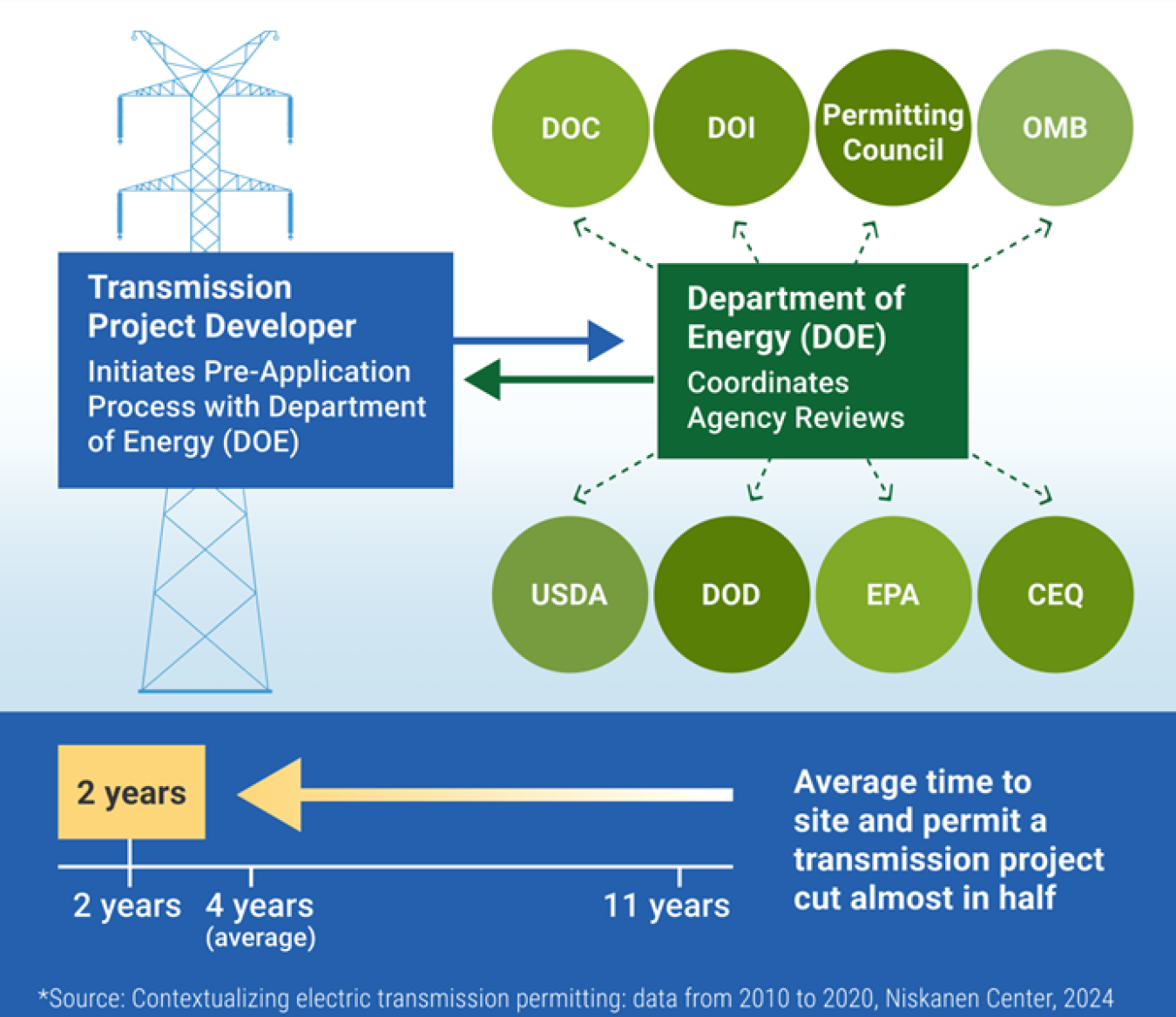
*Relevant federal agencies could include: Department of Agriculture (USDA), Department of Commerce (DOC), Department of Defense (DOD), Department of the Interior (DOI), Environmental Protection Agency (EPA), Federal Permitting Improvement Steering Council (Permitting Council), Council on Environmental Quality (CEQ), and the Office of Management and Budget (OMB)
**Contextualizing electric transmission permitting: data from 2010 to 2020, Niskanen Center, 2024
DOE will act as the lead agency to coordinate federal environmental reviews and authorizations to save both developers and federal agencies time and energy; prior to this program, transmission developers needed to navigate several unique, independent authorization and permitting processes set in place by multiple different agencies.
DOE will set a two-year deadline to issue permits and authorizations. If an agency does not adhere to the two-year deadline, then developers can begin a presidential appeal process to request the President to issue the appropriate permit. This will reduce the average time it takes to site and permit a transmission project by nearly half.
The coordinating functions of the CITAP Program will take place via the CITAP online portalThis was an empty link: , , which will allow project developers to directly upload relevant information and necessary documentation and will offer a centralized resource for Federal permitting communications. Through the portal, participating Federal agencies can view and provide input during the initial document collection process and during federal environmental reviews.
DOE requires transmission developers to develop a comprehensive public participation plan before they apply for federal authorizations and permits. This is a new and novel approach to transmission infrastructure development and will ensure that communities and key stakeholders are identified and accounted for at the onset of the permitting process.
Background and Standard Schedule
On April 25, 2024, the DOE announced a final transmission permitting reform rule that will streamline the transmission authorization process to a two-year timeline without sacrificing environmental reviews. By improving Federal transmission permitting processes and investing in transmission build out and grid upgrades, DOE is deploying a multifaceted approach to ensuring that Americans have clean, reliable, and affordable power when and where they need it.
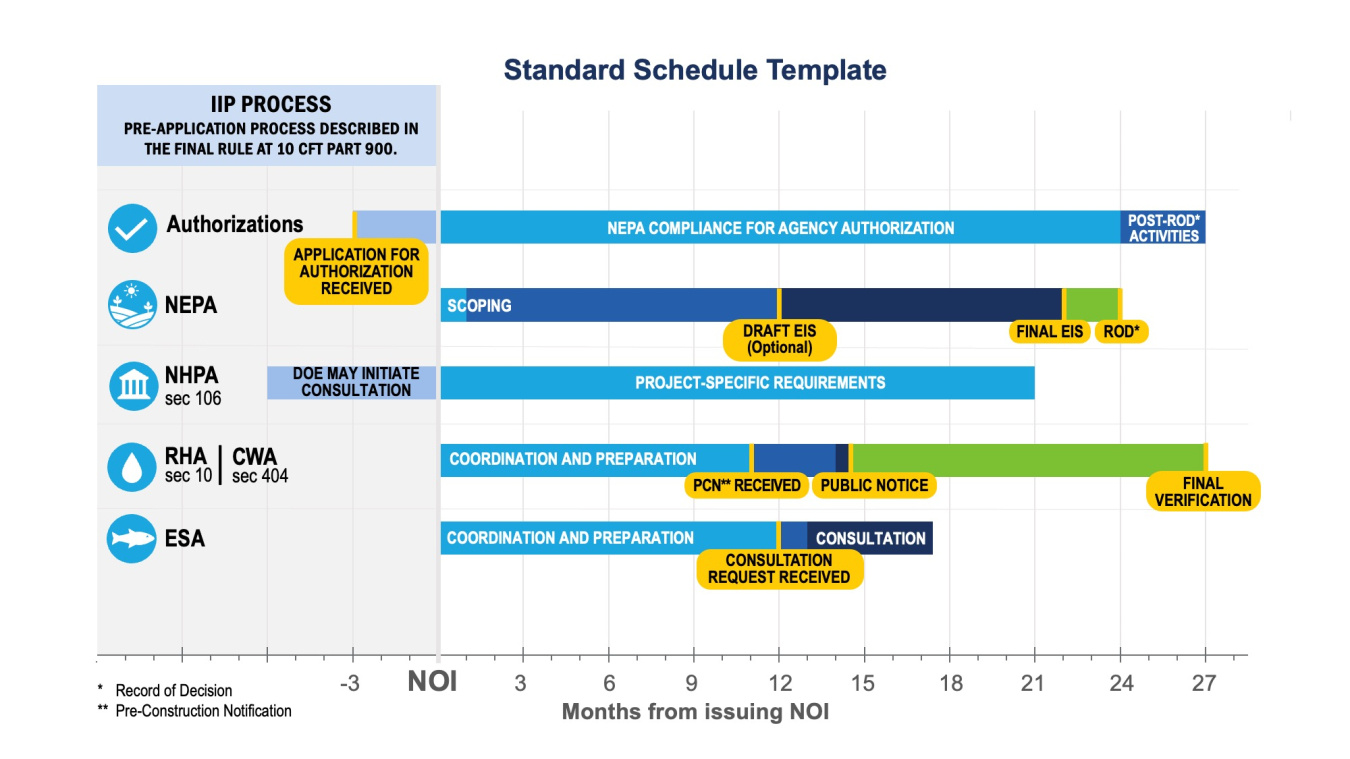
The Energy Policy Act of 2005 added Section 216(h) of the Federal Power Act. This provision of the law authorizes DOE to serve as the lead agency for coordinating all Federal authorizations and related environmental reviews necessary to site an electric transmission facility. In May 2023, nine federal agencies, including DOE, signed a Memorandum of Understanding to implement this authority to expedite the siting, permitting, and construction of electric transmission infrastructure in the United States while ensuring strong environmental protections and robust community engagement.
DOE released a final standard schedule template that outlines how Federal environmental reviews and transmission authorizations will be consolidated into a two-year review timeline.
During the pre-application process, DOE will work with applicants to collect all the necessary documentation and information that will be needed for any Federal environmental reviews and authorizations. DOE will also work with applicants and federal agencies to develop a project-specific schedule that incorporates robust analysis of project impacts and early and meaningful consultation with potentially affected Tribal Nations, communities, or other stakeholders.
Once the pre-application period is complete, the two-year review timeline clock will start. While the standard schedule is a template, each project may have its own project-specific schedule depending on its scope and location.
Frequently Asked Questions
What is the CITAP Program?
The Coordinated Interagency Authorizations and Permits (CITAP) Program implements Section 216(h) of the Federal Power Act to establish DOE as a coordinating entity between Federal agencies and relevant state and local actors responsible for permitting decisions necessary to site transmission lines.
Specifically, the CITAP Program:
- Establishes DOE as the lead agency to coordinate and accelerate Federal environmental reviews and permitting processes for qualifying electric transmission facilities.
- Sets a two-year binding schedule for Federal agencies without sacrificing the quality of environmental reviews and allows for an appeal, pursuant to statute, to the President, if deadlines are not met.
- Requires developers to submit a comprehensive public participation plan to ensure communities and key stakeholders are a part of the permitting process.
By acting as the lead agency, DOE will ultimately make the Federal permitting process more efficient. Whereas transmission developers used to navigate several unique, independent permitting processes and procedures set in place by multiple different agencies, DOE will now function as the lead point of contact and coordinate between developers and Federal agencies. Federal agencies will still make their own statutorily required decisions, but DOE’s coordination will assist developers in navigating those processes and develop a single environmental review document as the basis for all Federal decisions, reducing duplication of effort.
Ultimately, by enabling the U.S. to build new electric transmission infrastructure at a faster rate, CITAP will help increase access to a diversity of energy sources, reduce transmission congestion and energy prices, and deliver reliable, affordable power to consumers when and where they need it.
What is the purpose of the CITAP Program?
Expanded transmission capacity is desperately needed in the U.S. to enhance grid reliability, lower energy costs for families and businesses, and enable investment in American clean energy resources. But, currently, the process of developing and building transmission projects can take upwards of 10 years: the best available analysis finds it takes roughly 4 years for a new electric transmission line to complete an environmental impact statement, from Notice of Intent to Record of Decision. In fact, over the past decade, additional transmission capacity has been added at half of the average rate of the previous three decades. Lengthy review and permitting timelines make it difficult to build new transmission projects in a timely manner.
Through the CITAP Program, DOE is providing new services and resources to developers and other Federal agencies. The CITAP Program is intended to consolidate and accelerate the Federal environmental review and permitting processes for qualifying electric transmission facilities while ensuring that meaningful engagement with local communities, Tribes, landowners, and other stakeholders occurs early in the decision-making process and throughout the life of the project.
How does the CITAP Program work?
The CITAP Program begins with a preapplication process–the Integrated Interagency Preapplication (IIP) Process–and results in a DOE-led environmental review during which DOE will manage the timeline of Federal decisions on permits and authorizations. During the IIP Process, DOE will share documents and information and work iteratively with the developer and relevant Federal agencies to develop the information needed to conduct environmental reviews and authorizations. The information and document-sharing functions of the CITAP Program will take place via an online portal, which will engage participating agencies and allow agencies to view and provide input during the IIP Process and during Federal environmental reviews.
How does the CITAP Program enable energy development?
Historically, it has taken upward of a decade for new transmission projects to proceed through the development process and acquire the necessary permits and authorizations for construction. The CITAP Program will enhance and consolidate the Federal permitting and authorization processes to accelerate the development of new, large-scale transmission projects. Expanding transmission infrastructure will ensure that new reliable energy generation can connect to the grid and that the U.S. can reliably and affordably deliver clean energy from where it’s generated to where it’s consumed (e.g. homes and buildings).
Does the CITAP Program include community engagement?
The CITAP Program will improve public participation in siting and permitting of large interregional transmission projects beyond the status quo. While various Federal project authorizations and permitting procedures provide forums for public participation, the CITAP Program goes one step further by requiring developers to submit proactive project participation plans that outline specific opportunities for the public to participate in project decisions.
To apply to the CITAP Program, an applicant must include a public participation plan that conveys what public engagement they’ve conducted around their project thus far and planned future engagements. DOE and other relevant Federal and non-Federal entities will help developers iterate on their public participation plan to codify how the applicant will work with Tribes, local communities, and other stakeholders throughout the life of the project. The CITAP Program specifically encourages early engagement with Communities of Interest. Community of Interest is defined to include the following communities that could be affected by a proposed electric transmission project: disadvantaged communities; rural communities; Tribal communities; indigenous communities; geographically proximate communities; and energy communities. Importantly, outreach to Tribal communities under this definition is additional to, and not a substitute for, required Tribal engagement on the part of the project proponent or government-to-government consultation on the part of the Federal Government.
What transmission projects are eligible for the CITAP Program?
To participate in CITAP, a transmission project must satisfy the definition of “qualifying project”. A qualifying project is either:
A high-voltage electric transmission line (230 kV or above), or other regionally or nationally significant electric transmission lines, with attendant facilities that:
- Are used in interstate or international commerce; and
- Are expected to require an environmental impact statement; or
An electric transmission facility that is approved by the Director of the DOE’s Grid Deployment Office.
- Authorized under the Outer Continental Shelf Lands Act Section 8(p);
Qualifying projects do not include transmission facilities:
- Seeking a construction permit by FERC under Section 216(b) of the FPA 216; or
- Wholly located within the Electric Reliability Council of Texas.
Projects which are not eligible for the CITAP Program may still pursue their project outside of the program through regular avenues.
Why did DOE set 230kv, etc., for the qualifying project definition?
The CITAP Program is intended to efficiently use government resources by targeting projects that are the most likely to have significant permitting and authorization complexities while delivering significant benefits to consumers. Projects that do not automatically qualify for the CITAP Program still have an opportunity to gain entry to the Program, as the Department recognizes that the capacity of a proposed transmission line is not the only factor that can contribute to a project’s complexity.
How does this affect existing or under construction projects? Can those projects participate in this process?
Projects in any stage of development are not affected by the promulgation of the rule. Projects under development may still apply for the CITAP Program.
Is DOE targeting specific transmission projects through the CITAP Program?
No. The CITAP Program gives all applicants and proposed projects equal consideration and does not give preference for a specific transmission route or project.
How is DOE taking environmental impacts, including carbon emissions, into consideration through the rule?
At a high level, electric transmission facilities that will enter into the CITAP Program are likely to provide substantial benefits to consumers in the form of congestion relief, emissions reductions, and increased reliability and resilience, among other benefits, to ensure reliable, affordable power can be delivered to consumers when and where they need it.
In particular, DOE will coordinate all environmental reviews needed for authorizing the proposed project. Ultimately, DOE will complete a single environmental review document that will serve as the basis for all Federal decisions.
Specifically, applicants to the CITAP Program must submit resource reports which describe the proposed project and its impacts on land, water, animal life, and lifecycle emissions reduction. Within these resource reports, developers are required to provide estimates for reasonably foreseeable emissions from construction, operation, and maintenance, and reasonably foreseeable changes in greenhouse gas emissions and indirect emissions, along with a description of the reasonably foreseeable impacts from a failure of the proposed facility. After they are admitted to the program, developers will work with DOE during the preapplication process to continue building out these resource reports and collect the information necessary to obtain their respective authorizations and permits.
How will DOE ensure the quality of environmental reviews is maintained within a shorter timeline?
The CITAP Program does not fundamentally alter any environmental regulations or authorizations. DOE is only responsible for coordinating between agencies to have environmental reviews occur in parallel instead of in a piecemeal fashion; the single biggest delay in permitting and authorization approval timelines is the fact that developers have historically had to initiate and track individual review processes with separate Federal agencies, which can be difficult to align. DOE, through the CITAP Program, will coordinate with Federal agencies to align timelines and expectations without fundamentally altering any environmental review processes, and communicate this through the IIP Process, providing clarity and certainty to all parties. In addition, the IIP Process is designed to engage all impacted Federal agencies (and state and local siting authorities who choose to participate) and developers to develop information on potential environmental and cultural resource impacts of qualifying projects. The IIP Process improves the ability to obtain quality information on these impacts and analyze that information.
What’s the official process for participating in the CITAP Program? Is the public involved?
The first step in the CITAP Program is the Integrated Interagency Preapplication (IIP) Process, which requires developers to assemble the documentation they’ll need to facilitate the timely completion of Federal environmental reviews and permit authorizations. The IIP Process also helps developers build out and execute their public participation plan.
To apply for the CITAP Program, transmission developers may submit an initiation request to DOE. This includes a project summary and a project participation plan that highlights public engagement conducted thus far for the project and details of planned future engagements. DOE will then disseminate these materials to relevant Federal agencies and determine within 20 days if the project meets the necessary requirements to move forward in the CITAP Program.
If accepted, developers will work together with DOE and other Federal agencies to gather the information necessary to facilitate timely completion of various required Federal environmental reviews such as those conducted in compliance with the Endangered Species Act, the National Historic Preservation Act, Clean Water Act, and others.
During the pre-application process, DOE also encourages developers to schedule timely and focused meetings with relevant Federal and non-Federal entities to help identify potential siting constraints and opportunities while promoting thorough and consistent stakeholder engagement by the developer. At the close-out of the preapplication process, DOE will coordinate with the developer and other Federal agencies to design a project-specific schedule.
What is the Standard Schedule?
The standard schedule is a template that aims to consolidate all the Federal environmental reviews and authorizations for a transmission project into a two-year review timeline that begins with the issuance of a Notice of Intent (NOI) to prepare an Environmental Impact Statement (EIS).
Whereas the standard schedule is a template, each project will have its own specific milestones and requirements depending on its scope and location, which will include robust analysis of project impacts and early and meaningful consultation with potentially affected Tribal Nations, communities, and other stakeholders. DOE and applicants will develop the project-specific schedule during the preapplication process (IIP Process). DOE is then responsible for holding both developers and Federal agencies to the timelines and milestones set in the project-specific schedule.
How is CITAP different from the National Interest Electric Transmission Corridor (NIETC) Program?
The NIETC and CITAP Programs are distinct and unique programs. Through the CITAP Program (Section 216(h) of the Federal Power Act (FPA)), DOE will serve in a coordination capacity across the Federal government to set and maintain a schedule for environmental review of permits and authorizations for transmission projects within two years of the publication of a Notice of Intent (NOI) to prepare an environmental review document.
The NIETC Program derives its authority from Section 216(a) of the FPA. NIETC identifies areas where transmission infrastructure development is in the national interest. However, projects in these geographic areas may be eligible for coordination under the CITAP Program or by the Federal Energy Regulatory Commission (FERC).
What is FERC’s permitting role?
Section 216(b) of the FPA establishes FERC backstop permitting authority for NIETC projects.
Once DOE designates a NIETC, developers of transmission projects within the NIETC may apply to FERC for permits for the construction or modification of transmission facilities. FERC has the authority to issue permits within a corridor in certain circumstances where states lack authority to site the project, have not acted on an application after more than one year, or have denied an application.
If a transmission project is seeking a permit from FERC under Section 216(b) of the FPA, Federal environmental reviews and authorizations will be coordinated by FERC; in these instances the projects are not eligible to participate in the CITAP Program. However, Projects in NIETCs not seeking permits from FERC under this section would still be eligible for the CITAP Program.
Does this rule duplicate or exceed state regulatory application requirements, regional transmission organization stakeholder processes, or required Federal, state and local permitting functions?
No. The CITAP Program is intended to avoid the duplication of cost and effort that transmission developers and Federal agencies face in navigating the series of Federal authorizations necessary to site a transmission line and to allow both the project proponent and Federal agencies to avoid time- and resource-consuming pitfalls that would otherwise appear during the application process.
Can state siting authorities engage in the CITAP Program?
Yes. State siting authorities may, on a voluntary basis, participate in the CITAP Program alongside the participating Federal agencies and use the processes established by the CITAP Program, including IIP Process, DOE coordination, and DOE’s single environmental review document, as a basis for their own decision-making.
The 2005 Energy Policy Act (EPAct 2005) recognized the need for increased efficiency in the authorization process for electric transmission facilities and established a national policy to enhance the coordination and communication among Federal agencies with authority to site electric transmission facilities. Specifically, EPAct 2005 added Section 216(h) to the FPA, which designated DOE as the lead agency to coordinate all Federal authorizations and related environmental reviews needed for siting interstate electric transmission projects, including National Environmental Policy Act of 1969 (NEPA) reviews.
To implement the use of the authority granted to DOE under these two pieces of legislation and update the implementation of Section 216(h), DOE entered into a Memorandum of Understanding (MOU) with eight other Federal in May 2023 (2023 MOU). In the 2023 MOU, signatory agencies agreed to procedures through which DOE would coordinate Federal environmental reviews and authorizations required for electric transmission facilities under its authority in Section 216(h) of the FPA. You can read the full 2023 MOU on DOE’s website.
Following the signing of the 2023 MOU, DOE released a Notice of Proposed Rulemaking (NOPR) in August 2023 to establish the CITAP Program. DOE then opened a 45-day window for public comment on the proposed rule.
Who are the signatory agencies of the MOU?
The signatory agencies are:
- U.S. Department of Agriculture
- Department of Commerce
- Department of Defense
- Department of Energy
- the Environmental Protection Agency
- the Council on Environmental Quality
- the Federal Permitting Improvement Steering Council
- Department of the Interior
- the Office of Management and Budget.
Who was consulted during the development of the final rule? Was there a public comment process? Is there still a public docket?
The public docket, which includes all public comments and ex parte communications, is available on regulations.gov.
DOE developed the proposed rule with substantive engagement from other Federal entities through the interagency review process. DOE then provided a 45-day public comment period during which DOE noticed and provided a public webinar open to anyone to attend, and organized briefings with interested groups to introduce the proposed rule and listen to comments.
Through its outreach efforts, DOE received 50 unique comments on the proposed rule, 27 of which generally supported the CITAP Program.
Resources
Contact Us
Questions and comments can be submitted to citap@hq.doe.gov.