



The Federal Energy Management Program (FEMP) identified cooling tower side stream filtration as a technology that offers key benefits to the federal sector, including the potential to reduce energy and water use, decrease operating costs, and extend cooling equipment life. This overview provides agencies with key information to deploy side stream filtration systems that may otherwise be overlooked.
Cooling towers reject heat from buildings and/or processes through evaporation of water to the atmosphere. Cooling towers are generally exposed to the surrounding environment and move large volumes of air through water to reject heat to the atmosphere. This makes them susceptible to dirt, debris, and biological contamination.
The combination of these environmental factors, cooling tower process, and source water quality contribute to four primary treatment concerns encountered in most open-recirculating cooling systems: corrosion, scaling, fouling, and microbiological activity. A portion of water must be periodically flushed from the system in a process called "blowdown" to keep these concerns under control.
Filtration and/or treatment can be used minimize these concerns, increasing the "cycles of concentration," e.g., the number of times water is recirculated in the cooling tower before blowdown is required. Increasing the cycles of concentration reduces the amount of water used for blowdown.
Technology Description
Side stream filtration systems constantly filter a portion of water to remove suspended solids and organics, reducing the likelihood of fouling, scaling, and microbiological growth. Side stream filters may be installed parallel to the collection basin or between the pump and heat exchanger as shown in Figure 1.
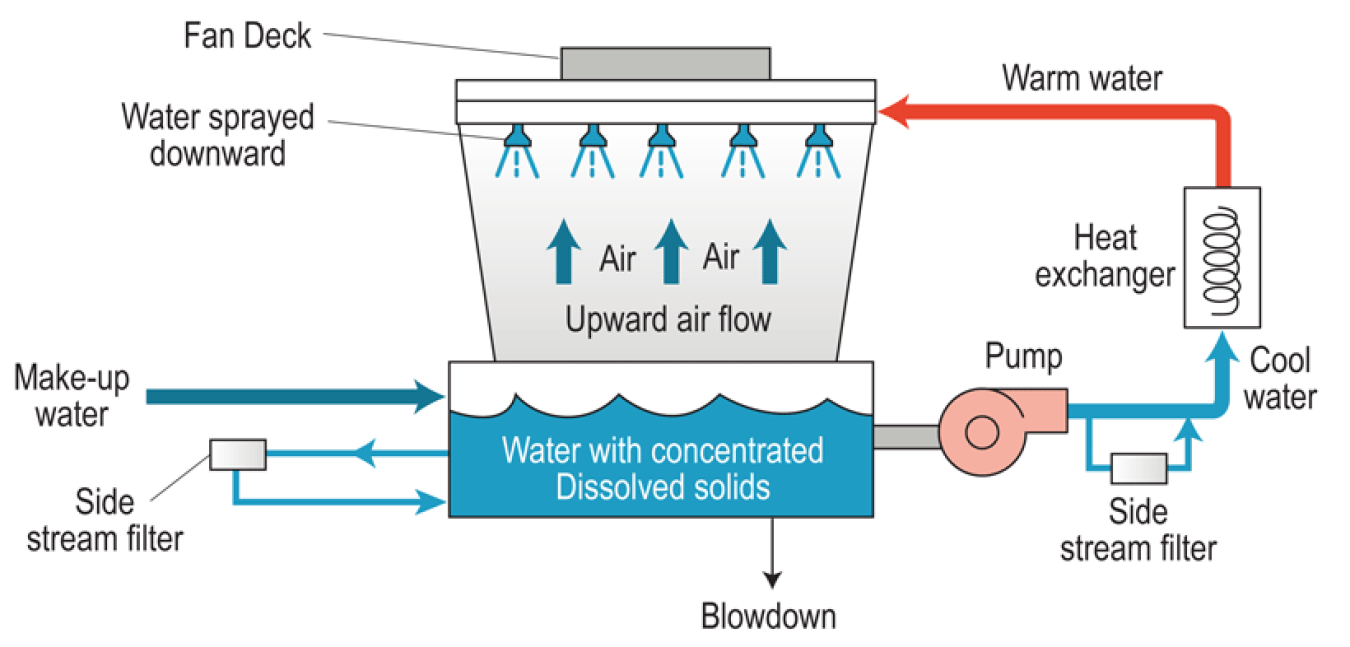
Figure 1. Cooling tower with two possible locations for side stream filtration
It should be noted that side stream filtration does not replace the need for chemical treatment. As ambient conditions and makeup water quality can vary significantly based on location, a water treatment specialist should be engaged to monitor and maintain cooling tower equipment for best performance and equipment life.
Side stream filtration has several benefits, as outlined below.
Reduces Fouling
Side stream filtration reduces suspended particles and helps to control microbiological activity by removing large particles that host microbiological growth. Fouling occurs when suspended particles or biological growth forms an insulating film on heat exchanger surfaces.
Reduces Scaling
Scaling occurs when dissolved minerals precipitate and form an insulating film on heat exchanger surfaces. Side stream filtration reduces fouling and corrosion by-products that act as nucleation sites for scaling.
Energy Savings
Fouling and scaling can cause a buildup of material on the heat exchanger surfaces, increasing the energy required by the chillers to remove heat from the system. Reducing fouling increases the heat transfer efficiency of the system, reducing energy use. Energy savings potential depends on the system configuration and conditions.
Water Savings
The increase in heat transfer efficiency decreases water loss due to evaporation. Additionally, side stream filtration reduces suspended solids, which can increase cycles of concentration due to blowdown. Water savings potential depends on the system configuration and conditions.
Mitigates Legionella
Side stream filtration removes large particles that host microbiological growth, which reduces the likelihood of Legionella forming in the cooling tower, which is a serious health concern.
Reduces Chemical Use
Chemical treatment is required to remove dissolved particles and microbiological growth. Solids buildup creates a buffer that reduces the effectiveness of chemical treatment. Therefore, removing suspended solids via side stream filtration can reduce chemical use.
Lower Upfront Filtration Cost
Side stream filtration continuously filters a portion of the water flow, which can be more cost effective than a full-flow filtration system, which must be sized to filter the full system recirculation rate.
Reduces O&M Costs
Side stream filtration reduces the frequency that cooling towers must be shut down for maintenance and extends the life of equipment. Traditionally, cooling towers are cleaned by draining the tower and removing sediment mechanically or manually from the sump. Side stream filtration allows cooling towers to operate for longer periods between full cleaning, reducing downtime, labor, water loss, and chemical use. Side stream filtration also reduces fouling and scaling on heat exchangers, which reduces the frequency that they must be taken offline for repairs.
Consider the following issues when investigating the deployment of side stream filtration:
- Side stream filtration is most beneficial for cooling tower systems that experience significant solids buildup, fouling and scaling concerns, and/or difficult biological issues.
- Side stream filtration does not remove dissolved particles. Additional water treatment (typically chemical) may be required to control scaling, microbiological activity, and corrosion issues.
- Cooling tower systems, local environmental conditions, and water quality vary significantly. Therefore, every system has different filtration needs.
- Particle size distribution and total suspended solids tests are inexpensive and can help determine the most appropriate filtration technology.
- Filters should be sized appropriately for a given application.
- Particle size distribution and total suspended solids tests are inexpensive and can help determine the most appropriate filtration technology.
- Side stream filtration is most beneficial for cooling tower systems that experience significant solids buildup, fouling and scaling concerns, and/or difficult biological issues.
Centrifugal separators remove solids from water by the centrifugal force developed as water passes through the device. Separators are fed high-velocity raw water to develop the circular flow pattern that produces the centrifugal action. This causes heavy solids that are suspended in the water to migrate toward the separator's sidewalls and downward, into a solids holding chamber. Filtered water rises through the vortex and is returned to the system through an outlet at the top of the separator. Solids collected in the holding chamber are periodically or continuously purged.
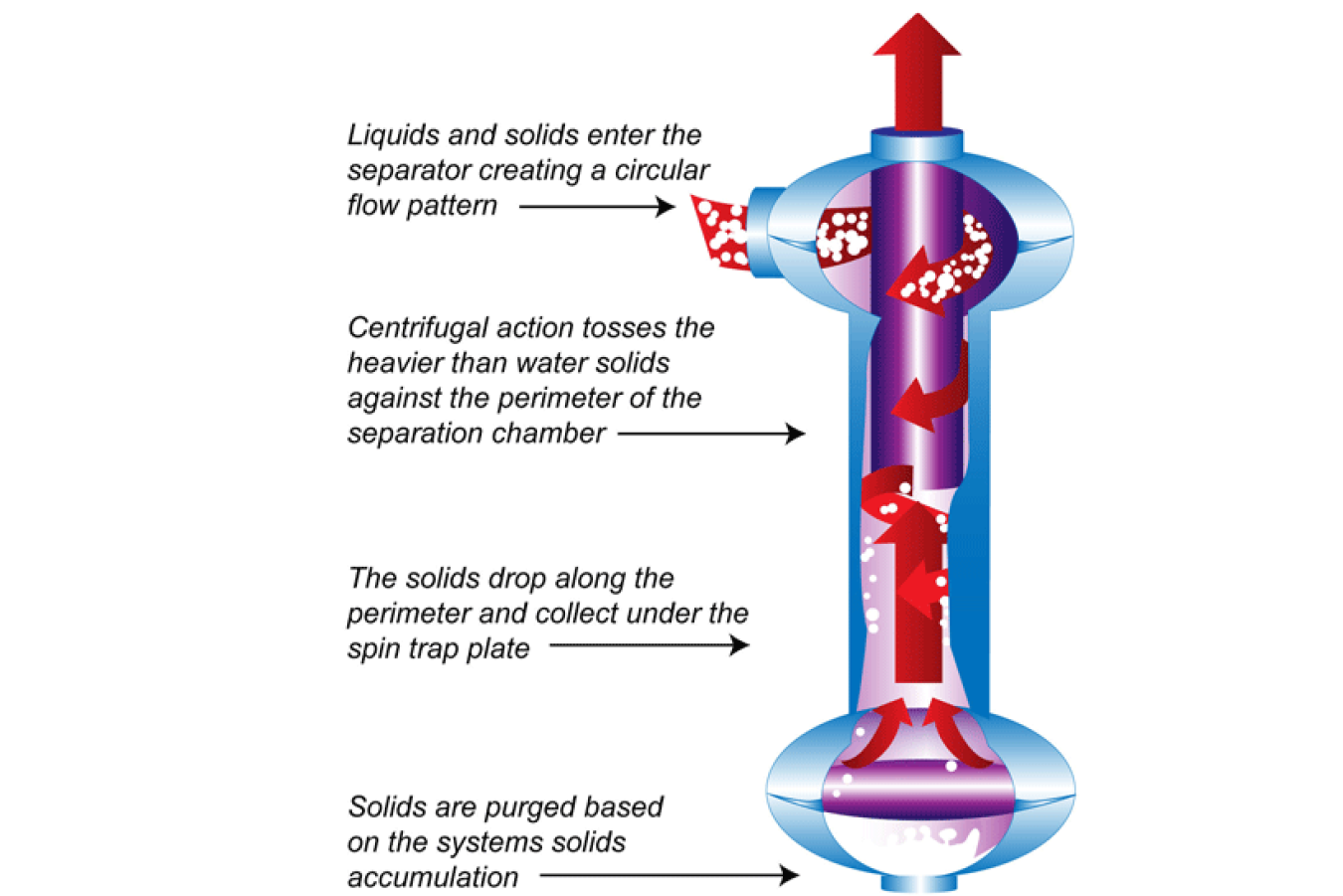
The capacity for solids removal is a function of particle density, size, and shape as well as device design. Centrifugal separators are most efficient at separating large, heavy particles. They require little maintenance and infrequent replacement.
An automatic screen filter, also known as a self-cleaning screen filter, uses system pressure to self-clean.
Cooling water enters the filter through an inlet and passes through a rigid cylindrical screen, trapping particles larger than the screen openings to form a filter cake. The buildup of the filter cake inside the screen causes a difference in pressure between the inlet and the outlet of the filter. A controller monitors the pressure in the filter and opens a flush valve when it senses a differential pressure threshold has been exceeded. When the flush valve opens, the difference between the water with higher pressure in the filter and the atmosphere causes high suction forces at the openings of each of the suction scanner nozzles. The suction force causes water to flow backward through the screen at a high velocity through each small nozzle, pulling the filter cake off the screen and out the suction scanner and flush valve to the drain.
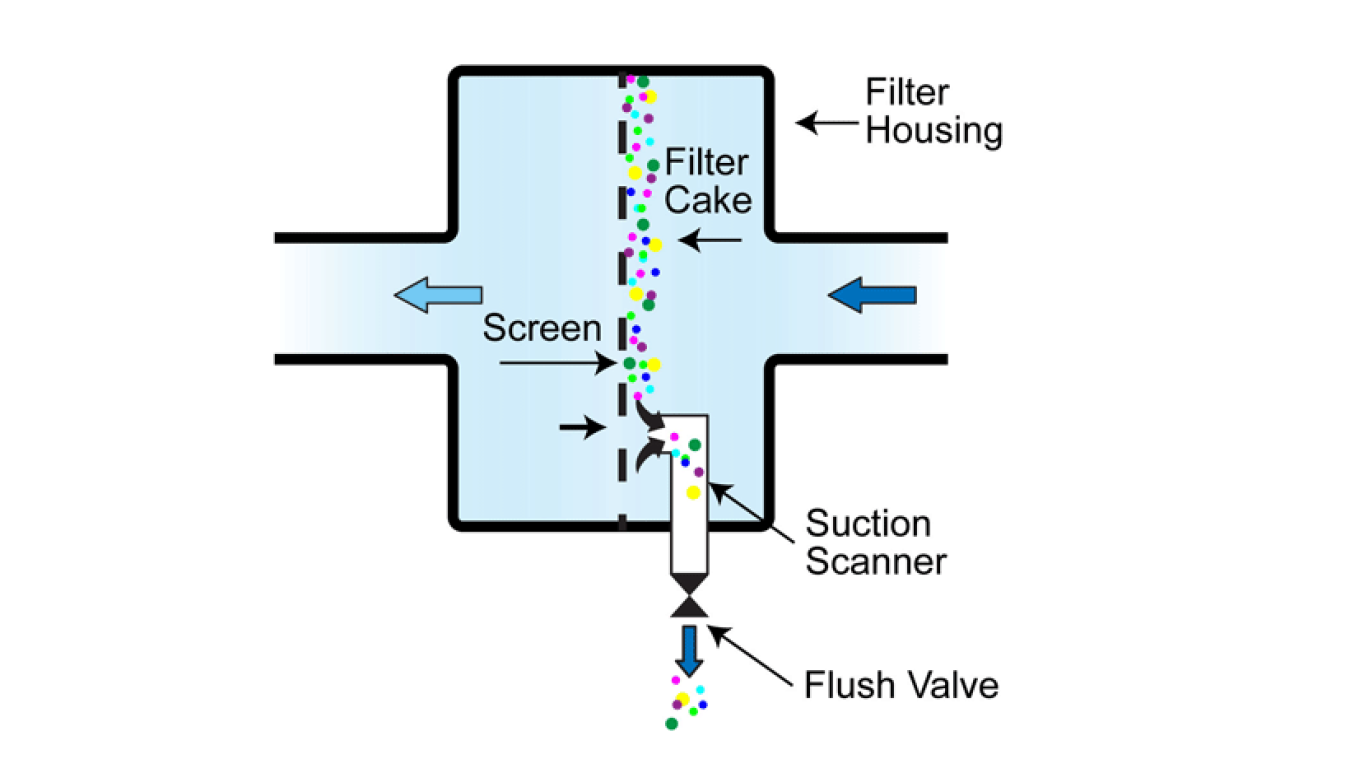
Automatic screen filters are appropriate for systems that cannot be interrupted, such as industrial processes and hospitals. It should be noted that automatic backwash components contain moving parts that may require frequent maintenance; however, the compartments require infrequent replacement.
Polypropylene discs are stacked together under pressure and grooved to filter particles of specific sizes. Each disc has etched grooves in a slightly different pattern array between the top and bottom of the disc. When multiple discs are stacked and centered around a skeletal cylindrical structure ("spine") the discs form a hollow cylinder with the ends of the grooves exposed to both the inside and outside surfaces of the cylinder. The different groove patterns of the stacked discs create intersections of different sizes to trap particles when water passes from the outside to the inside of the hollow cylinder.
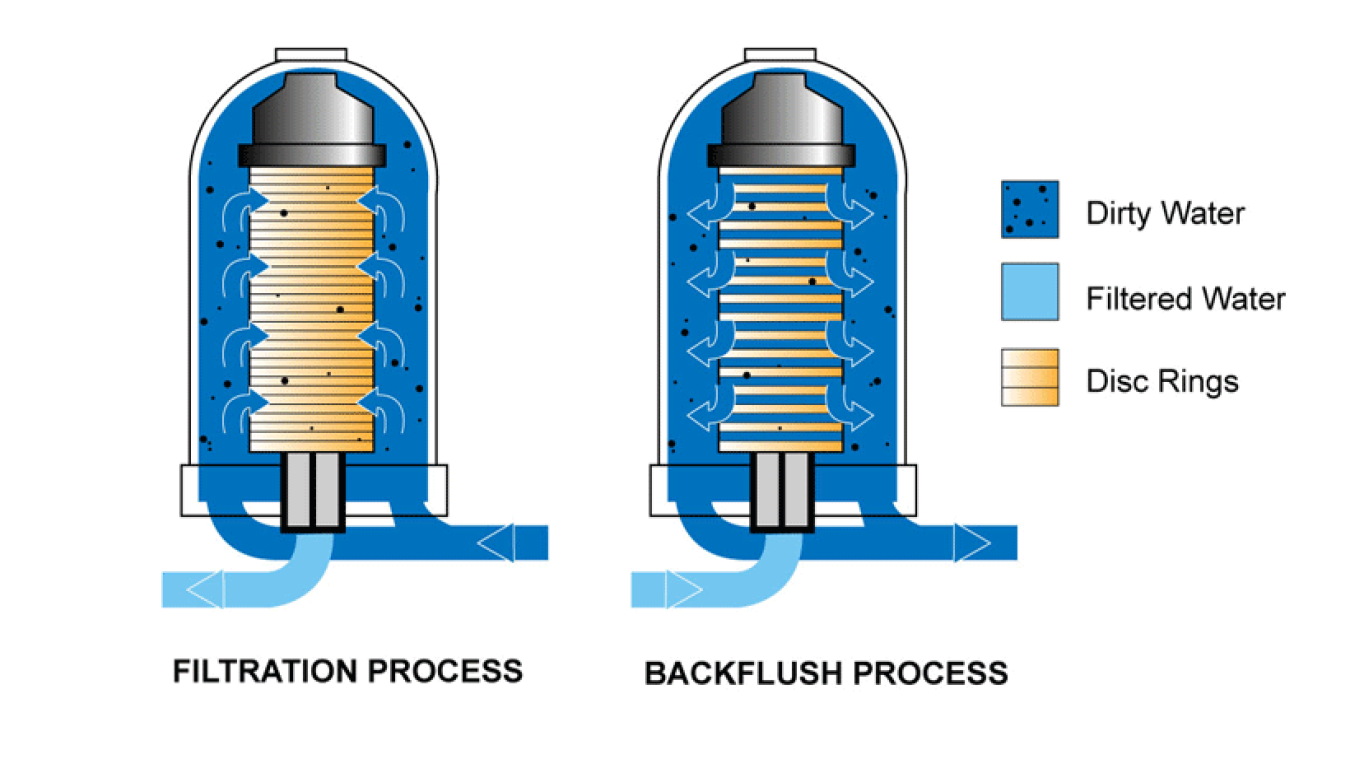
As particles are captured within the disc stack, a pressure differential is created. When a specified pressure differential or timing interval is reached, the stack pressure is relieved, and the filtered water is forced through the disc stack in reverse through several nozzles within the disc stack spine, cleaning the discs in 10–20 seconds. Disc filters can backflush multiple filters sequentially, and therefore, the filtration process is seldom interrupted.
Sand filters pass water from the top of their tanks through layers of sand and/or other media. Two filter configurations are common in cooling towers:
- One type forces pressurized water through layers of media from coarse to fine, trapping particles of increasingly smaller size.
- The other type uses a top layer of ultra-fine media and pressures water through an angled inlet, creating a vortex of water, which causes suspended solids to accumulate on the media bed and filter wall.
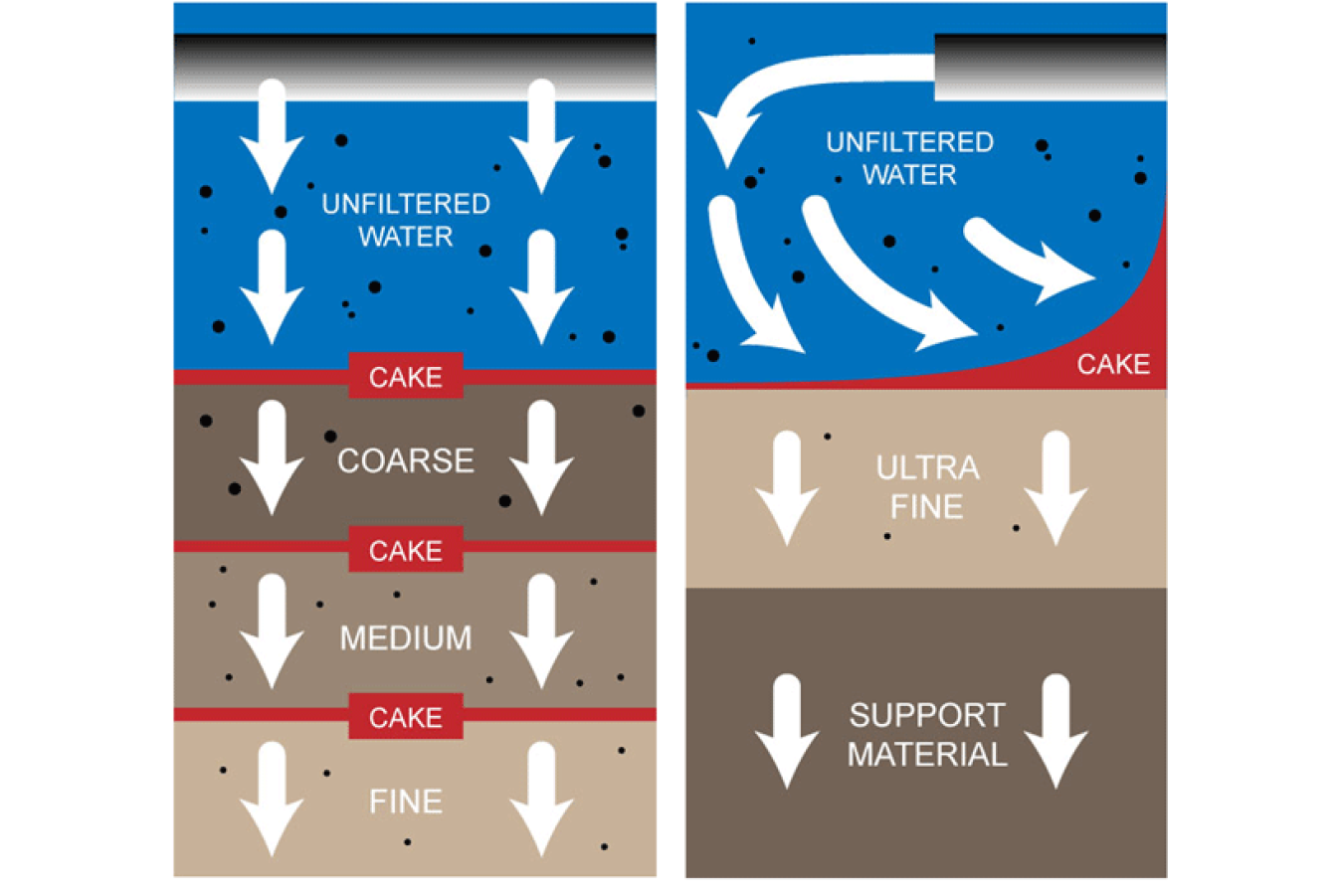
Two types of sand filter configurations.
Sand filters are usually very efficient at removing fine and low-density particles that cooling towers scrub from the air, but they are less effective at removing high-density sand-like particles because those particles cannot be effectively removed by backwashing.
Sand filters can promote biological growth due to the filter medium and increased temperature of recirculating water. Supplemental chlorine may be needed. Backwash in the reverse direction is used to clean the sand filter.
Sand filter media requires periodic inspection and replacement.
- One type forces pressurized water through layers of media from coarse to fine, trapping particles of increasingly smaller size.
Technology Option Comparison
Table 1 provides an overview of the side stream filtration technologies and key characteristics.
Table 1. Side Stream Filtration System Characteristics
|
Filter Type |
Filtering Mechanism |
Most Appropriate Applications |
Maintenance and Other Considerations |
|---|---|---|---|
|
Centrifugal Separators |
High-velocity water is fed in a circular pattern that moves heavier particles down and out of the system |
Best for removal of large, heavy particles |
Requires periodic inspection and servicing of purge components only |
|
Automatic Screen Filter |
Water moves through a rigid screen, where large particles are trapped and sucked out of the system |
Best for systems that cannot be interrupted, such as industrial processes and hospitals |
Automatic backwash components contain moving parts that may require frequent maintenance |
|
Plastic Disc Filter |
Grooved, stacked plates trap particles as water moves through the discs |
Appropriate where removal of both solids and organics are required |
Consumable discs may require frequent replacement |
|
Sand Filter |
Layers of granulated sand trap particles as water moves through the sand layers |
Best for applications that require the removal of fine and low-density particles |
Sand media and electromechanical parts require periodic inspection |
Additional Resources
For more information about cooling towers and water efficiency, see:
More Opportunities
Read about these additional water-efficient technology opportunities.