



The EEIO-IIA tool, currently in beta version 1.0, is an Excel-based scenario building tool that allows users to conduct rapid “what-if” analysis based on user-defined industrial impacts assumptions.
Industrial Technologies Office
September 25, 2023 minute read time
The Environmentally Extended Input-Output for Industrial Impacts Analysis Tool (EEIO-IIA), currently in beta version 1.0, is an Excel-based scenario building tool that allows users to conduct rapid “what-if” analysis based on user-defined industrial impacts assumptions. EEIO-IIA is a top-down, economy-scale model that represents the U.S. economy with 71 unique subsectors (25 of which are industrial sectors). The EEIO-IIA tool can be used to explore and visualize data for these 25 industrial subsectors. The tool has a 2018 base year, consistent with the Manufacturing Energy Consumption Survey.
Users can build impacts scenarios in the tool by modifying assumptions related to factors such as:
- U.S. Electric Grid Mix
- Fuel Mix & Electricity Use by Subsector
- Energy Requirements by Subsector
- Specific Technologies
- Product Demand Change by Subsector
EEIO-IIA also provides base-case (2018) summaries for each of the industrial subsectors included in the model. Base-case data for the industrial sector are shown in the figure below.
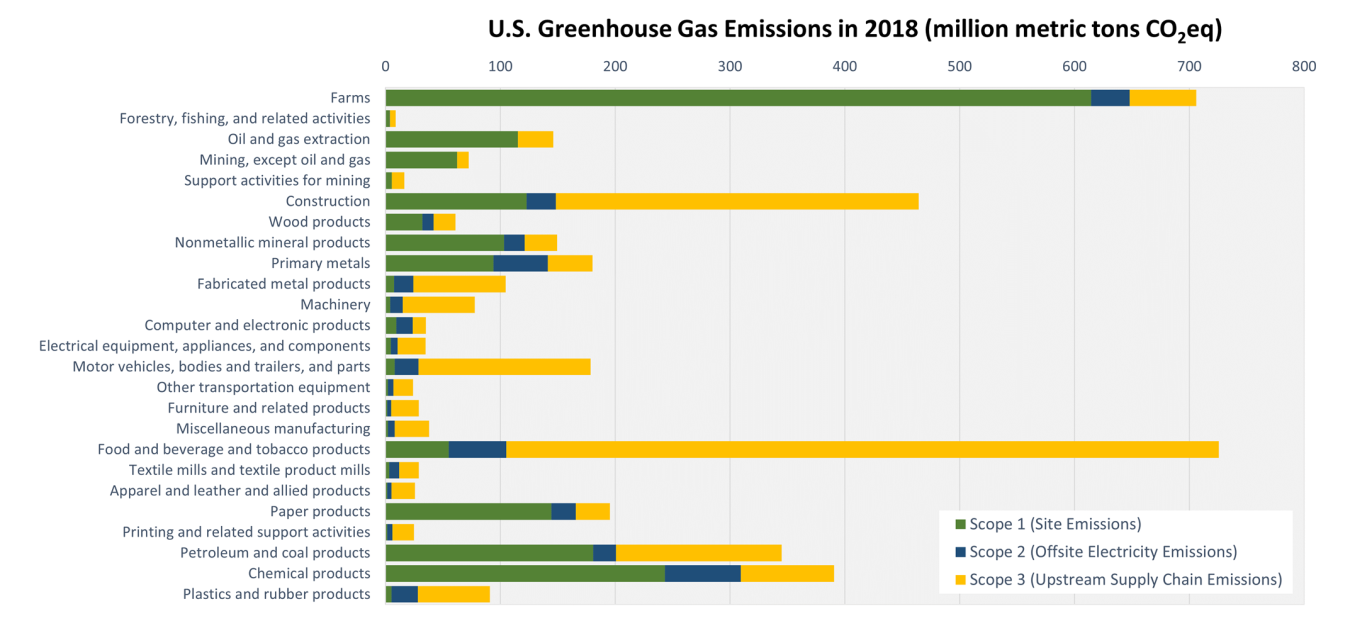
Download the EEIO-IIA Tool Overview & All Industrial Subsector Summaries to learn more about the tool’s functionality and see detailed base-case results for the 25 industrial subsectors in the model.
EEIO-IIA Industrial Subsector Summaries
Industrial Subsector Summaries for each of the 25 industrial subsectors included in the model are provided as supplementary resources to accompany the release of the EEIO-IIA tool. Results visualize the summary information for that subsector using base case EEIO-IIA data for 2018. These results for the 25 individual industrial subsectors are available through the links below.
- Farms
- Forestry, fishing, and related activities
- Oil and gas extraction
- Mining, except oil and gas
- Support activities for mining
- Construction
- Wood products
- Nonmetallic mineral products
- Primary metals
- Fabricated metal products
- Machinery
- Computer and electronic products
- Electrical equipment, appliances, and components
- Motor vehicles, bodies and trailers, and parts
- Other transportation equipment
- Furniture and related products
- Miscellaneous manufacturing
- Food and beverage and tobacco products
- Textile mills and textile product mills
- Apparel and leather and allied products
- Paper products
- Printing and related support activities
- Petroleum and coal products
- Chemical products
- Plastics and rubber products
Development Team
EEIO-IIA was conceived and developed by researchers at Energetics with funding from the U.S. Department of Energy’s Industrial Technologies Office (ITO).
Energetics Development Team:
Samuel Gause, Heather Liddell, Caroline Dollinger, Elvin Yüzügüllü, Jordan Steen, and Karla Morrissey
Advising:
Joe Cresko, U.S. Department of Energy
Sponsor:
Industrial Technologies Office, U.S. Department of Energy
Tool Download & Documentation
EEIO-IIA (in beta version 1.0) and its documentation can be downloaded from the following links:
EEIO-IIA Version 1.0.xlsx
EEIO-IIA Documentation.pdf
Contact:
The tool is currently in beta, and we are encouraging users to send feedback based on their experience. Please contact Samuel Gause (Samuel.Gause@ee.doe.gov) with any tool-specific comments or questions.