



What Are Low Temperature Geothermal Resources?
Low-temperature geothermal resources are generally considered those below 300°F (150°C). Low-temperature geothermal resources have many uses and can serve a wide array of community customers, including urban centers, rural areas, and remote communities.

Geothermal direct use is the use of geothermal energy for heating or other applications without first converting it to electricity. Direct-use applications draw thermal energy from the subsurface to the surface in order to directly provide it to buildings for heating or apply it to industrial processes like fish farming, greenhouses, or beer brewing.
Networked geothermal systems are geothermal systems connecting many buildings in a shared network, which can meet the heating and hot water demands of entire neighborhoods, city blocks, campuses, or communities. Rather than powering one building at a time, these systems provide heating and/or cooling to multiple homes or businesses together.
Geothermal heat pumps (GHPs), also known as ground-source heat pumps (GSHPs), can be used to heat and cool individual homes and buildings. GHPs efficiently exchange temperatures by using the constant temperature of the subsurface as a heat sink when ambient temperatures at the surface are hotter (e.g. during the summer) and a heat source when ambient temperatures are cooler (e.g. during the winter).
Increasingly, some low-temperature resources below 150°C can be used for power generation under the right conditions using binary cycle electricity generating technology, which passes low-temperature geothermal fluids through a heat exchanger with a secondary, or "binary," fluid that has a much lower boiling point than water. The modest heat from the geothermal fluid causes it to flash to vapor, which then drives the turbines, spins the generators, and creates electricity.
Underground Thermal Energy Storage (UTES) takes advantage of large subsurface storage capacities, geothermal gradients, and thermal insulation associated with deep geologic formations to store thermal energy that can be extracted later.
Under certain conditions, geothermal energy can be harnessed in combination with other energy technologies. Many types of hybrid systems exist and are commercially deployed already. The Office of Geothermal supports work to expand the efficiency and use of these systems, including through hybrid demonstrations as well as research on solar hybrids at geothermal fields and geothermal storage solutions. Check out these resources to learn more:
- GeoBridge - Geothermal Hybrids
- A Review on Geothermal-Solar Hybrid Systems for Power Production and Multigeneration Systems (2025)
- Geothermal Hybrid Systems: GeoVision Analysis Supporting Task Force Report (2019)
- Solar-Driven Steam Topping Cycle for a Binary Geothermal Power Plant (2018)
- Hybridizing a Geothermal Plant with Solar and Thermal Energy Storage to Enhance Power Generation (2018)
- Stillwater Hybrid Geo-Solar Power Plant Optimization Analyses (2015)
The Office of Geothermal's Research on Low Temperature and Coproduced Resources
The Office of Geothermal conducts research, development, and demonstration (RD&D) activities focused on improving the efficiency and utility of low-temperature geothermal systems.
The Office of Geothermal also researches the direct use of thermal resources for energy storage as well as process and space-heating applications, which have the potential to provide cost-effective, reliable thermal energy in large portions of the United States.
Learn about the Office of Geothermal's initiatives.
Initiatives
Direct Use and Thermal Energy Storage Projects
District-Scale Geothermal Energy Pilots
Federal Geothermal Partnerships
Technology Commercialization Fund
Direct Use and Thermal Energy Storage Projects
The Office of Geothermal is currently funding multiple projects focused on assessing and advancing direct use and thermal energy storage (TES) technologies.
- NrgTEK, Inc. – Electrical and Thermal Energy Storage for Geothermal Power Plants
- NLR – Reducing Data Center Peak Cooling Demand and Energy Costs with Underground Thermal Energy Storage (UTES)
- WVU – Geothermal Deep Direct-Use Combined with Reservoir Thermal Energy Storage on the West Virginia University Campus-Morgantown, WV
- NLR – Techno-economic Analysis and Market Potential of Reservoir Thermal Energy Storage (RTES) Charged with Solar Thermal and Heat Pumps
- NLR – UTES Seasonal Storage: ReEDS Model Development and Analysis
- Energy Discovery, Education, Learning & Tech - Energy DELTA Lab: Project Oasis
Learn more about these projects on the Office of Geothermal’s geothermal storage and direct use pages.
District-Scale Geothermal Energy Pilots

The District-Scale Geothermal Energy Pilots initiative, formerly the Community Geothermal Heating and Cooling (CommGeo) initiative, is supporting three communities to install district-scale geothermal heating and cooling systems, often referred to as Thermal Energy Networks, or TENs.
Federal Geothermal Partnerships

Under the Federal Geothermal (FedGeo) Partnerships initiative, Oak Ridge National Laboratory is leading a team of laboratories, universities, a state agency, and industry partners to provide technical assistance and help expand deployment of geothermal heating and cooling technology at federal sites.
GHP PATHs Prize
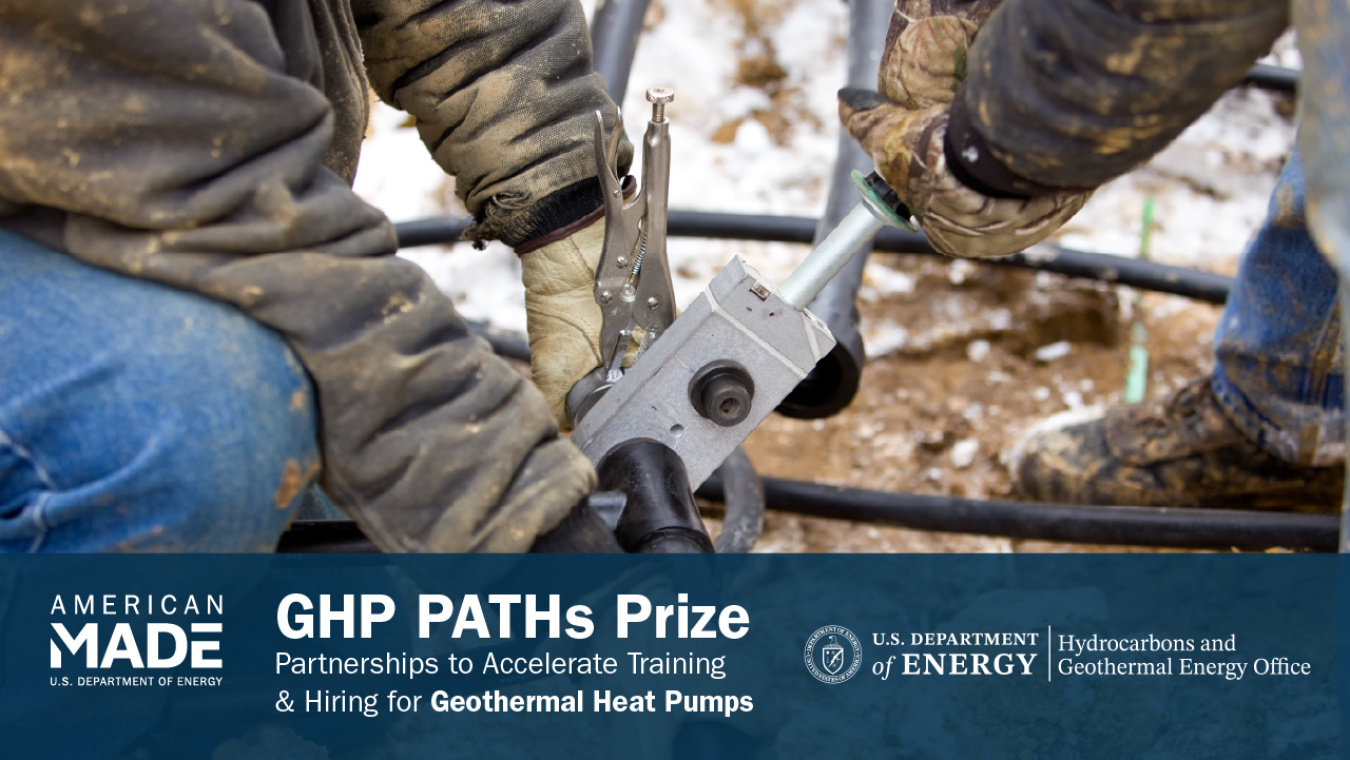
The $3M Partnerships to Accelerate Training & Hiring for Geothermal Heat Pumps (GHP PATHs) Prize aims to kickstart regional partnerships focused on streamlining workforce entry and growth for geothermal heat pumps by fostering connections and collaboration.
Technology Commercialization Fund
The Technology Commercialization Fund (TCF), coordinated by DOE’s Office of Technology Commercialization and supported by several DOE program offices, enables flexibility to promote promising energy technologies. In order to flexibly meet the power and thermal demands of buildings in an energy-efficient manner, Oak Ridge National Laboratory and Purdue University invented the dual-purpose underground thermal battery (DPUTB), under a TCF-funded project. The DPUTB integrates a ground heat exchanger and underground storage, enabling a building to reduce its peak electric demand and reduce its power consumption by 11% compared with the conventional heating, ventilation, and air conditioning system. This novel geothermal heat pump technology produces operational efficiency and energy savings in a simulated residential building with its ability to shift or level the electric load while reducing power consumption.
Resources
- GeoBridge: Networked Geothermal, Thermal Energy Storage, Direct-Use, and Low Temperature Power Generation
- GDR: District-Scale Geothermal Energy Pilots
- Geothermal Heat Pump Case Studies
- Grid Cost and Total Emissions Reductions Through Mass Deployment of Geothermal Heat Pumps for Building Heating and Cooling Electrification in the United States (2023)
- Overview of Available Low Temperature/Coproduced Resources in the U.S. (2015)
- A Technical and Economic Analysis of an Innovative Two-step Absorption System for Utilizing Low-temperature Geothermal Resources to Condition Commercial Building (2015)
Learn More
-
 The Office of Geothermal partners with industry, academia, U.S. Department of Energy national laboratories, and other entities to further the development of geothermal energy technologies.September 10, 2026
 -
 Visit this one-stop shop to see what the Office of Geothermal is working on. From the Salton Sea in California, to Utah’s Beaver County, to the U.S. Military Academy West Point in New York, the Office of Geothermal is bringing geothermal everywhere.September 21, 2026
 -
 Learn how geothermal heating and cooling technologies, including thermal energy networks (TENs), geothermal direct use, and geothermal heat pumps offer efficient temperature control solutions and can help reduce energy costs and stabilize the grid.July 24, 2026
Office of Geothermal emails bring geothermal funding opportunities, events, publications, and activities directly to your inbox.